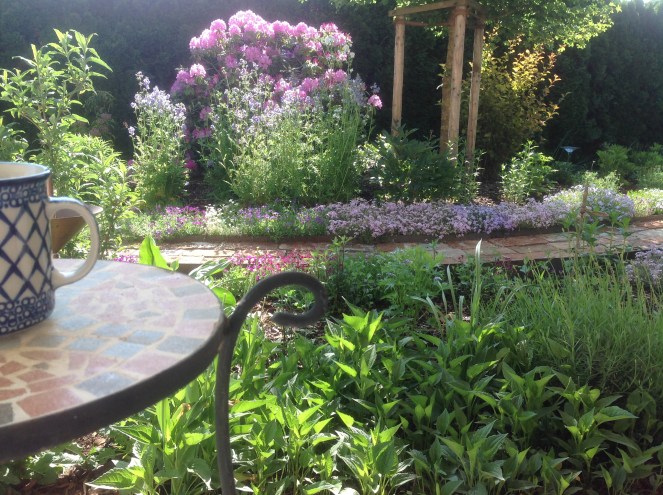
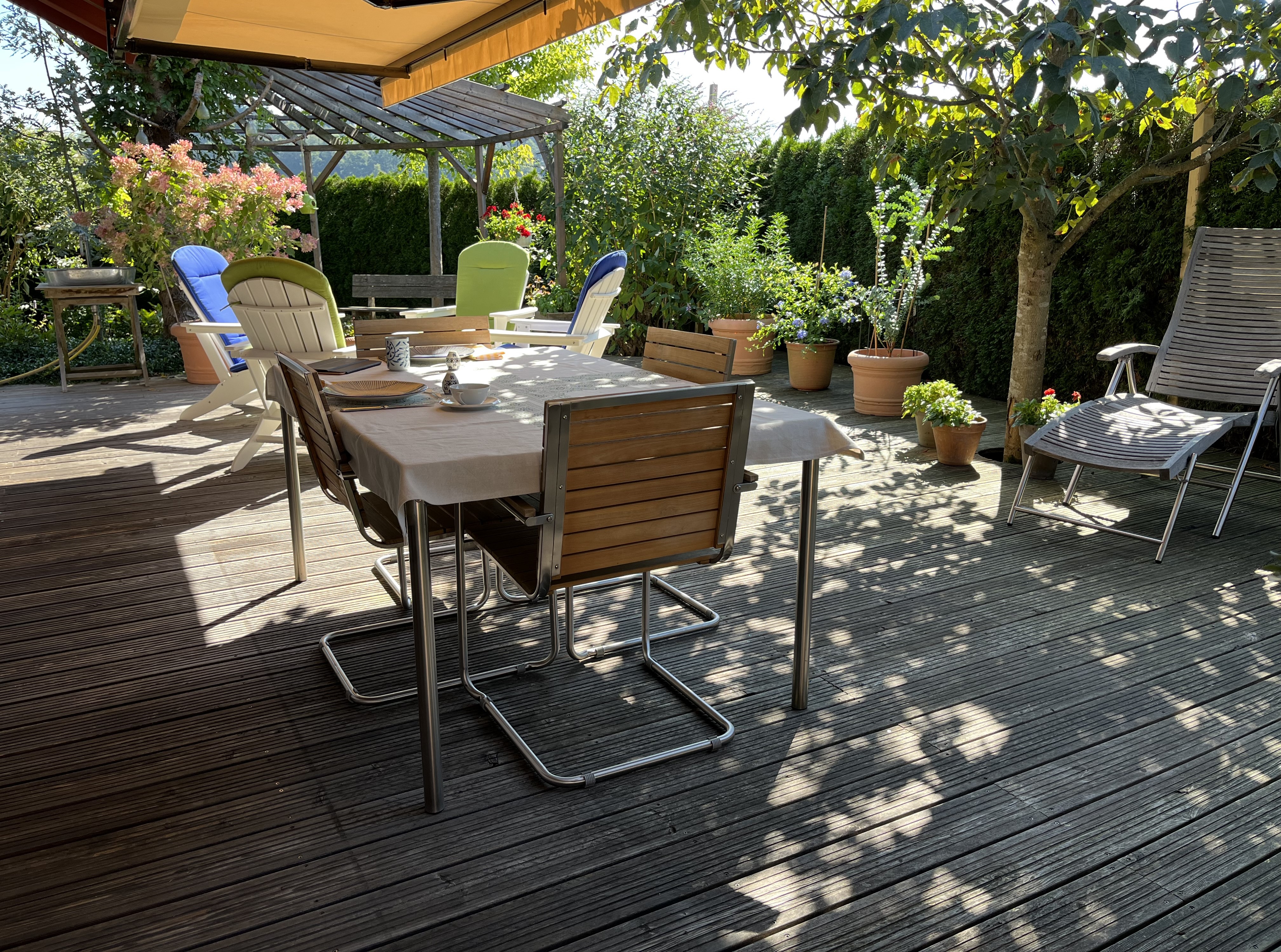
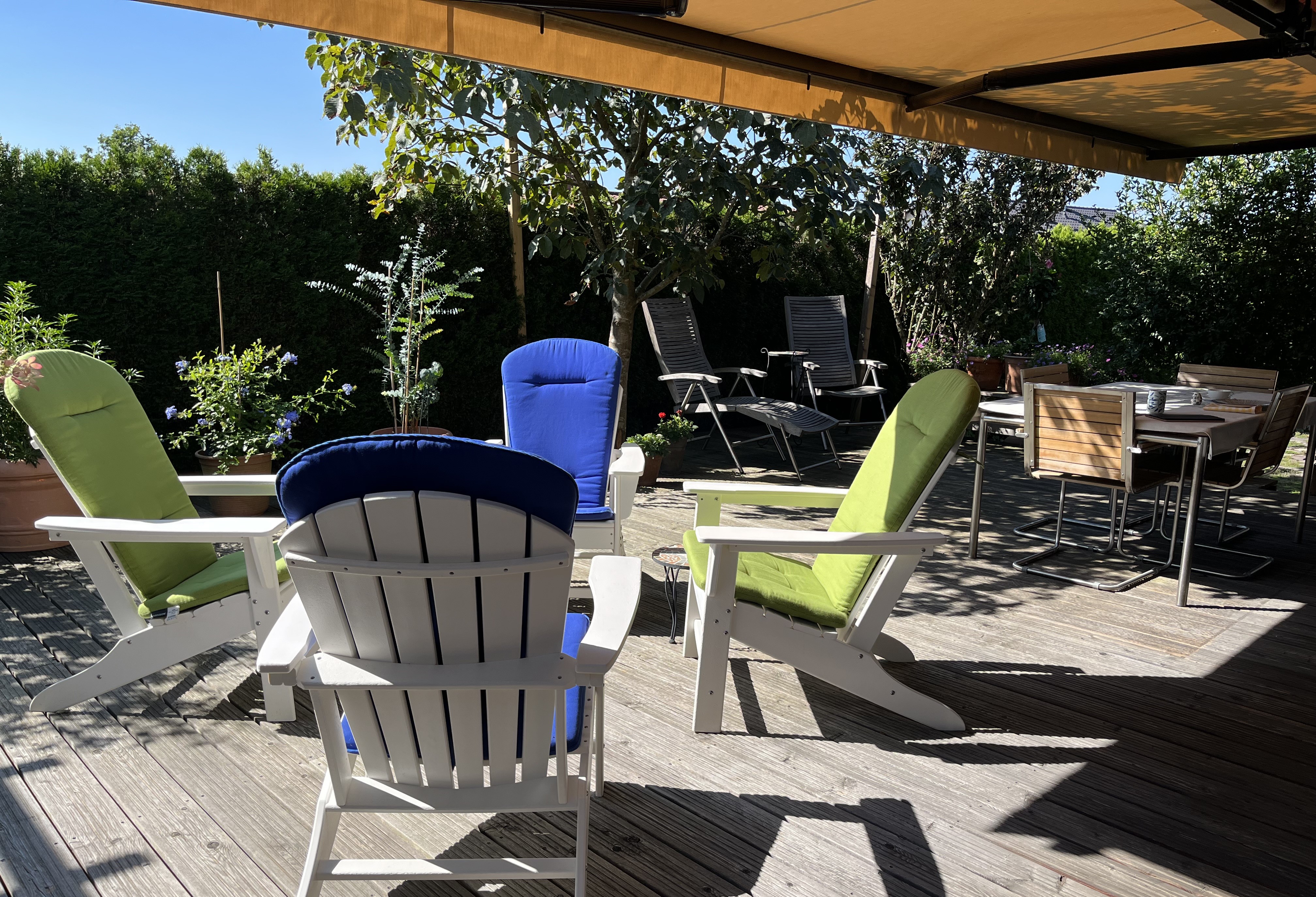
September 12, 2023: In the past few weeks, our terrace has really lived up to its reputation as an outdoor room. Thanks to cooler temperatures, accompanied by wonderful breezes, we’ve been spending most of our time on the terrace.
Every year I arrange things a little differently – always looking for that optimal configuration of furniture, sun, and shade. The red chestnut tree is slowly making this job easier and easier as it casts more and more shade the larger it becomes. Also, the passauer pomeranze, as it grows and fills out, casts very much appreciated shade on the west side of the terrace.
As high summer comes to a close, late summer/early fall begins. I can never decide which I prefer more: Spring or Autumn. There’s the eruption of flowering plants in Spring , which really charges one’s battery; and, you have this wonderful feeling of finally being able to spend time outside, the warmth of the sun on your skin. But, Autumn brings its own charm: the days are warmer than in Spring, without being too hot; the light seems gentler, less harsh than in Summer; there is less and less active work to do in the garden, leaving more time to just enjoy the garden.
The days are noticeably shortening now, which is a double-edged sword. At our lattitude (just south of the 50th parallel), the shortening of the day seems to be more pronounced than I remember it being in CT or CA. The later the sun rises and the earlier it sets is kind of bittersweet – the ending of anything can be kind of melancholy. But, then again, visions of a fire in the Kachelofen, apfelstrüdel in the oven, the acer rubrum turning brilliantly red just followed by the acer campestre with its brilliant yellow leaves … that feeling of Gemütlichkeit swells up inside me and I can’t wait to sip my hot tea under a blanket looking out the window at a dormant garden.
I guess I just love the changing of the seasons and the promise each season’s start brings with it. The gentle slide from summer into autumn is no different. Summer’s not finished with us just yet (certainly not since global climate change) but it’s nice to know that a change is coming!

September 6, 2023: So, I had to post today about my big garden triumph (and also just to rest my weary bones after a tough gardening job!)
As much as it hurt, I had to remove a tree today. The plum tree had to go. The tree has been in the garden (in various spots) almost from the very beginning but besides a few plums here and there, the harvest was always disappointing.
Because I do not like to use pesticides, I don’t spray my fruit trees (well, now, tree – the apple tree is still there). As a result, especially with the plums, come harvest time I was left with half-eaten, wormy plums. Now, I guess there are some who would use them – “What’s wrong with a little extra protein?” they might say. And, if I were interested in making plum juice, I might agree. But, I planted the tree so we could snack on the fruit, for preserves, and to make plum cake (one of Georg’s favorites). Wormy plums don’t much appeal.
And, to boot, the ants used the thing every year for their own farming (lice farming – ugh and yuck). Thank goodness there is Neem Oil, a biologically acceptable form of combatting insects. But, that was a lot of hassle especially when there were no plums to harvest at the end of the year.
So, after several years of mulling it over, I decided it had to go … this year. I’ll be planting a Eucalyptus tree in its place (stay tuned for that!).
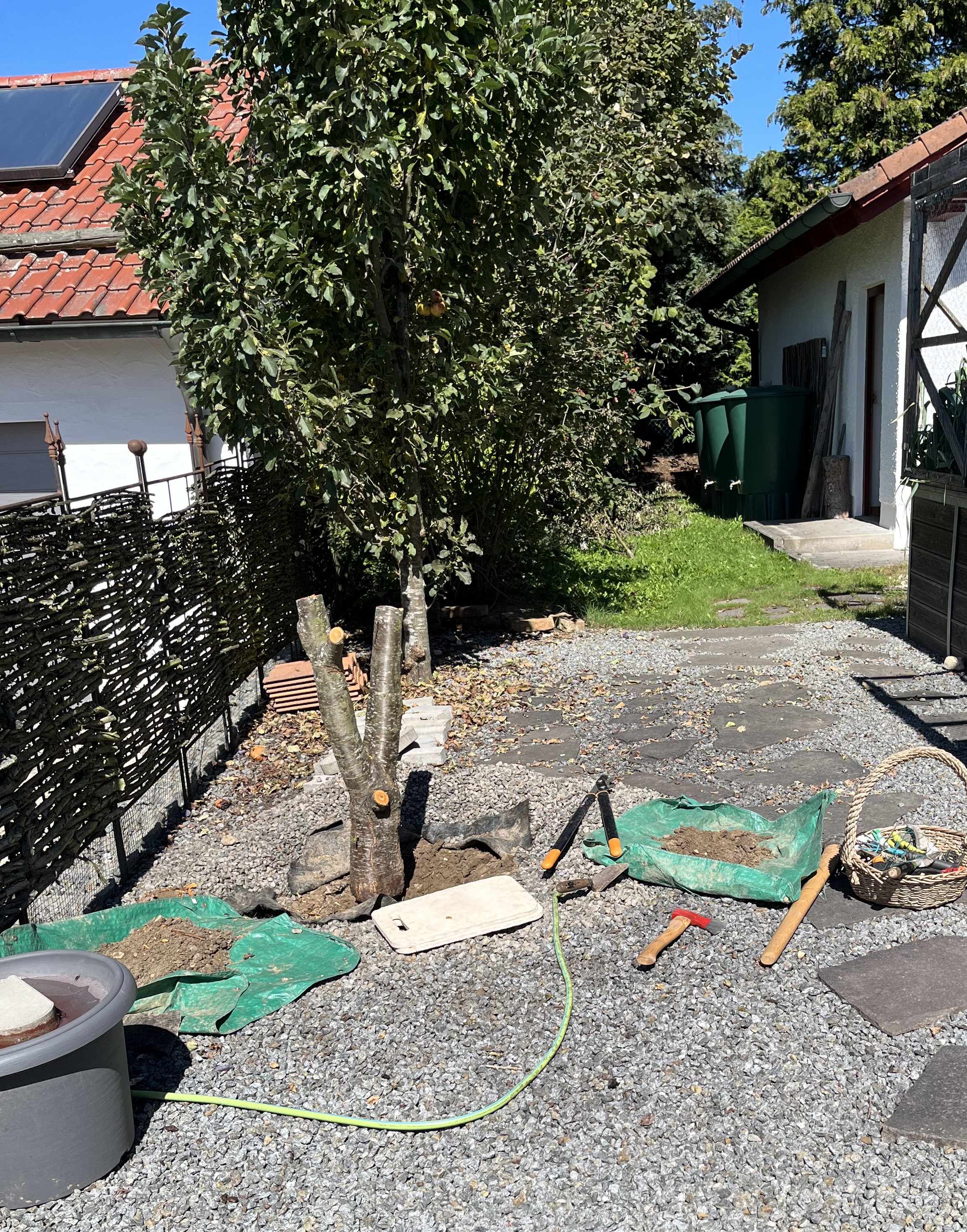

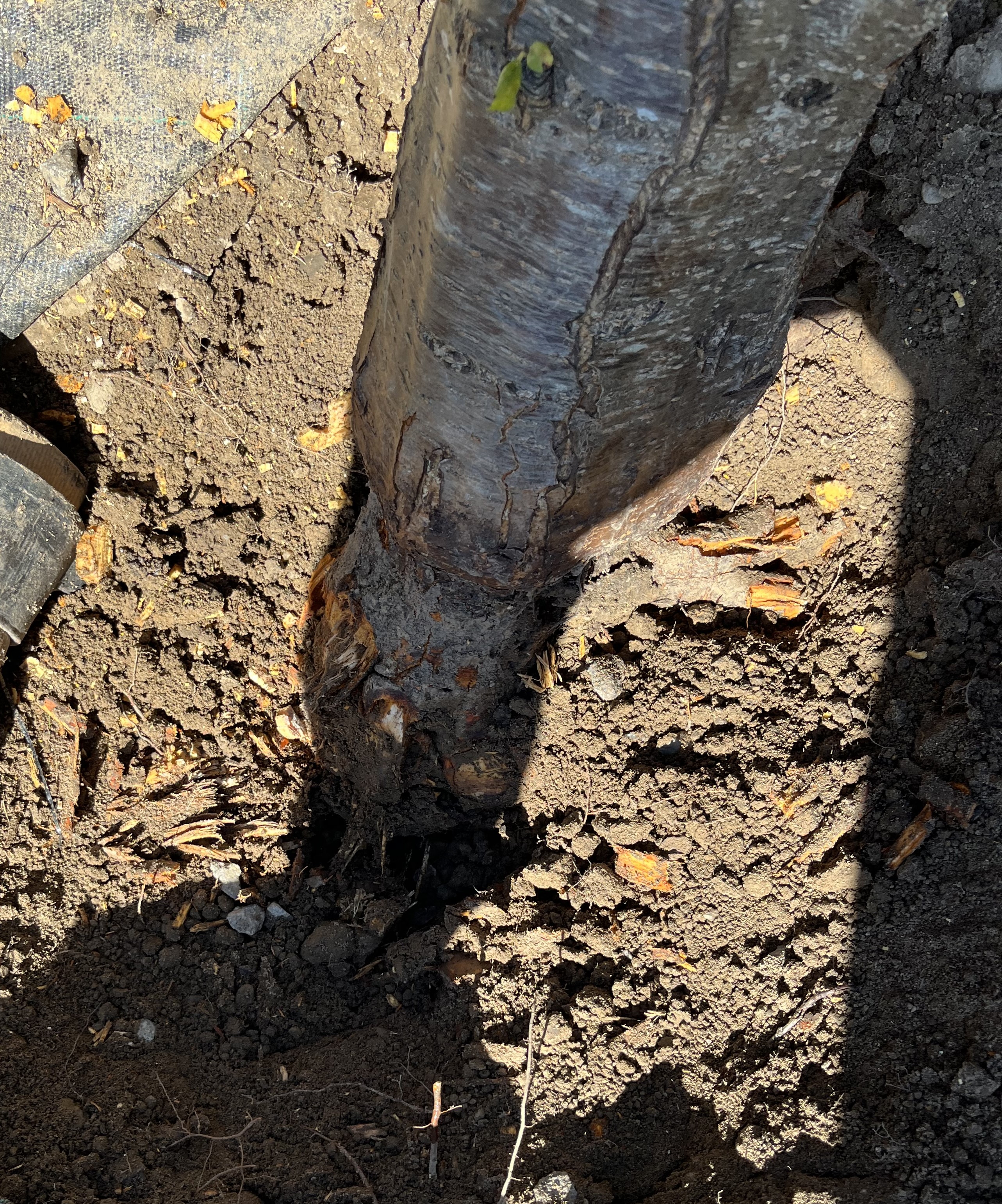
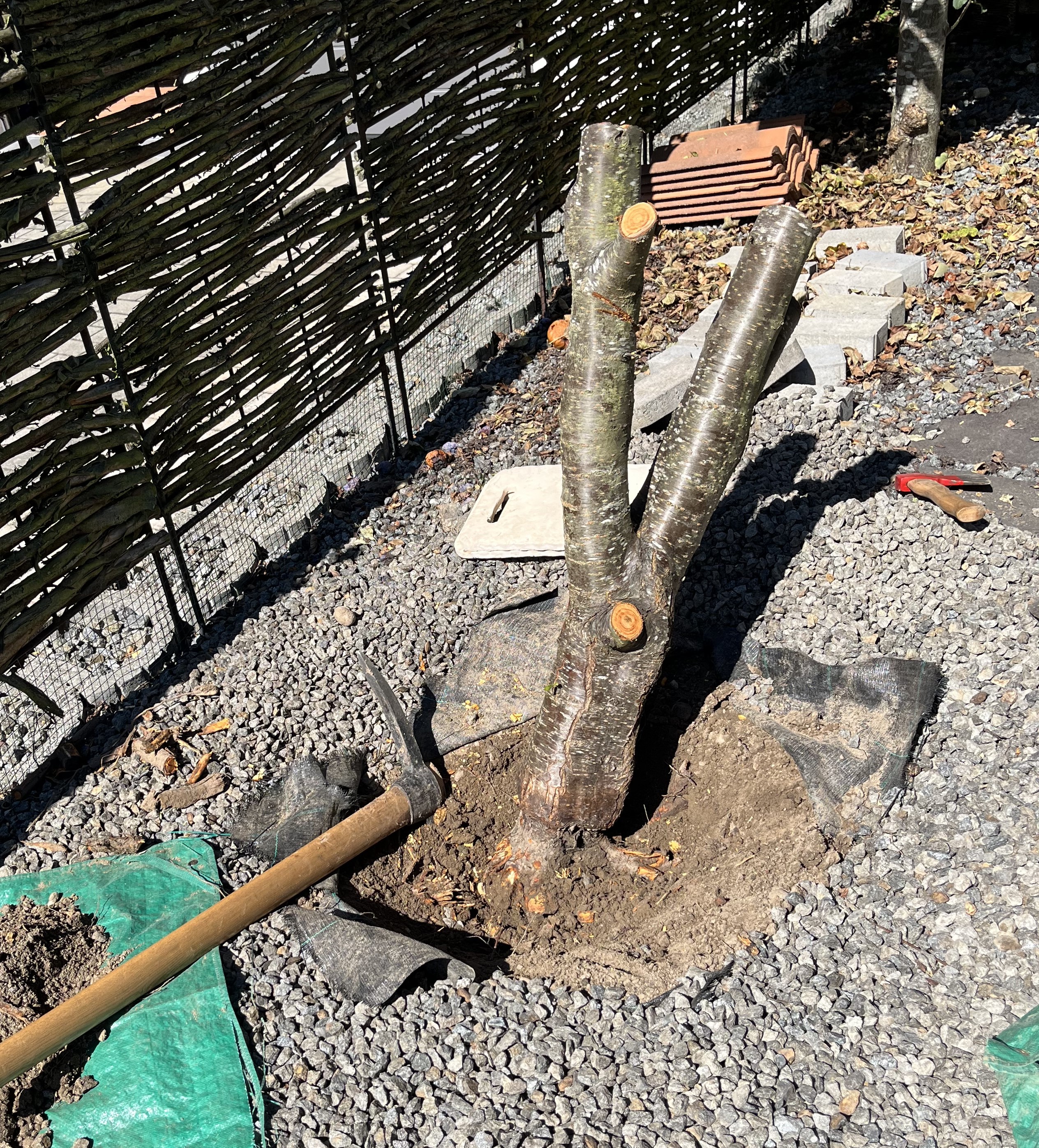
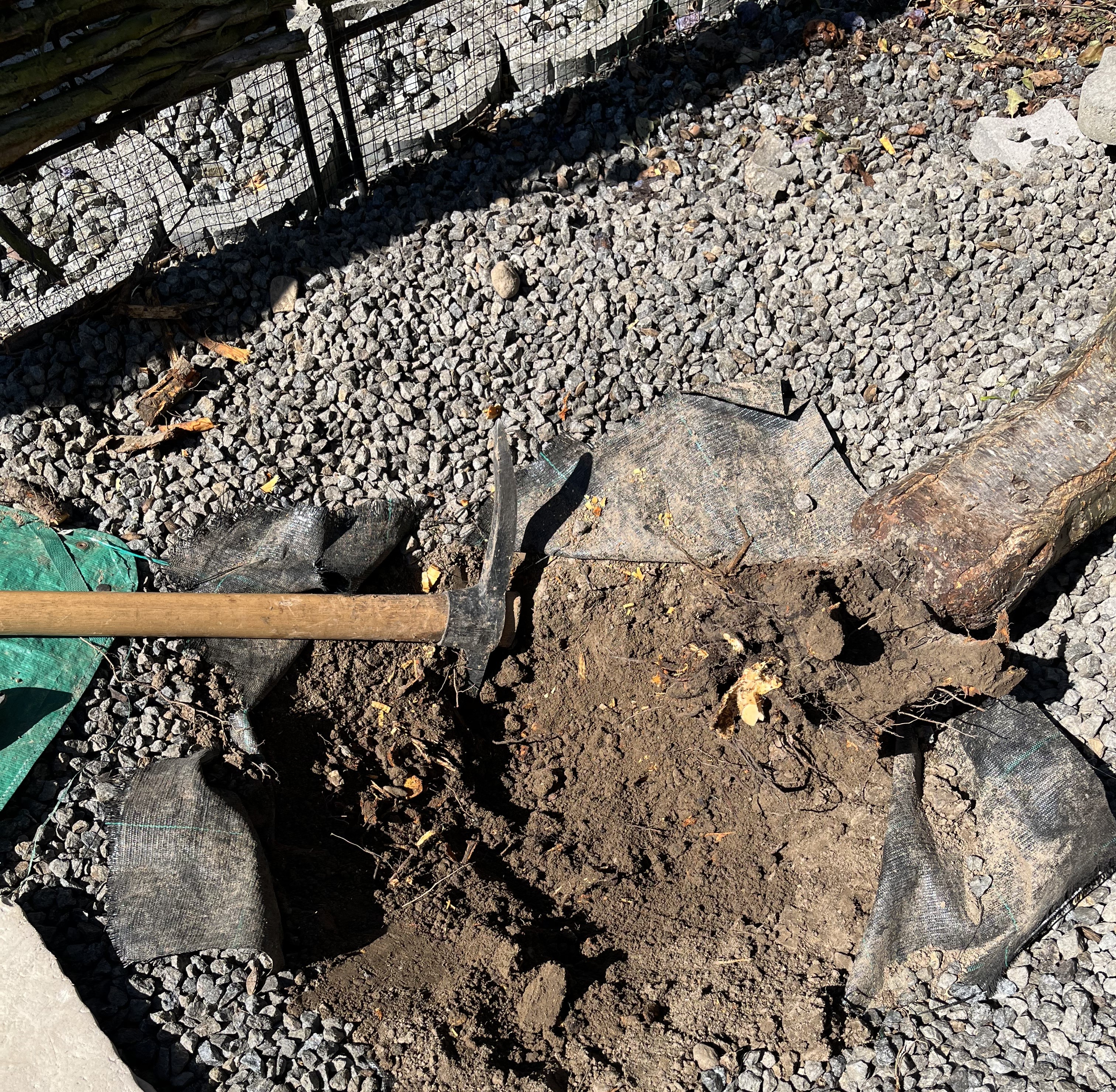
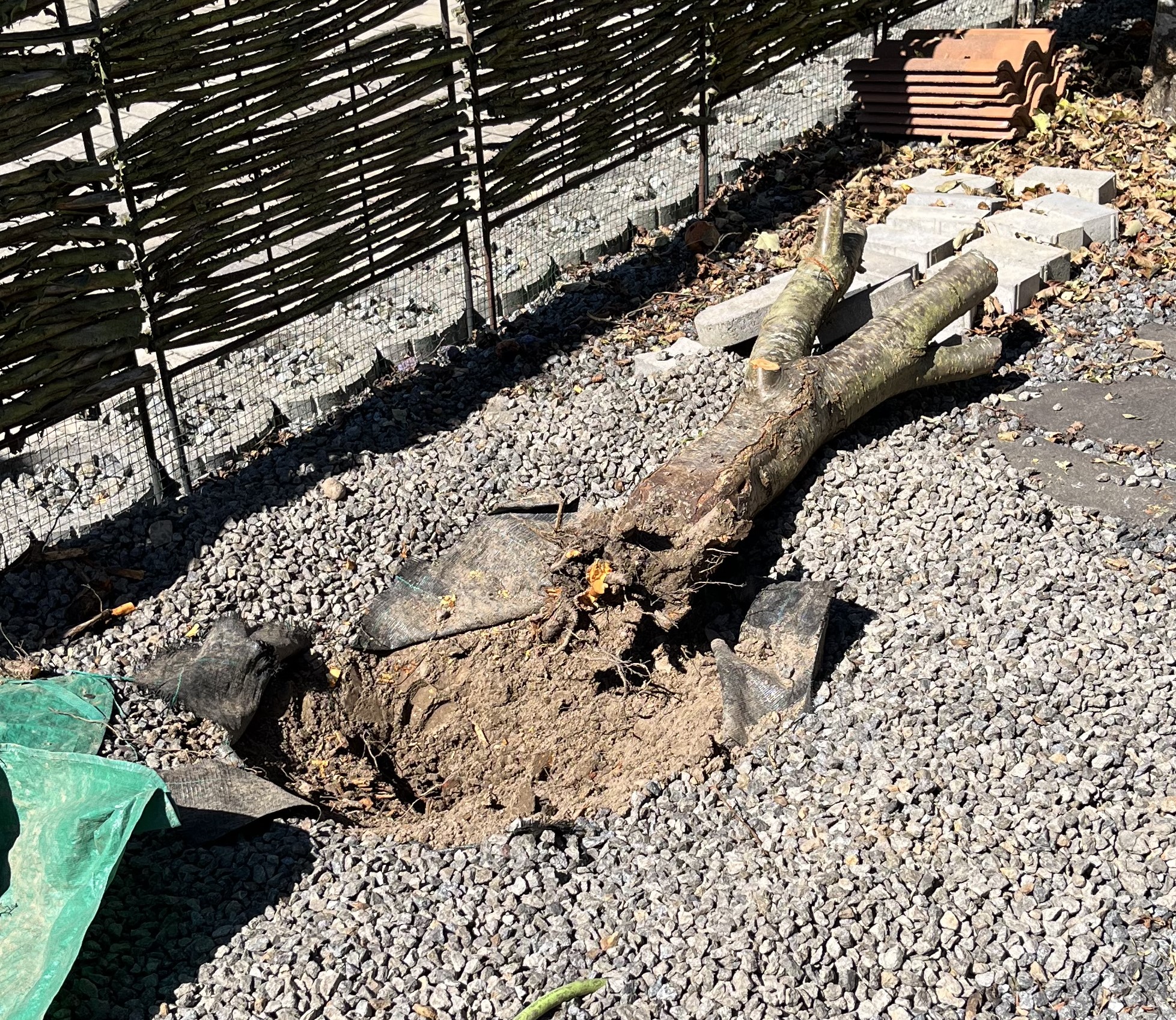
Who needs power tools or the help of a man??? It took about 1 1/2 of chopping, sawing, pushing/pulling. But, in the battle Plum Tree Roots vs. Claudia, Claudia won!
Thanks so much for stopping by! Feel free to drop me a line if you have any questions or comments (see Contact page). I’d love to hear from you.
Update August 21, 2023: Happy Monday! A new start to a new week. Today’s post deals both with the garden and a embroidery project.
It’s going to be hot here, as it has been the last week or so. As a result, I got my gardening chores done really early.
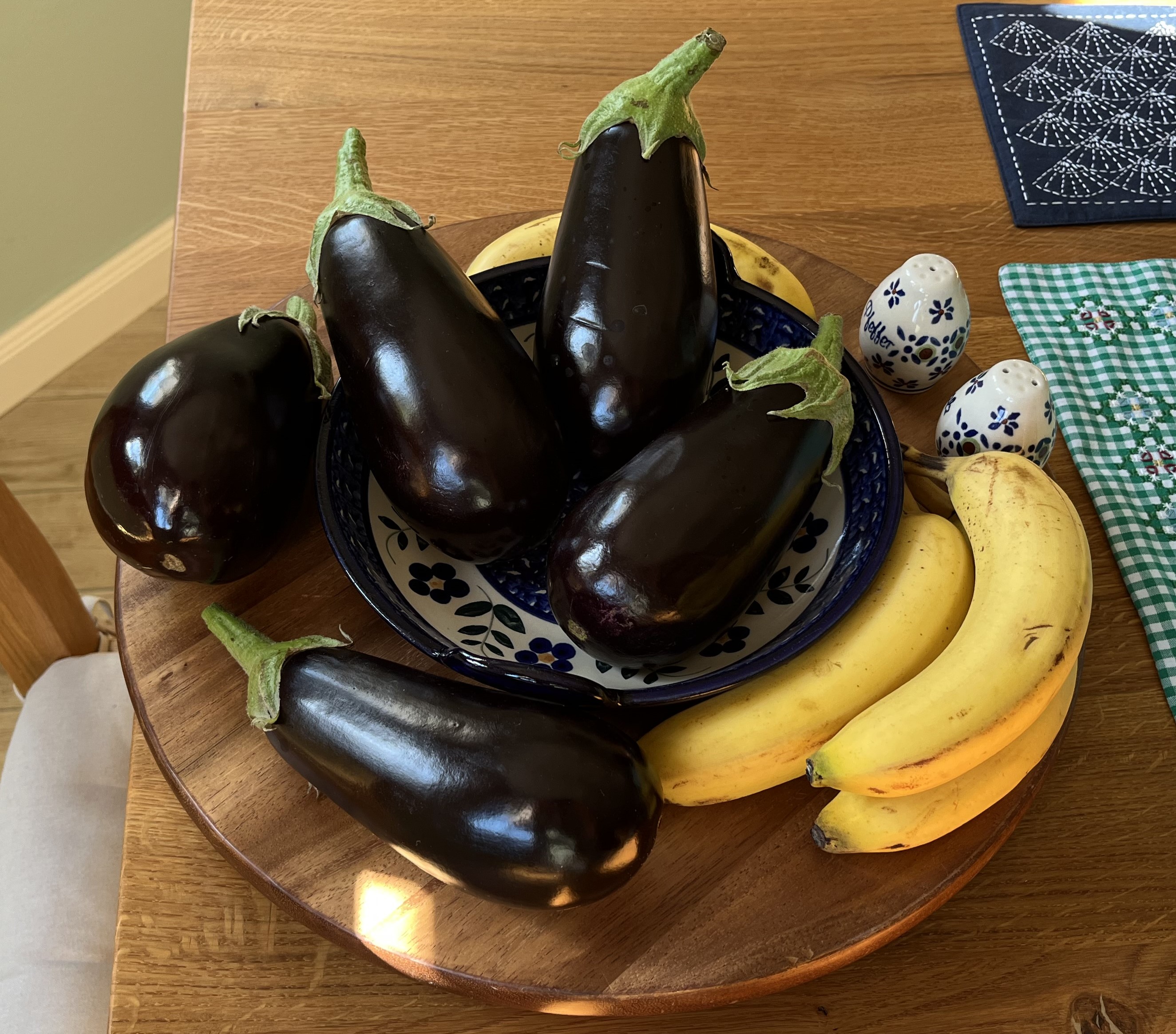
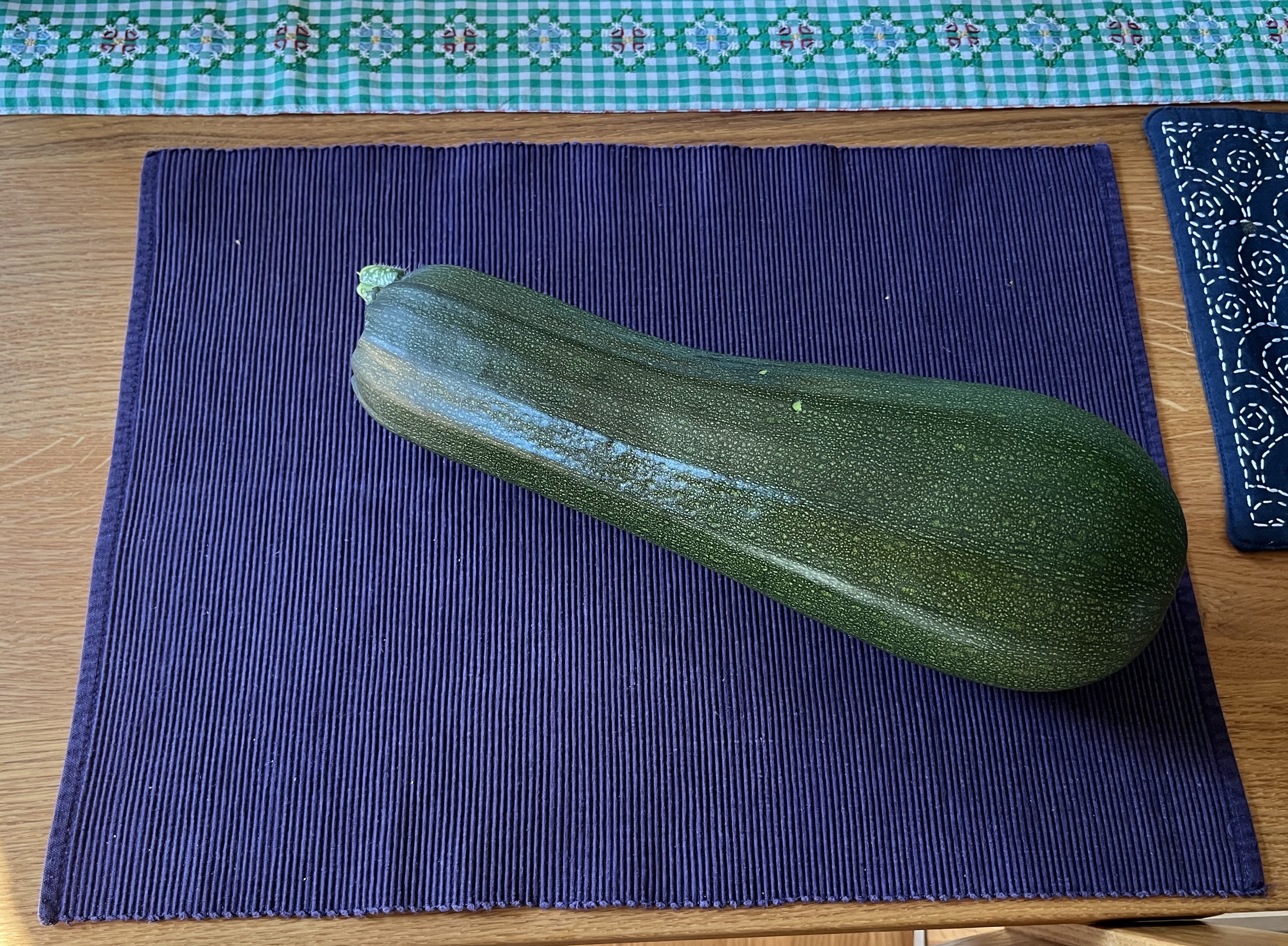
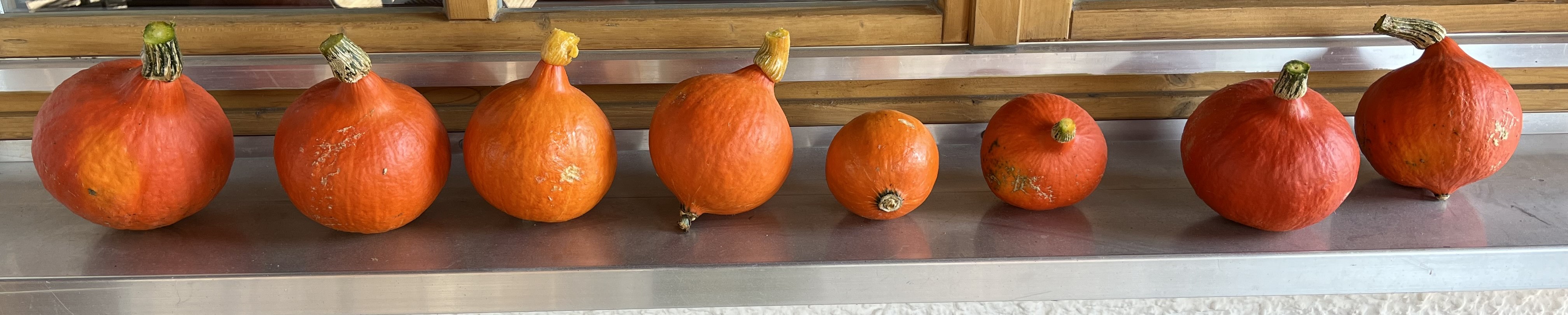
Given that the gardening phase of the year is coming to an end, today’s main chore was to prune things back and harvest. So first up, here are some photos of what was harvested today:
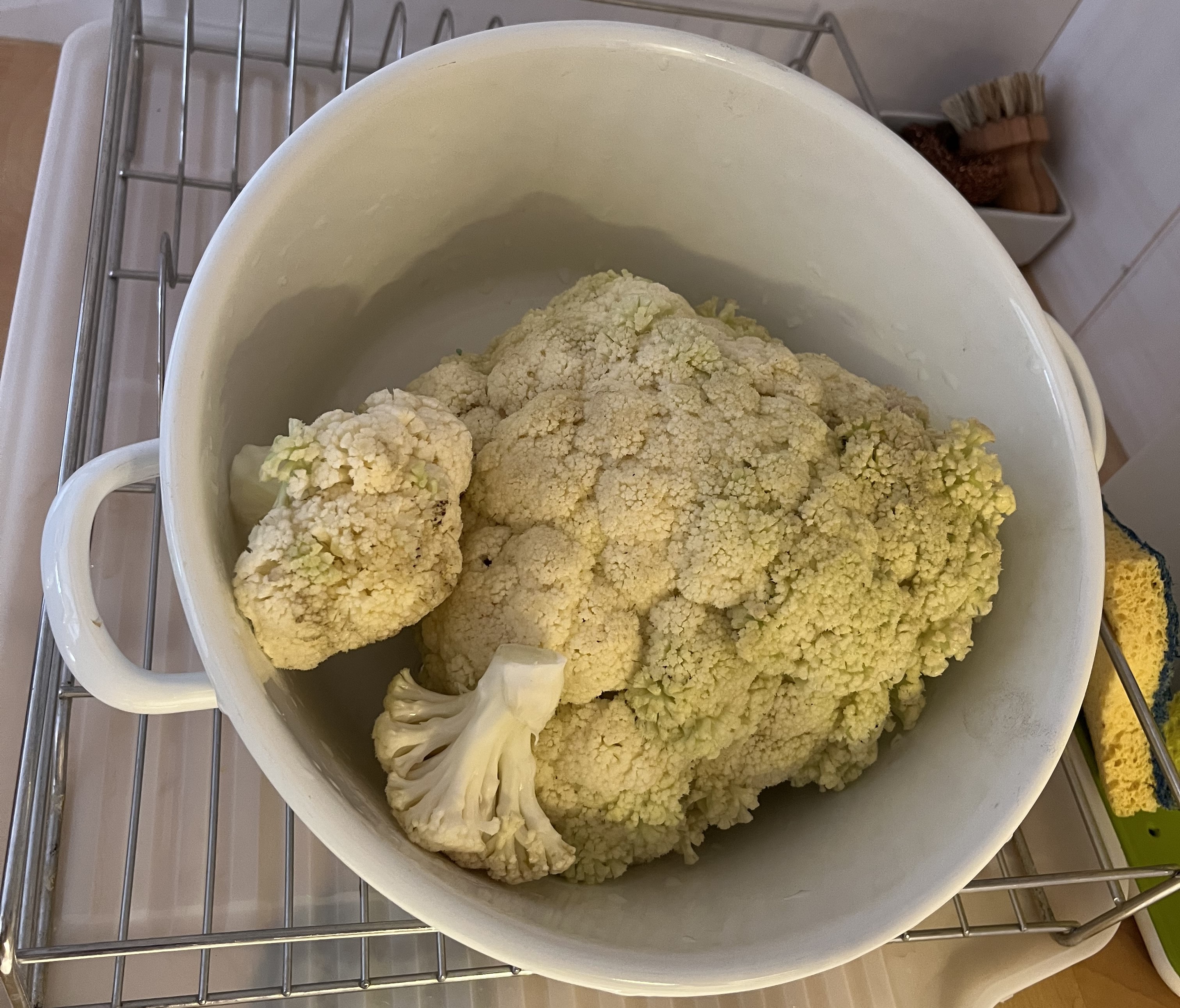
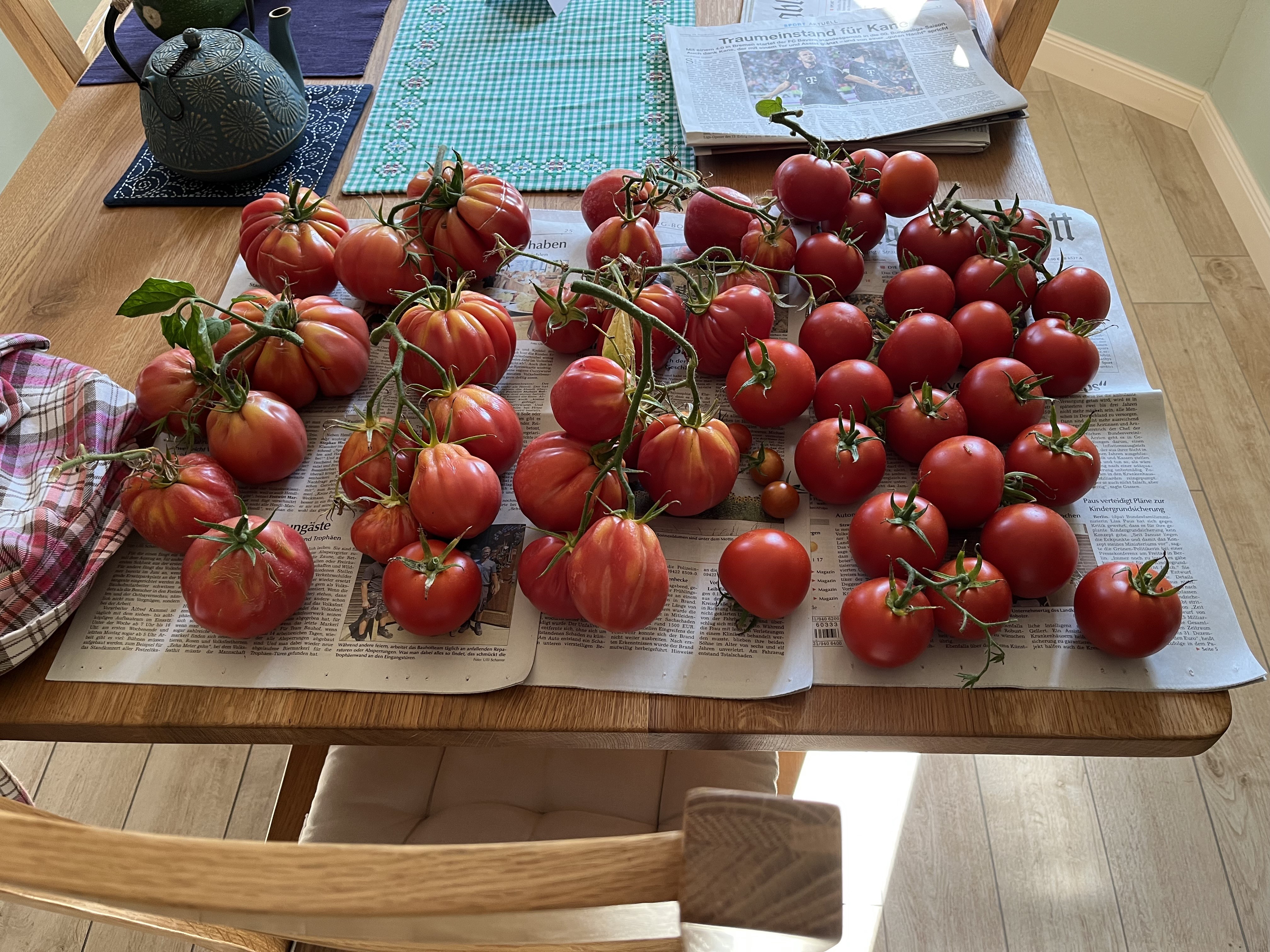
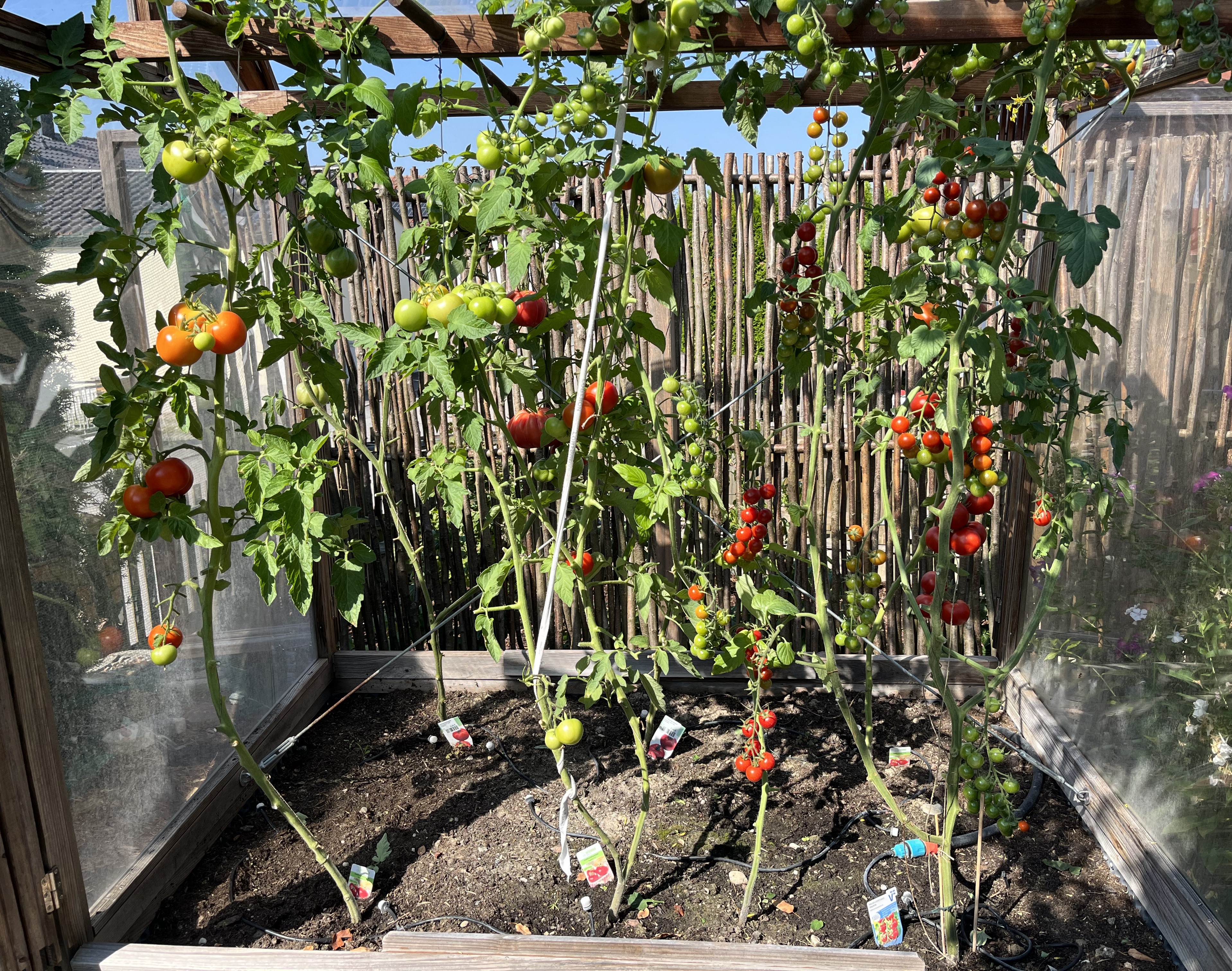
The tomato harvest has reached about its mid point, still a lot of tomatoes left on the plants but already enough to start making some sauce.
The three hokkaido pumpkin plants really suffered from the heat; the plants really looked bad. Even though I could have left the pumpkins on the plants a little longer, I don’t think it would have made much difference and decided just to harvest them and take what I could get.
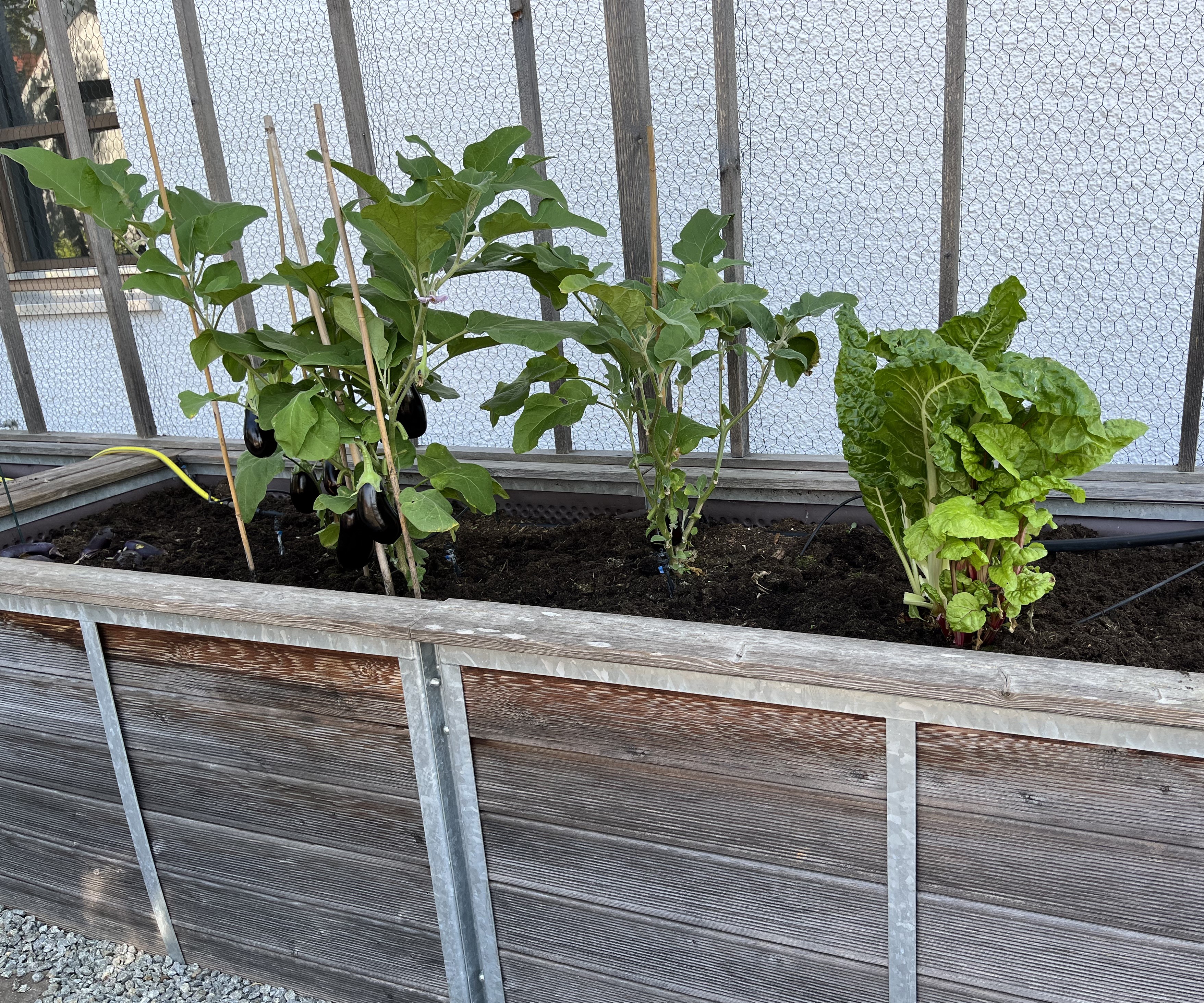
The eggplant and zucchini plants are still flowering and producing fruit – that will go on for a while yet.
So, that’s the “harvest” for today. I also cleaned up the raised beds, removing plants as necessary. Here’s how the beds look now…
So, that’s the “harvest” for today. I also cleaned up the raised beds, removing plants as necessary. Here’s how the beds look now…


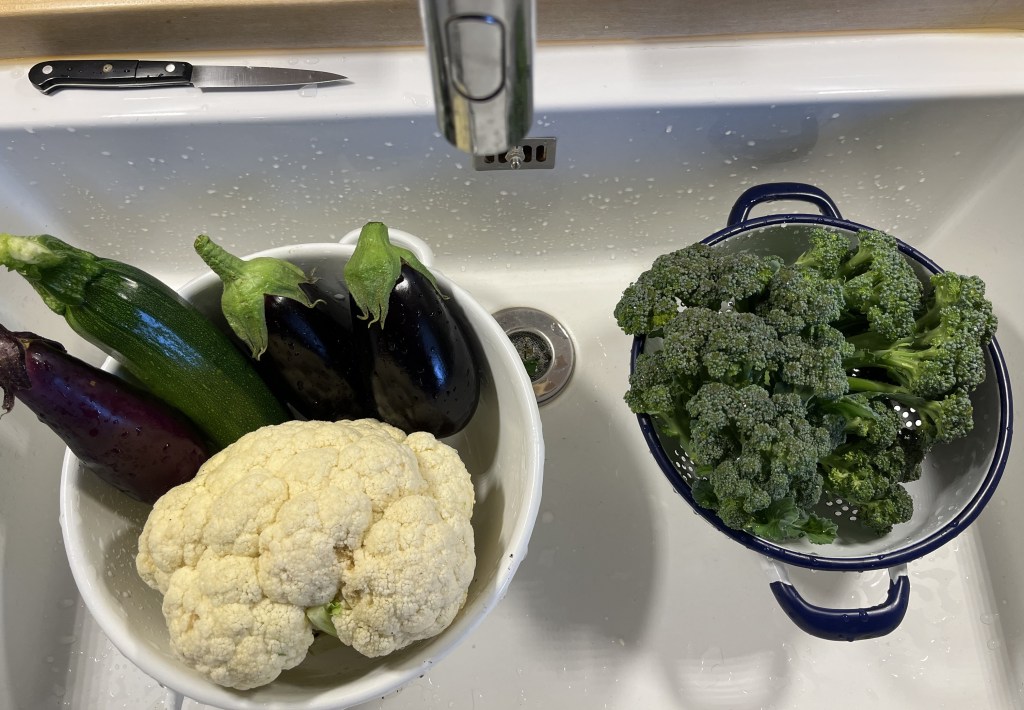
Update 2.08.23: A quick addition to yesterday’s post below. Despite the rain, I went out to the veggie garden to see if the broccoli was ready to harvest – I planned on making a soup with it for tonight, so it was kind of important that there be broccoli ready to cut. To my surprise there was not only broccoli but the first cauliflower as well … picture perfect! That plus some (more) egg plants and another zucchini and we are set for the next couple of days!
Update 1.08.23: Welcome to August! A month, which tends to be the hottest and most humid of the year where I come from (New England), is here in Lower Bavaria a month where you start seeing signs of Fall.
Our garden is on the the 49th parallel. The town where I spent most of my childhood is on the 41st parallel. Eight degrees can make a world of difference, combined with the influence of the Jet and Gulf streams. Already the days are noticeably shorter by the time August comes around.
This year, it looks like August is going to be a cool end to the summer. In the coming days, we’ll be having unusually cold temperatures, which is just fine by me … and the plants in the garden.
So far, the harvesting continues pretty well. We have a continuous flow of egg plants and zucchini. The last two broccoli plants will be harvested soon. And, we’re starting to enjoy the tomato harvest.
Speaking of tomatoes, a tip about ripening. I came home one day to find the two Ochsentomaten (Ox tomato) plants on the ground. The weight of the tomatoes had pulled the plants down. I had to do some quick repairs to the rope holding the plants as well as cut back some of the branches which had broken. Unfortunately, those branches had tomatoes on them. What to do with green tomatoes???
Now, there are some in some of the US southern states (among other places), people fry up the green tomatoes. I never really understood the point of that. I plant tomatoes so I can either use them for sauce or enjoy that intense flavor that only comes from home grown tomatoes.
Tomatoes can ripen off the vine. It will take longer and some say that the flavor is not as intense as ripening on the vine, which makes sense. But, they do ripen. And, a neat trick to accelerating this process is to place apples around them. Apples (and bananas, too) release ethylene gas, which speeds up the ripening process. Take a look …
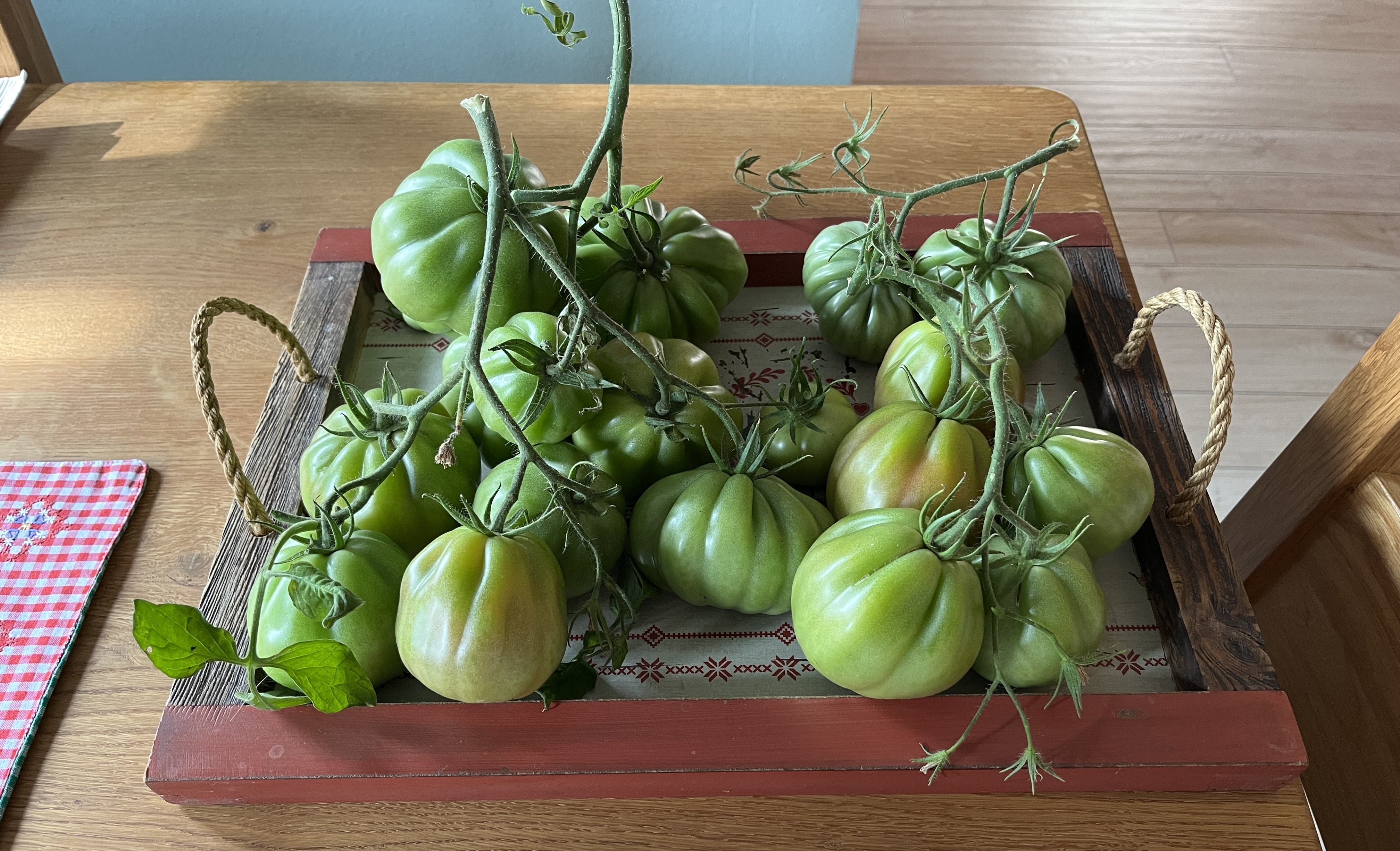
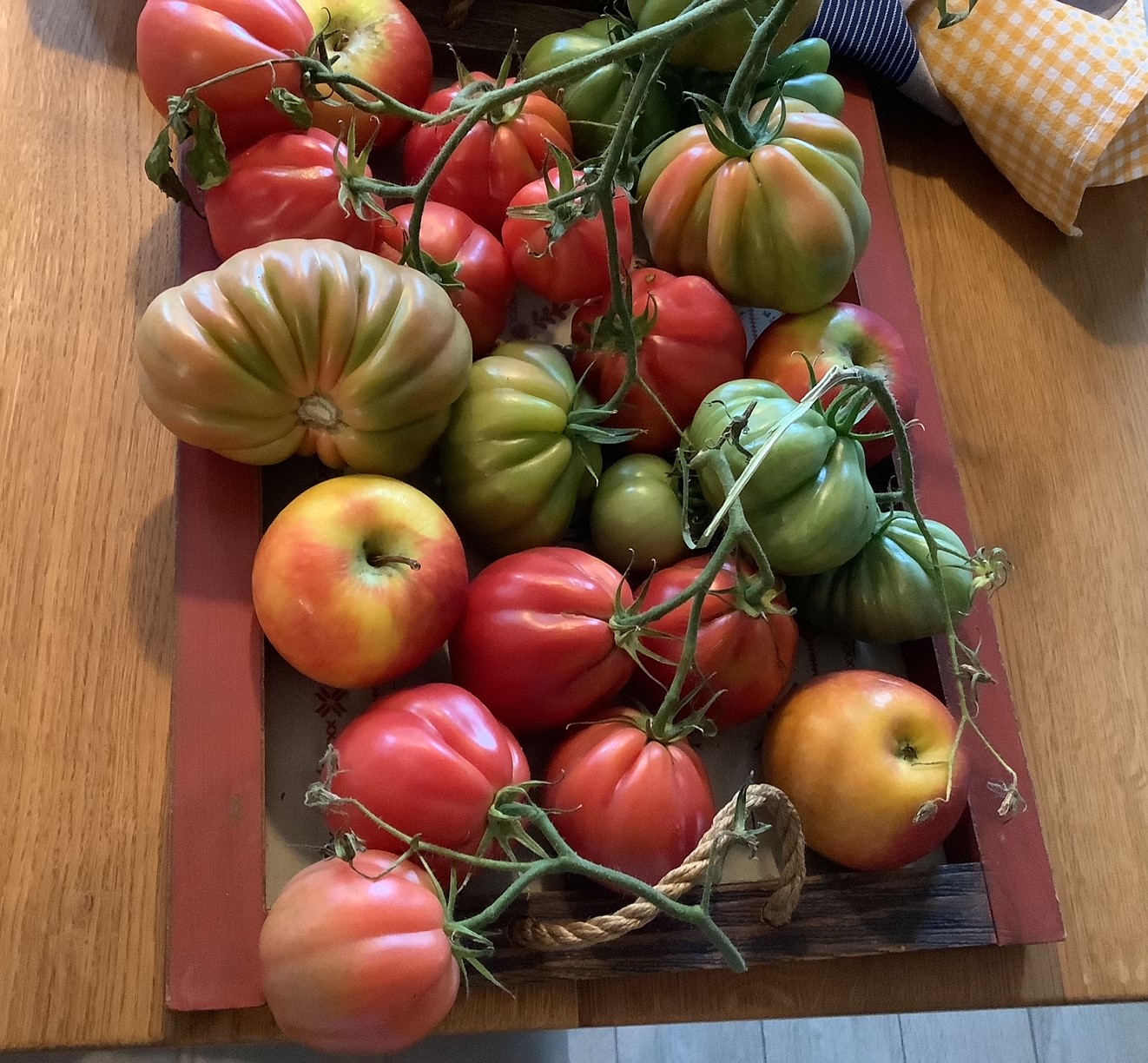
The picture on the left shows the tomatoes as they were when I removed them from the plants. I placed 4 apples in and around them, covered them with a couple of kitchen towels and voila! You can put the tomatoes with an apple or a banana in a container but it shouldn’t be airtight. You want enough of a seal to trap most of the gas but still allow air to ciruclate. This is why I just covered them with two towels – enough to trap most of the gas without limiting the air circulation. A little more than a week later and they are on their way to ripening! I am guessing it will take another week for most of the tomatoes to ripen fully.
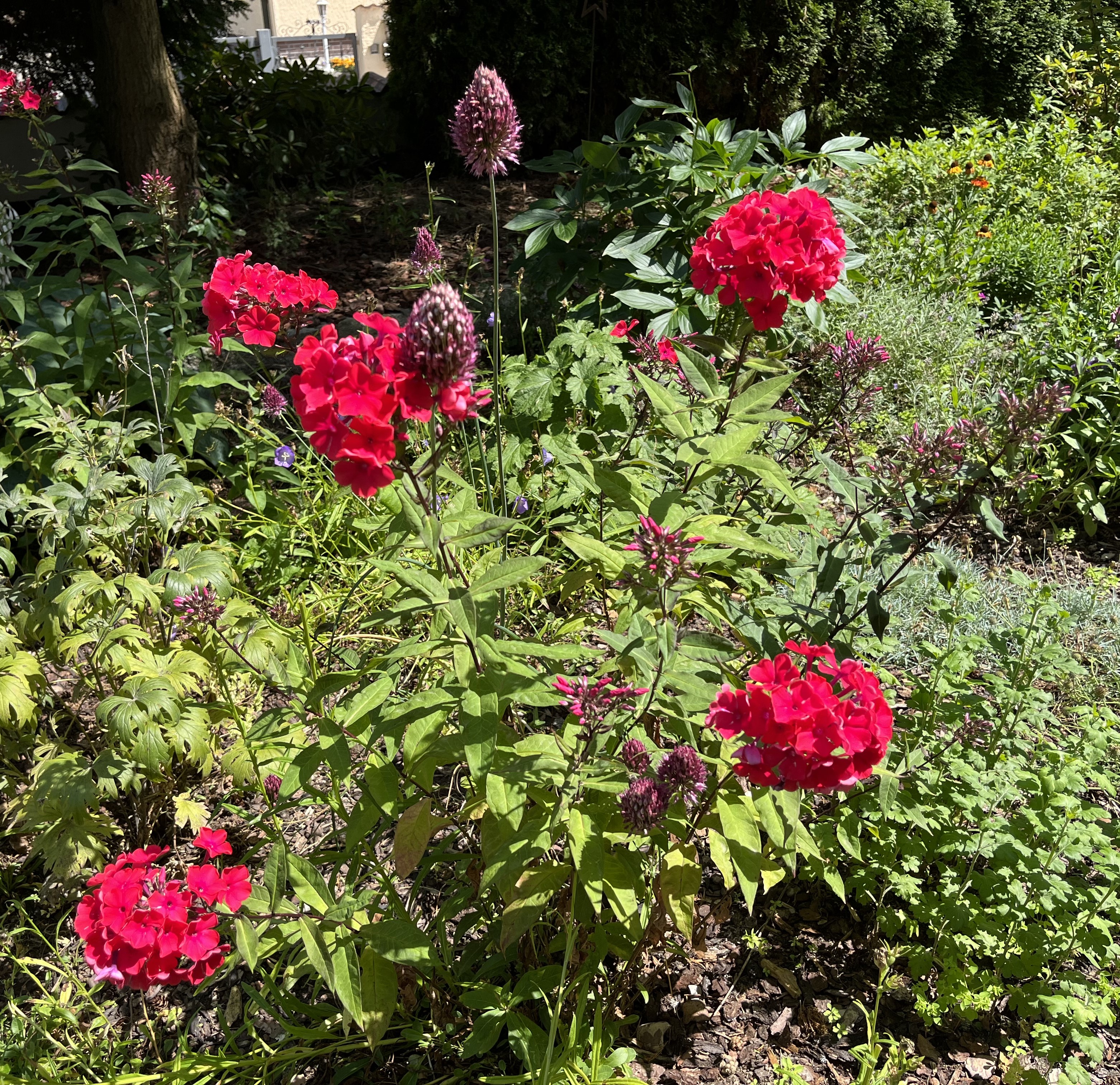
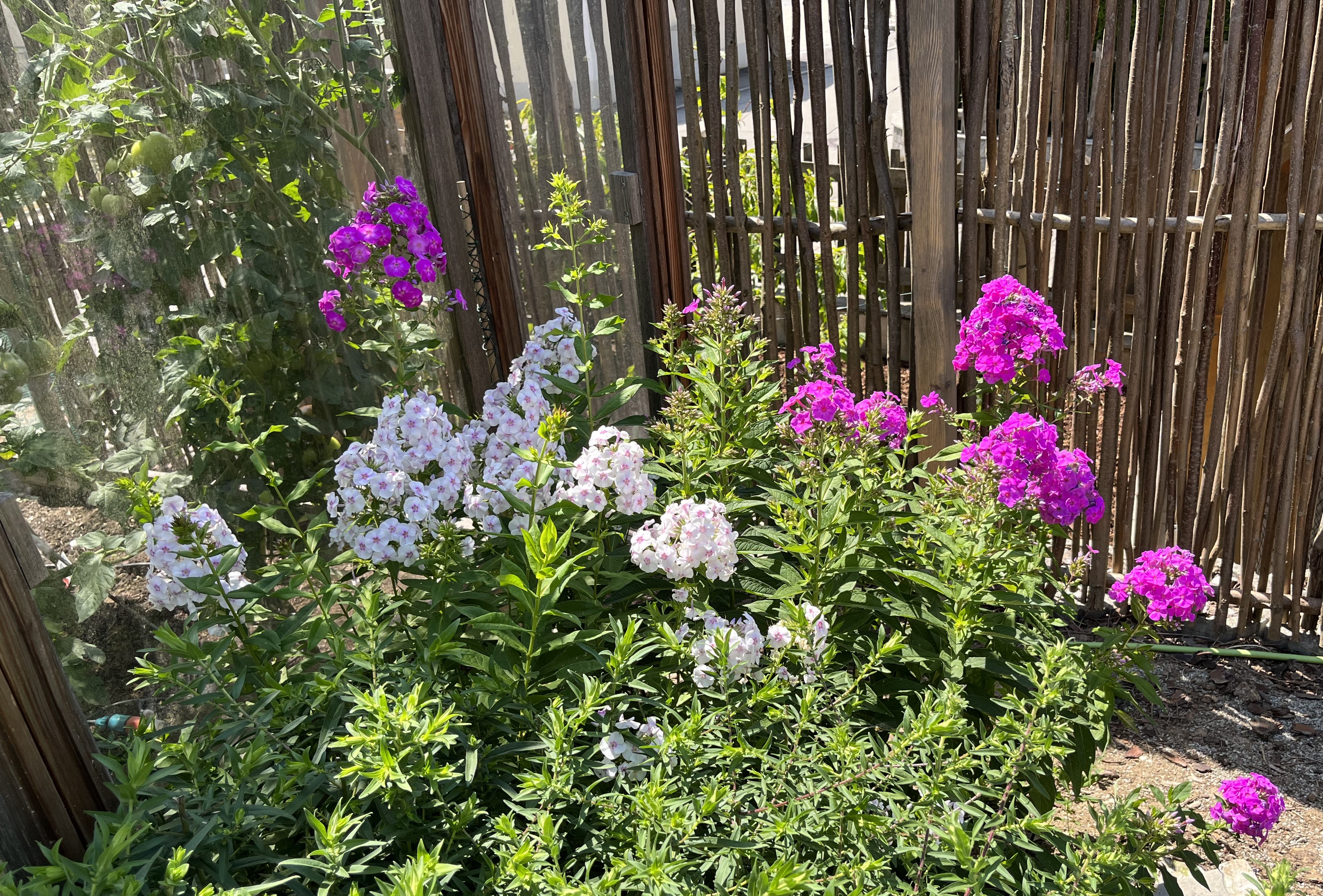
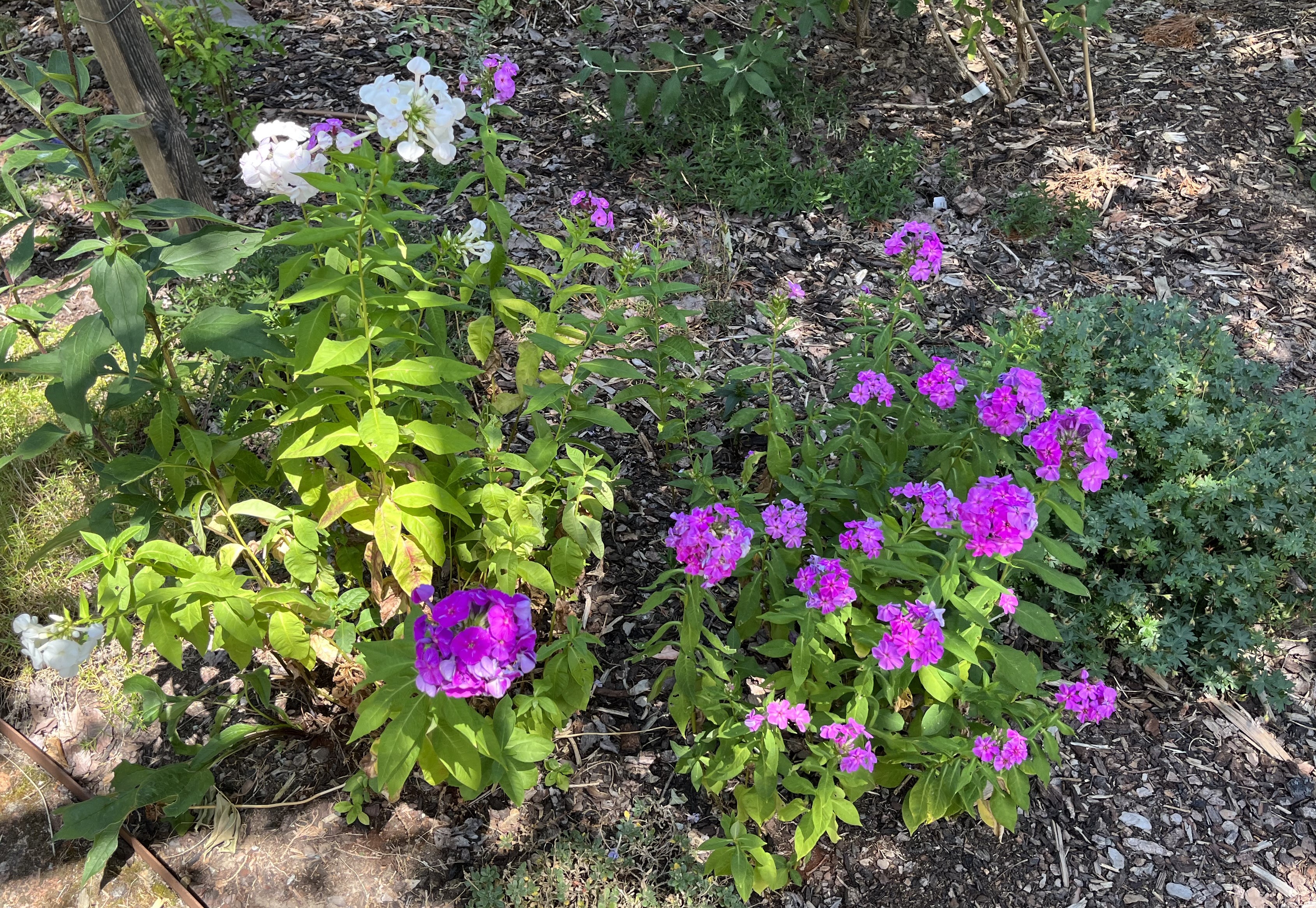
Along with the veggie garden, the rest of the garden is developing nicely. At this time of year, the phlox starts to bloom. I have two different varieties: a special hybrid which blooms in a radiant red and the common variety that blooms in white, purple, and pink. I just love them!
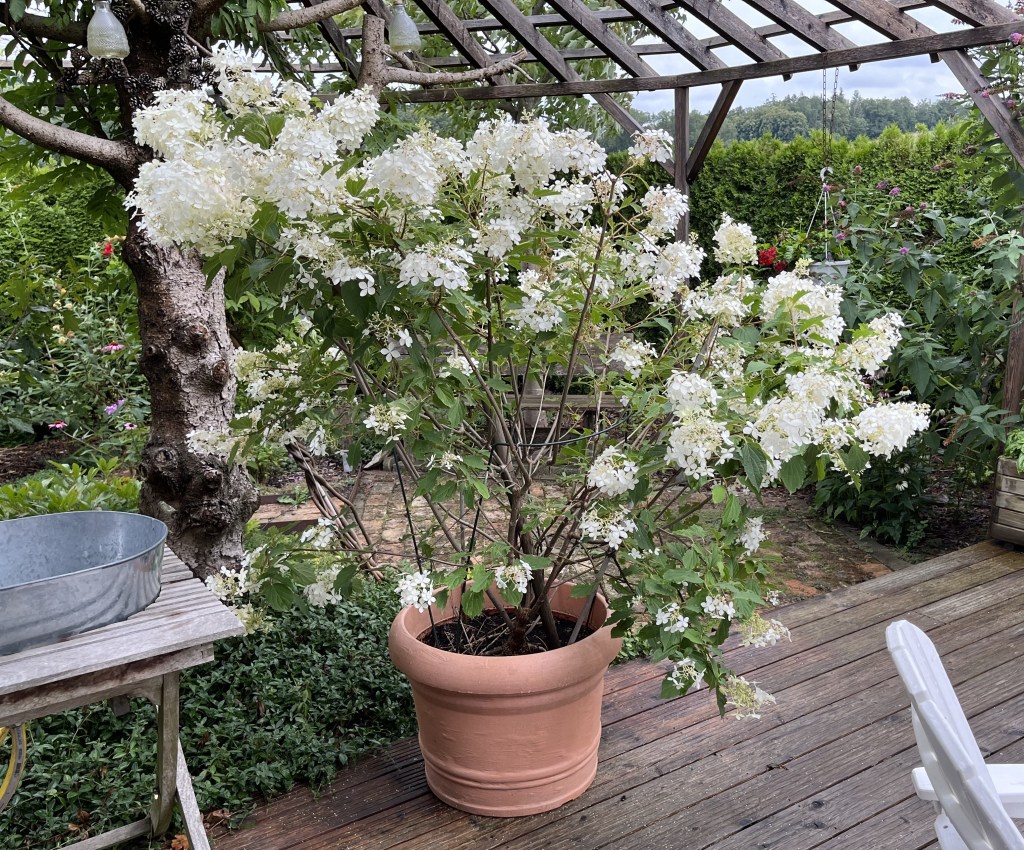
And, along with the hydrangeas in the garden, I also have a white hydrangea in a big pot on the terrace. I keep it outside during the winter, wrapped in protective/warming jute, in the warmest spot of the garden. It survived last year with no problem but somehow it has weevils (Rüsselkäfer). These darned things have decimated a lot of its leaves but the plant is healthy enough to deal with them. Still, this little infestation is not good long term.
A friend recommended nematodes. This is a biological solution, i.e. as opposed to using some sort of pesticide. I have not experience with them but followed the directions and watered them into the pot this afternoon. We’ll see how that works. All that being said, the plant is still beautiful and adds a wonderful flair to the terrace.
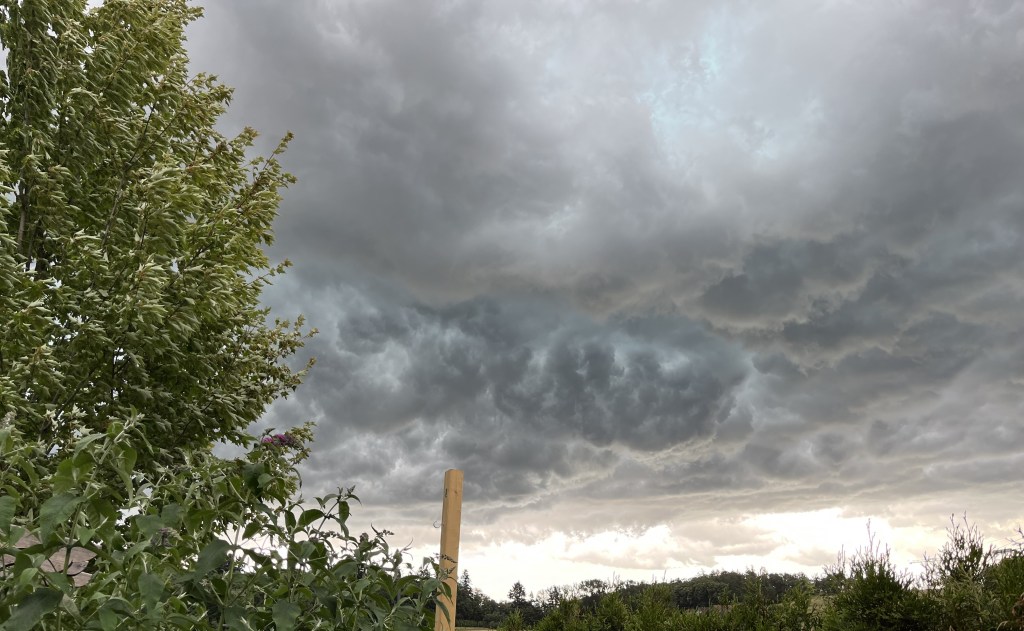
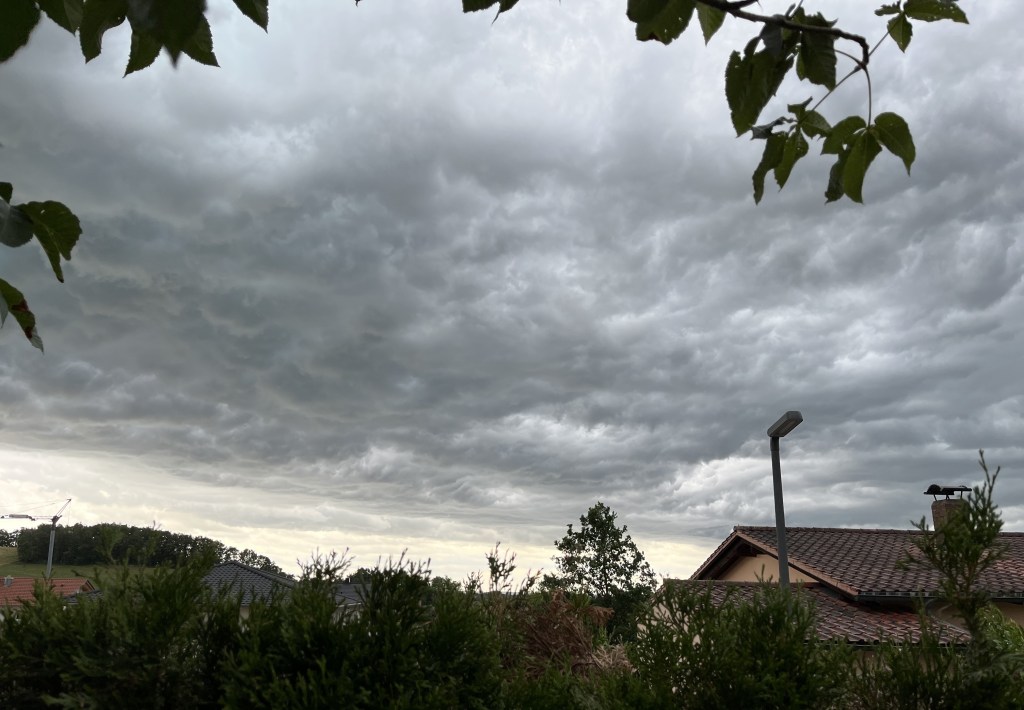
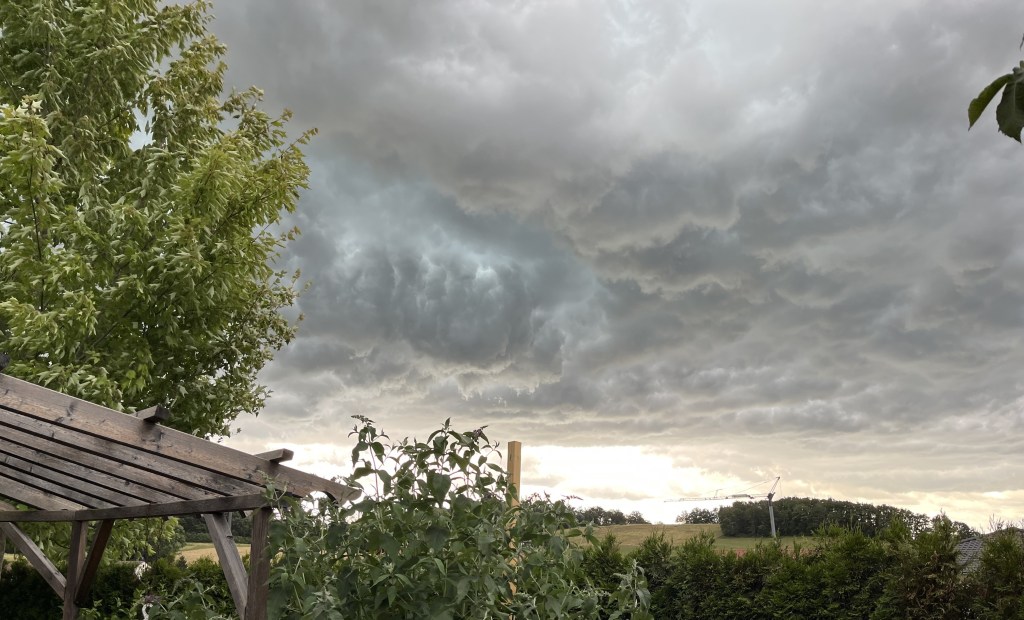
And, finally, we’ve had some somewhat serious storms over the past several weeks. I went out an photographed the sky before one of them a few days ago. The sky reminded me so much of what crashing waves look like from under water!
Update 19.07.23: What a difference two small weeks can make! The garden is handling the hot and dry weather relatively well. Some plants are suffering a little. But, thanks to a rain shower here and there, our rain barrels are constantly being replenished and we have rainwater for those plants that need it.
The harvesting has already started. The lettuce plants are almost done for the season. At some point, it just gets too hot; once their growth starts to shoot up into the air, it’s time to move on. I still have two lettuce plants left and will be using them up shortly.
I harvested some broccoli yesterday. It’s so nice to have truly fresh broccoli in the summer. And, it couldn’t be easier to grow. You just have to make sure to protect the plants from the cabbage flies (Kohlfliegen), which is why I cover the plants with an insect net right from the start. That’s the only solution I’ve found that is pretty much full proof.

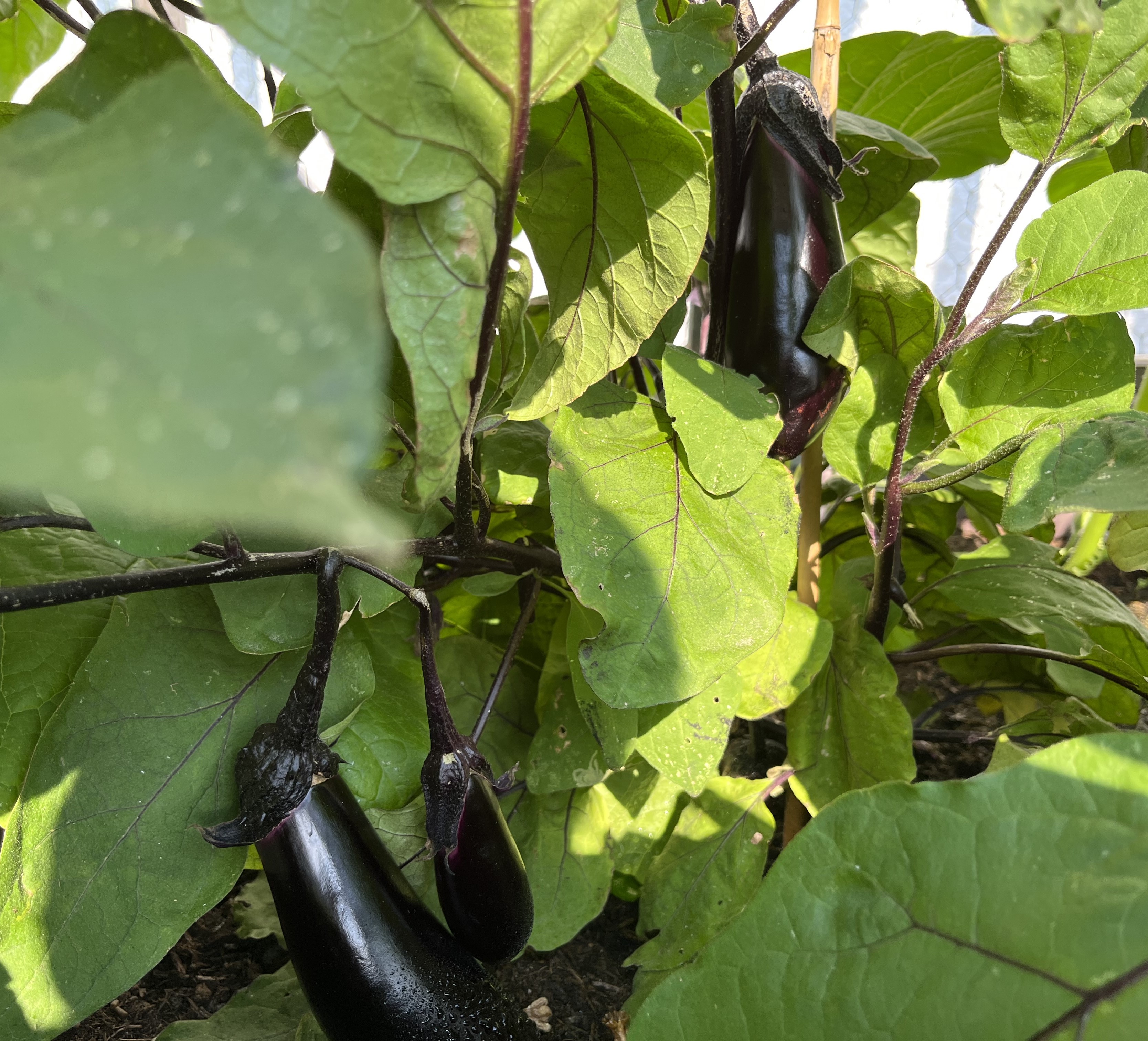
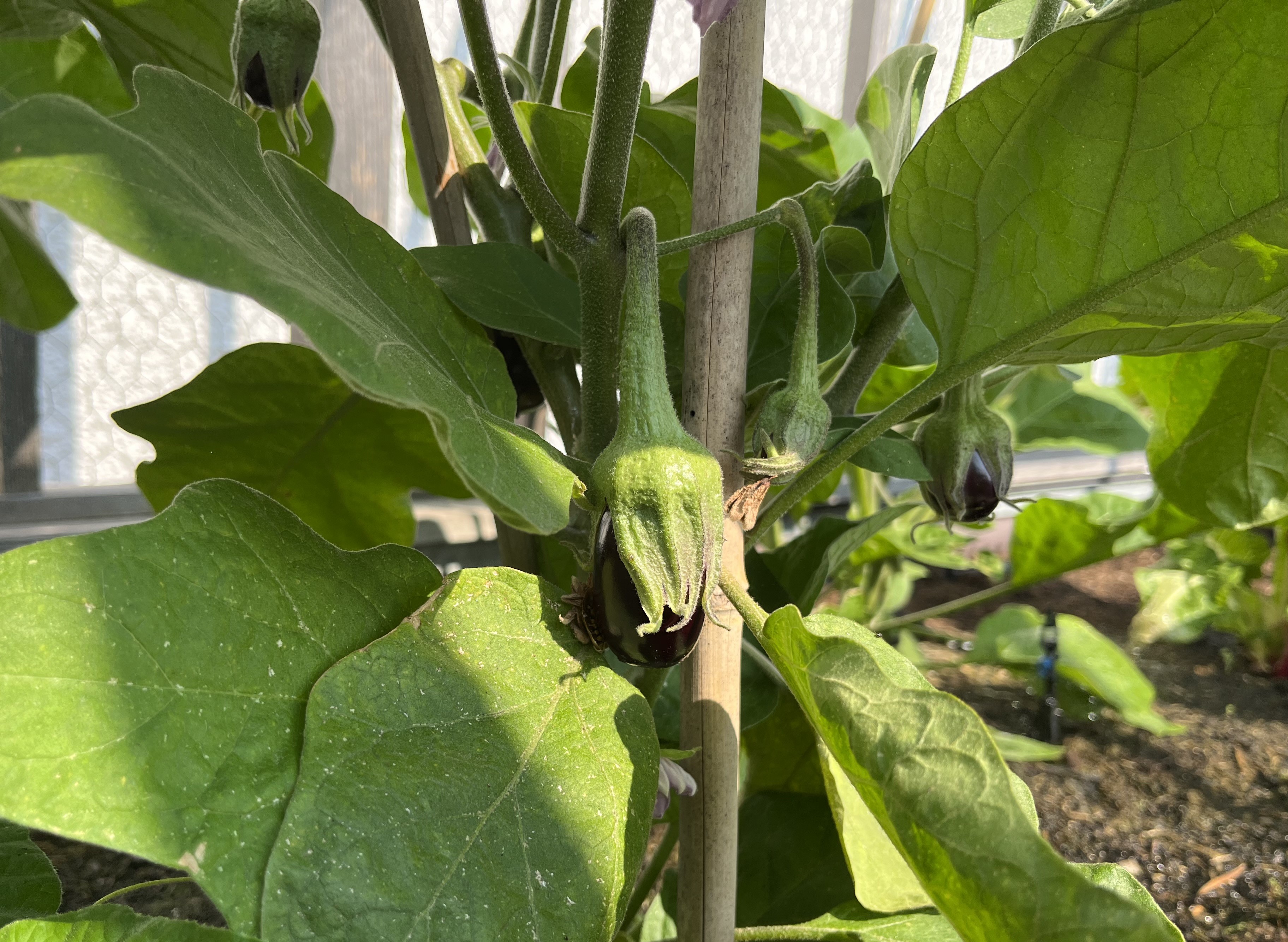
The eggplants are producing very well this year. Some years, I go to harvest a perfect-looking eggplant and when I turn it around, there is a big hole in it. I don’t know what eats eggplants but it sure is disappointing. But, this year so far, so good; I only lost one eggplant.
One of my favorite ways to use eggplant is as part of a veggie-burger. You salt the eggplant and let it sweat for about 30 minutes (helps to remove any bitterness) and then fry the slices (or grill them). Then you take slices of tomatoes and avocado and pile all the slices (eggplant + tomato + avocado) on a bun which has been spread with a yogurt/mayo mix (yogurt, mayo, minced garlic, one or two – or three! – shots of tobasco, salt and pepper). Yum yum!
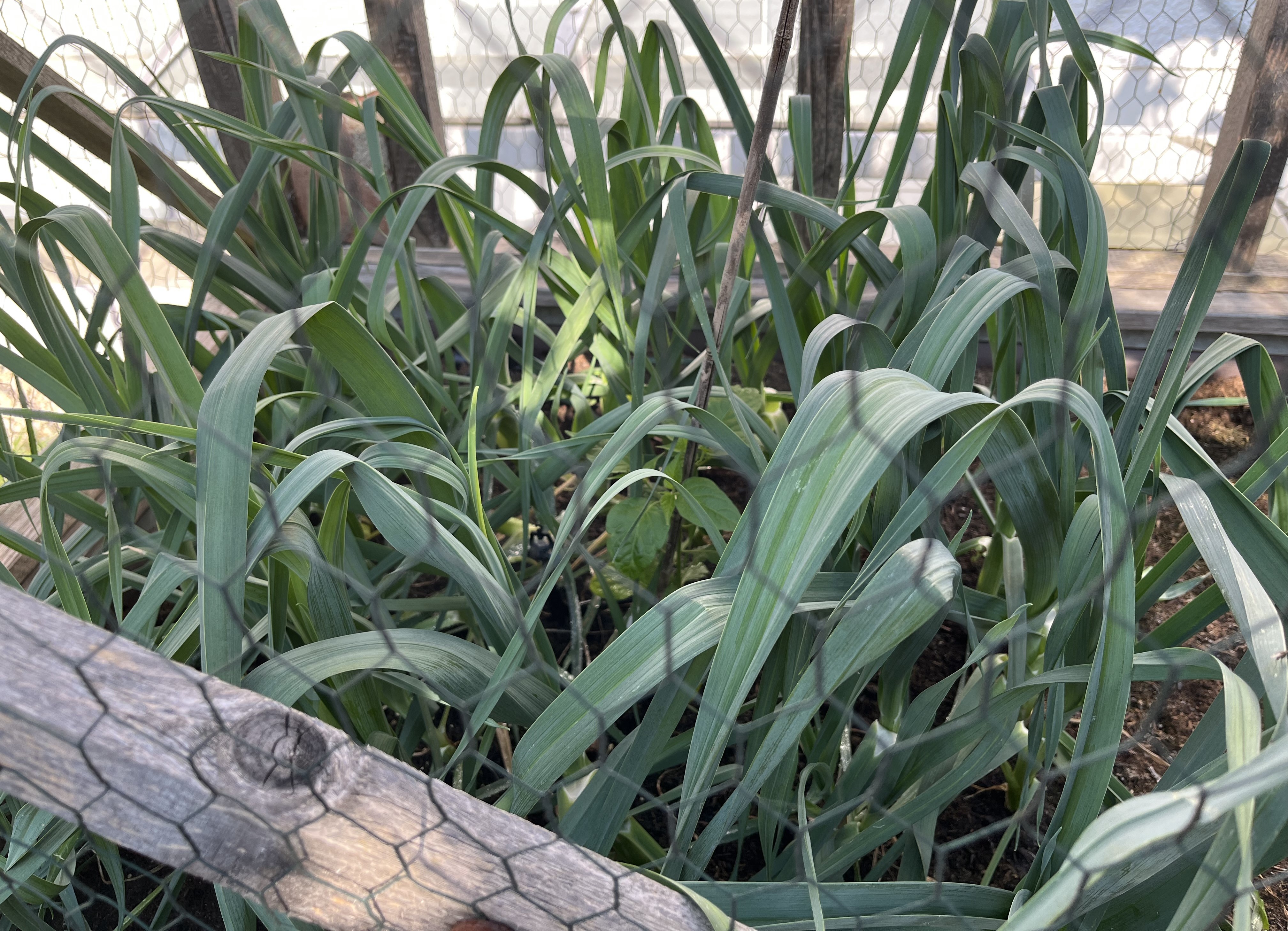
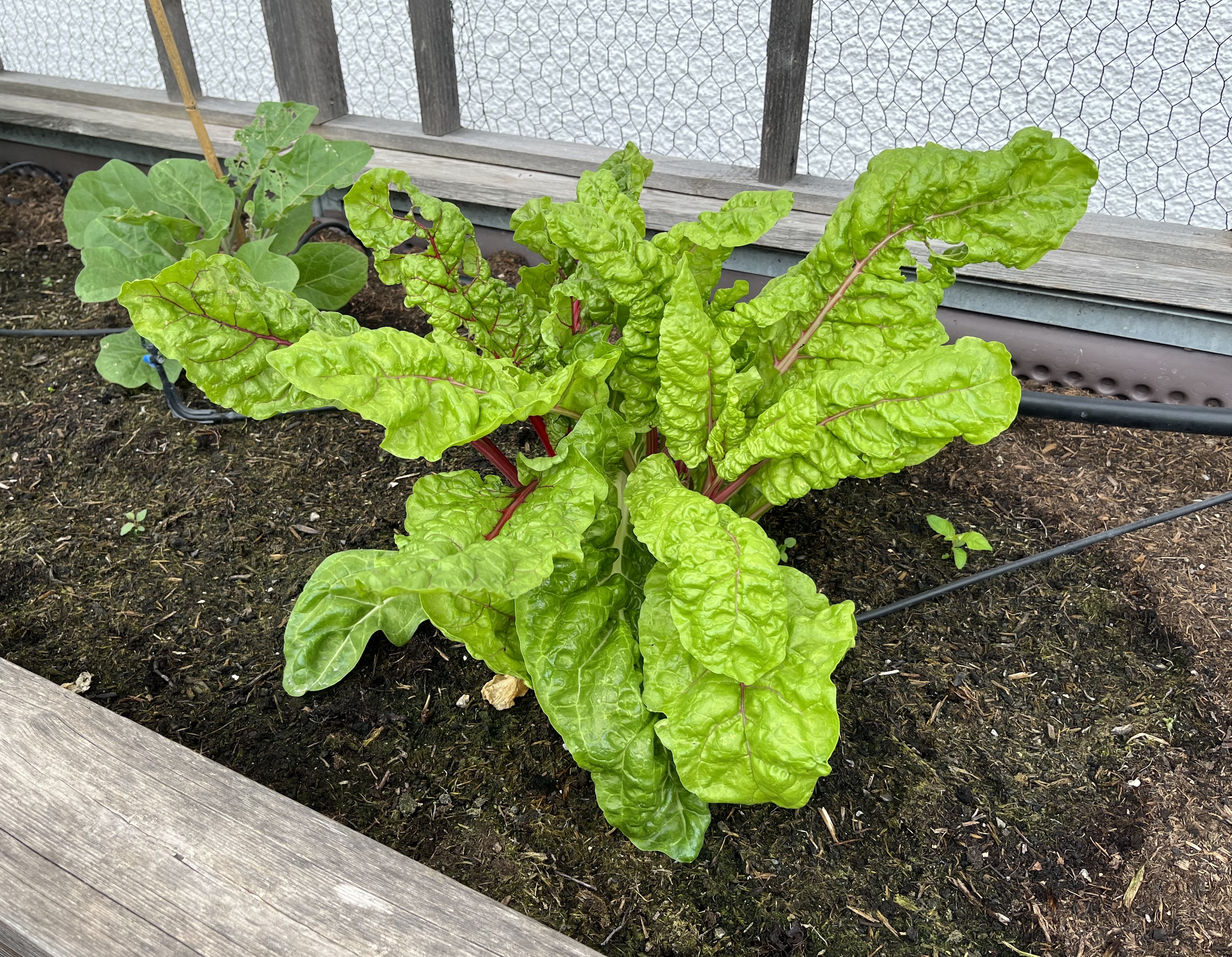
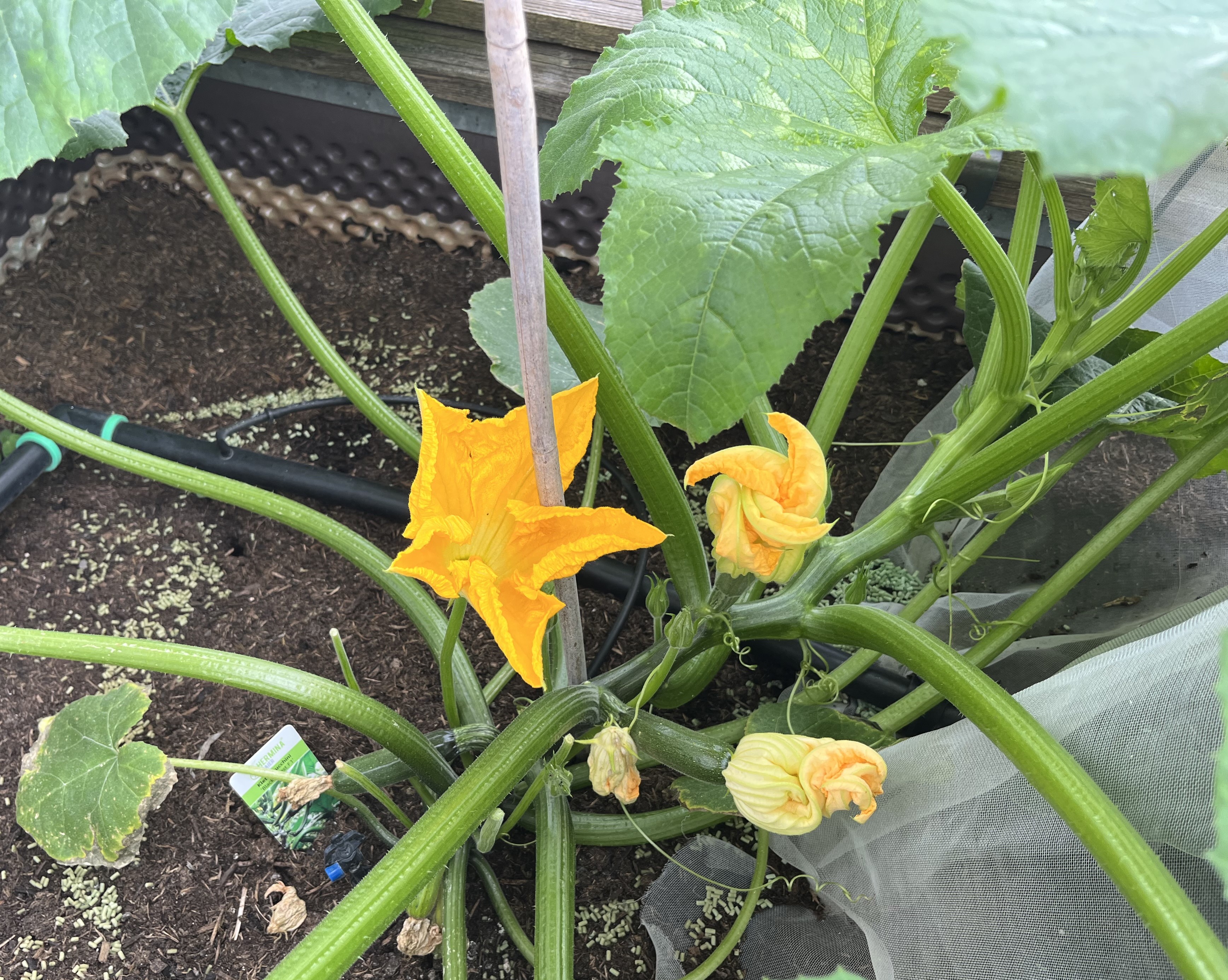
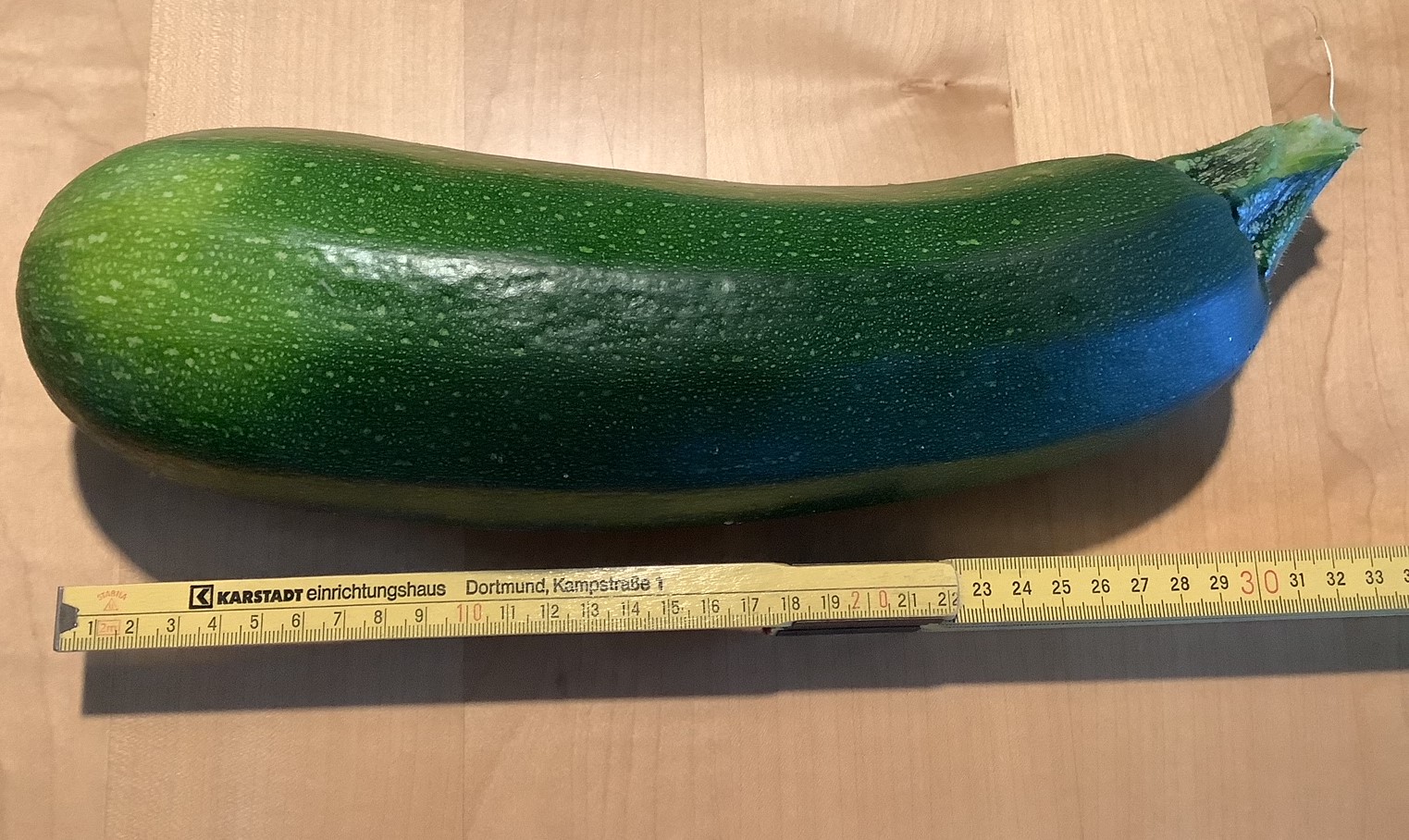
The leeks, mangold, and zucchini plants are all doing well. We went away for the weekend and I came back to a monster zucchini! The thing weighs over 1,5 kilos! I used some of it for zucchini brownies (really yummy recipe, if anyone is interested) and the rest I’ll use to make zucchini pancakes.
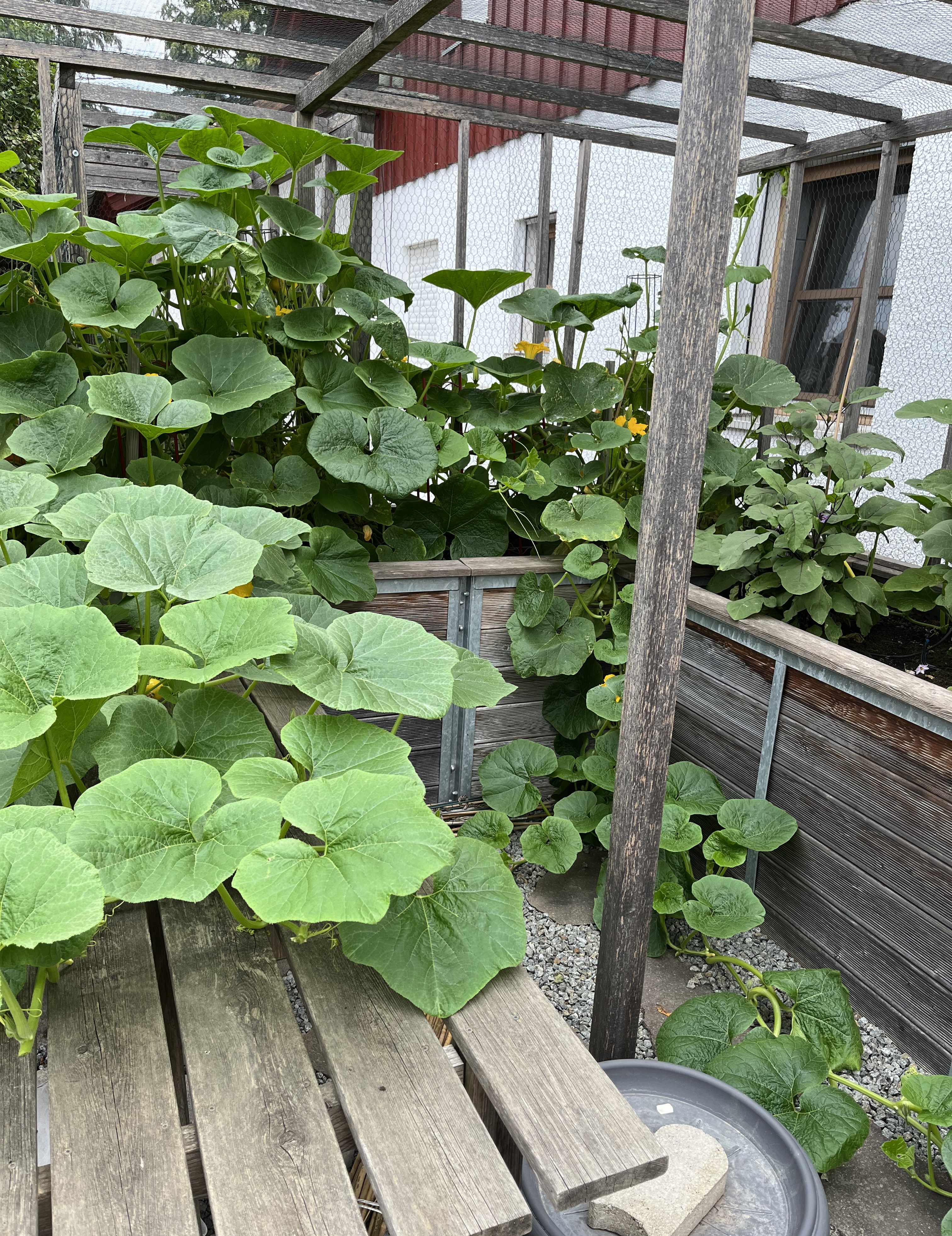
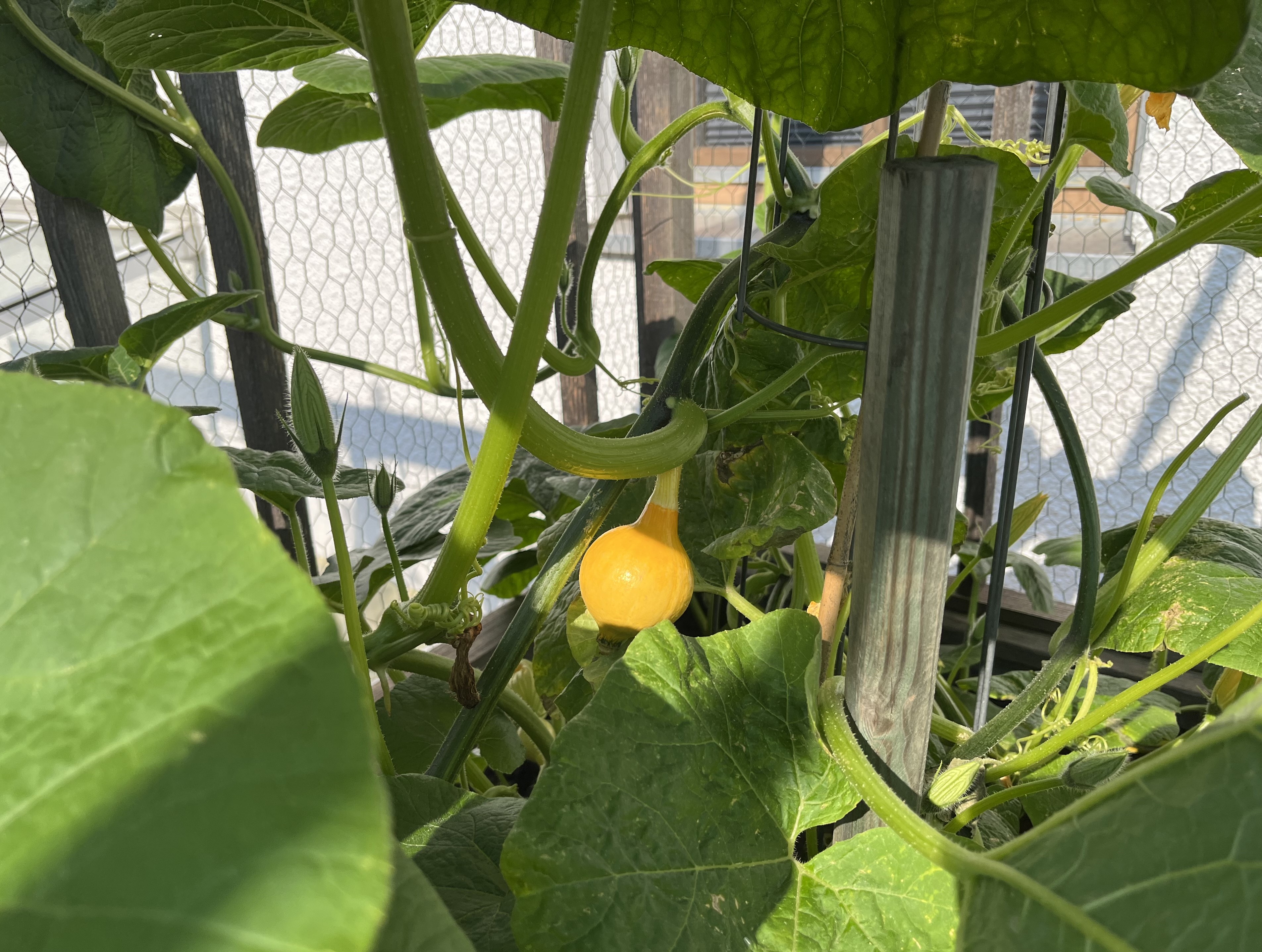
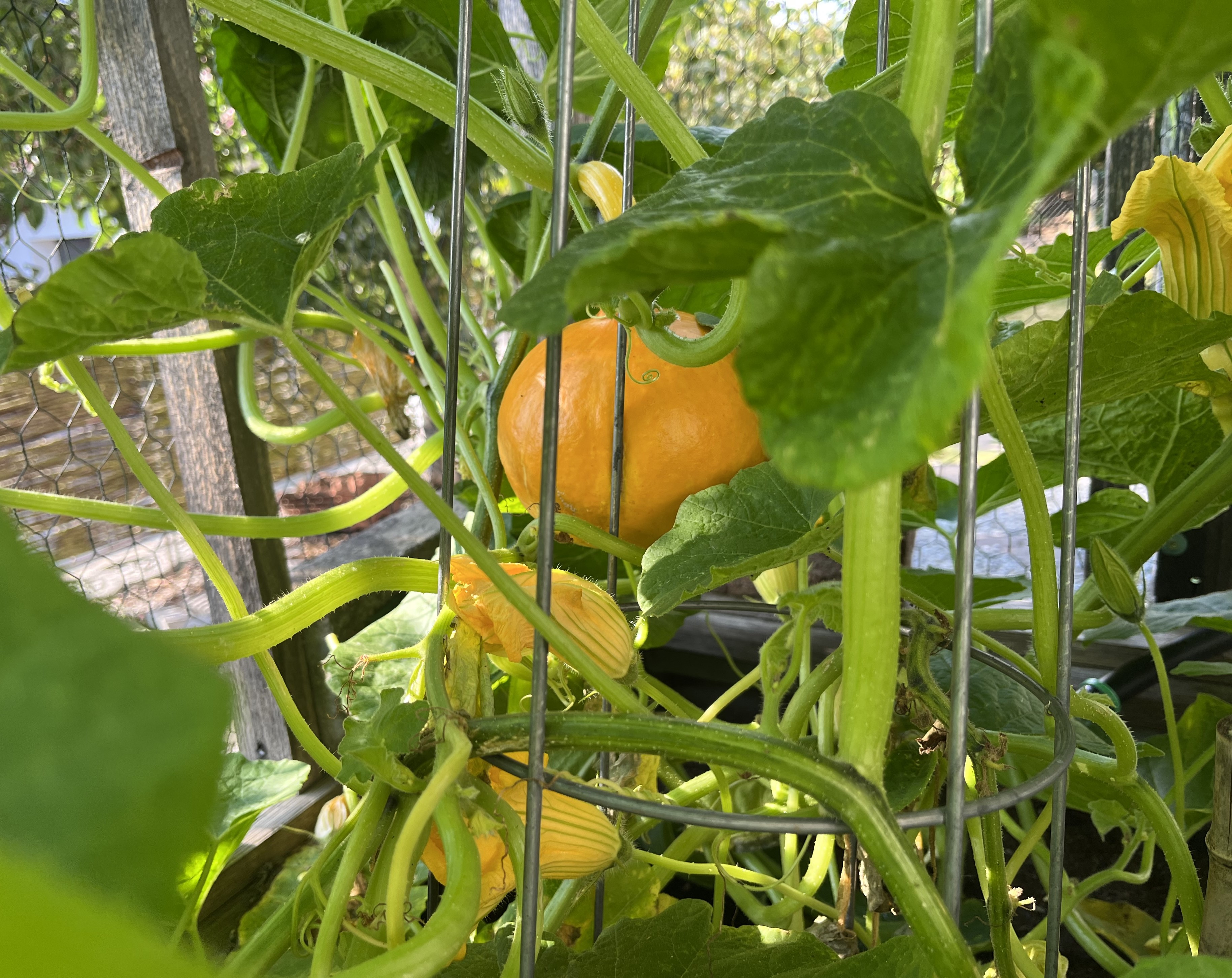
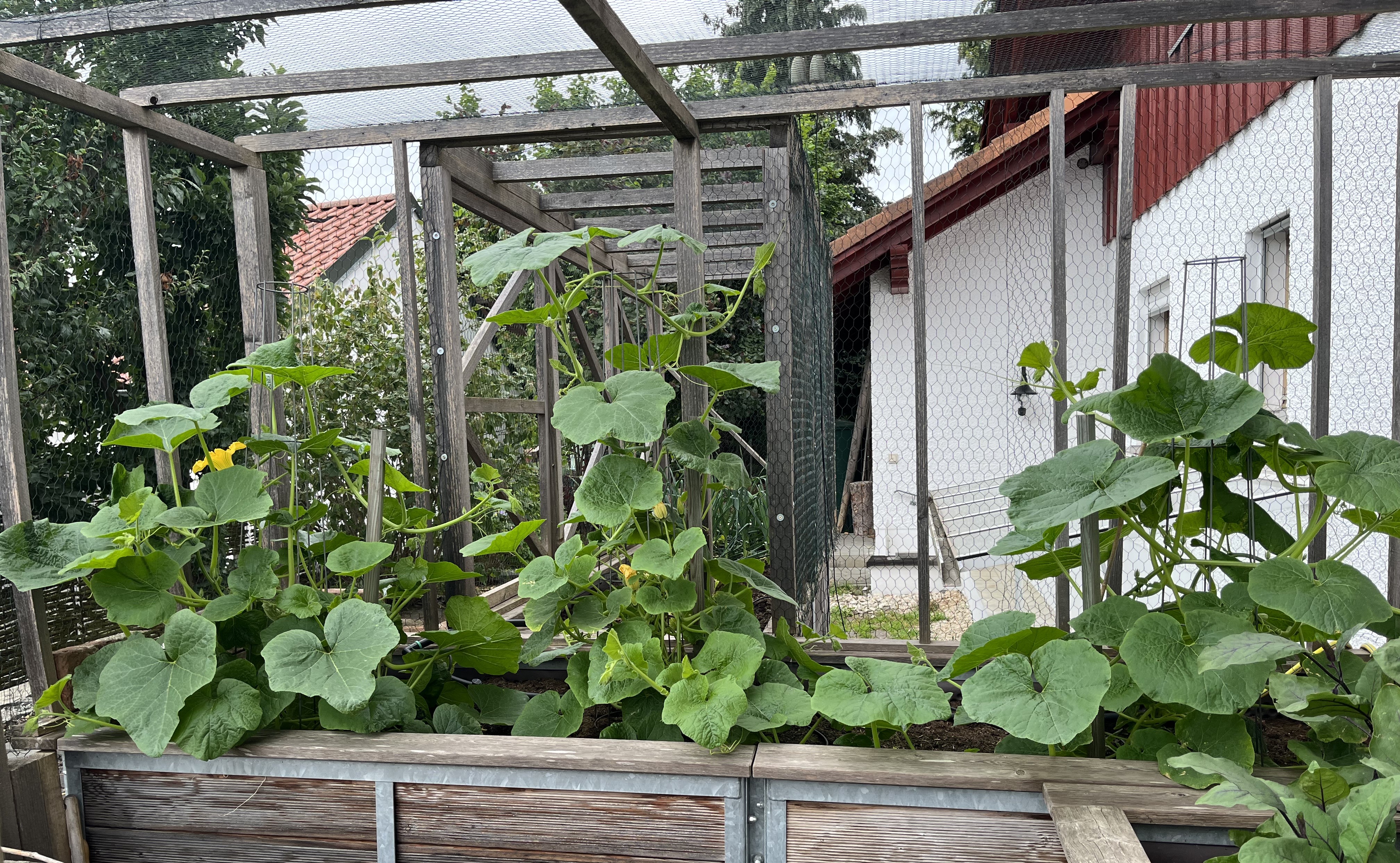
The hokkaido pumpkin plants are growing and growing and growing. They are actually kind of taking over the vegetable garden. I trimmed them back a little yesterday and have to keep after them … without destroying any fruit. It is interesting to note the differece in flowers. There are some flowers that end up turning into a pumpkin and those that don’t. As it has been explained to me (still have to verify this), the flowers on long stems are “male” and basically infertile, i.e. no fruit. But, the bees and other insects do sure love them!

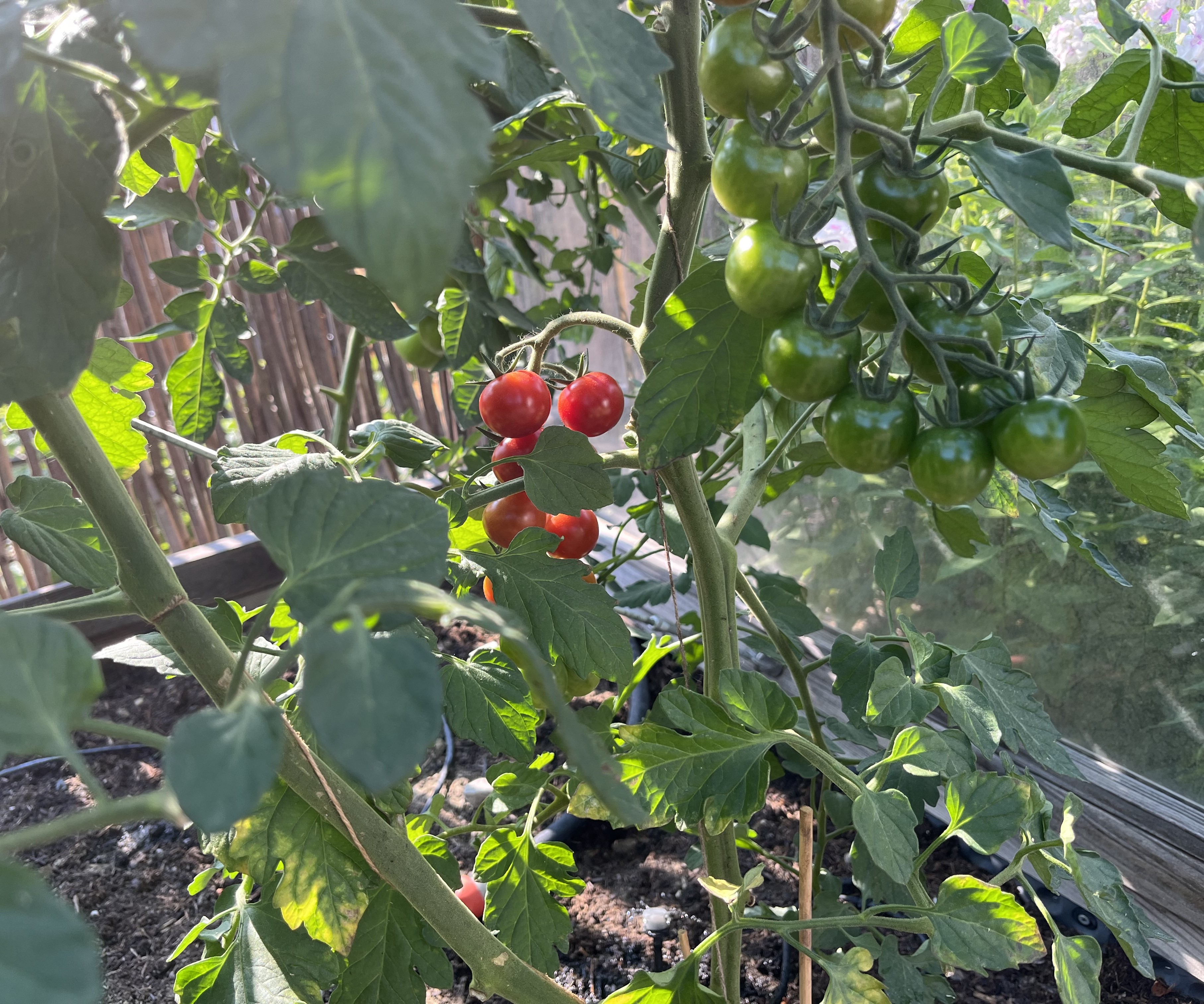
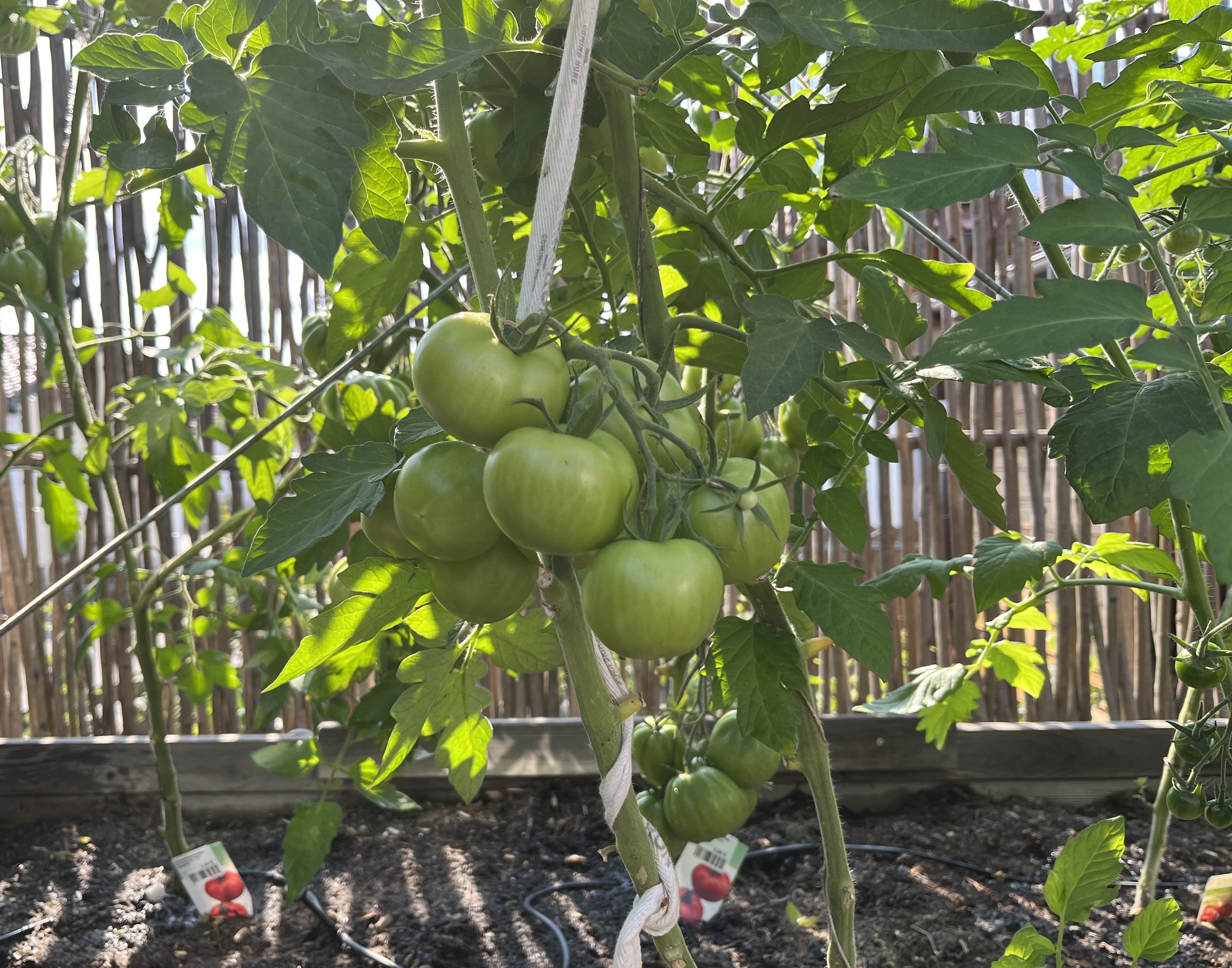
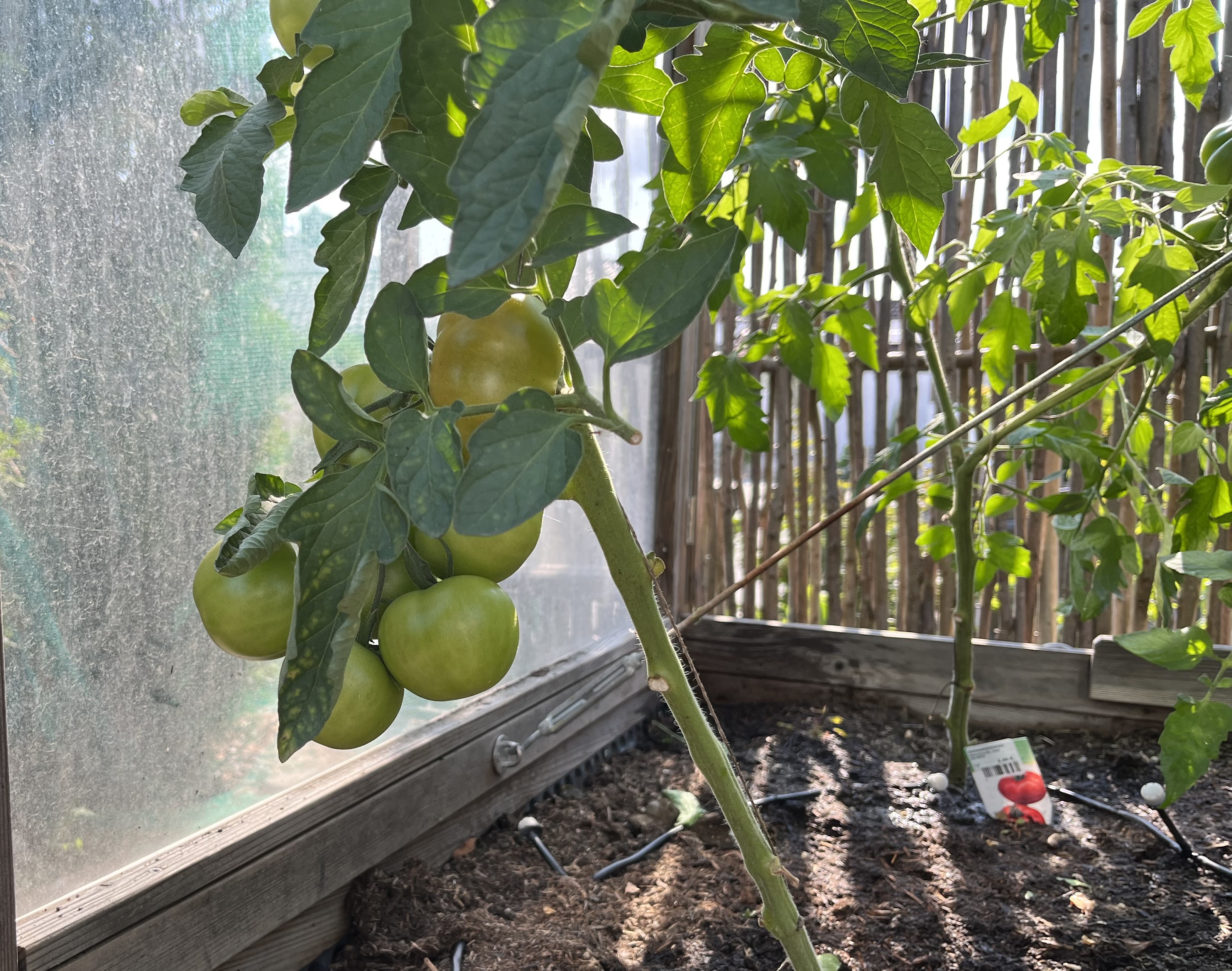
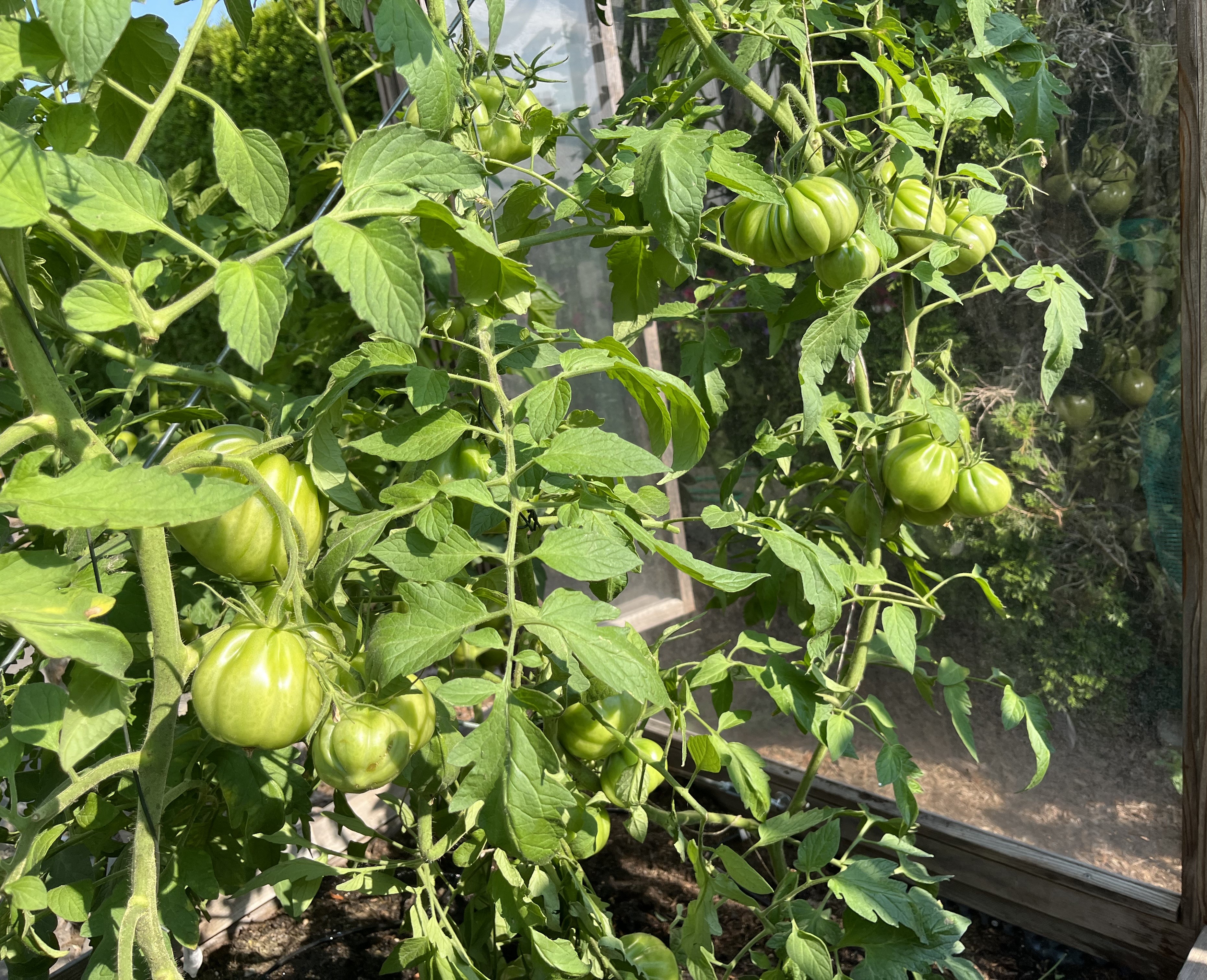
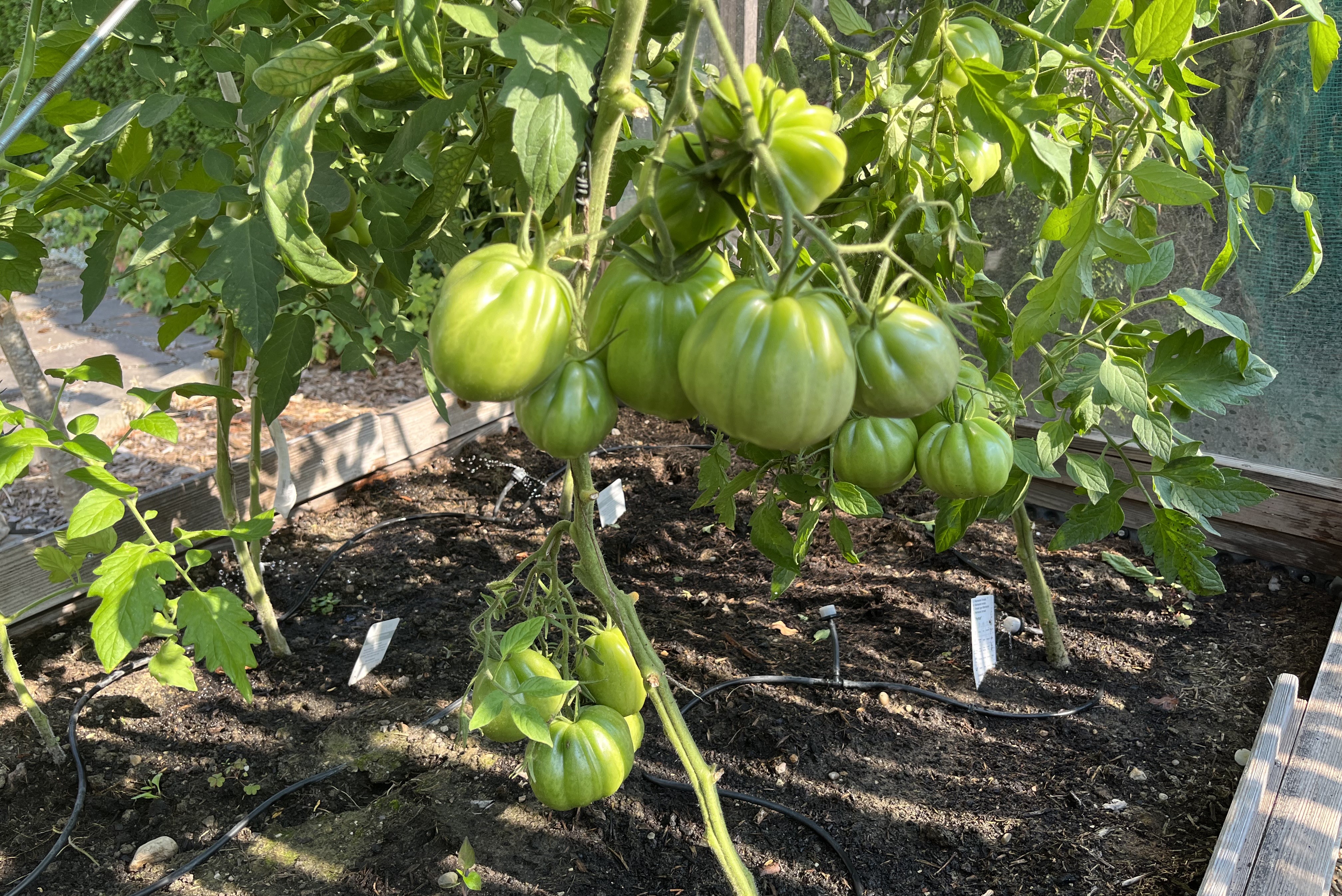
And, the tomatoes. Ah, the tomatoes. As every year, the cherry tomatoes are ripening first and I think the first will be ready to harvest in maybe a week. The sauce and ox tomatoes are taking a little longer. When we got back from the weekend, I noticed that the two ox tomato plants had bent over themselves due to the weight of the fruit. I hope I caught it in time and that the stems aren’t broken inside. If not, I will have to see if they can ripen off the vine. Fingers crossed, though! It will probably be a good 2-3 weeks before these tomatoes are ready to harvest. But, it is worth the wait!
With the next update, I’ll include photos of the rest of the garden. So, stay tuned!
Update 2.07.23: Welcome to July! July, here, is when the garden is kind of in between phases. The glorious explosion of blossoms, that marks the beginning of spring, is over but the summer/late summer blossoming has yet to begin. So, there is a lot of green. July is also the time when the garden starts to get kind of overgrown and I have to prune things back.
The Jasmin bush got chopped the other day and the hasel nut trees in the back got clipped this morning. While doing these tasks, I took some pictures of those plants currently blooming.
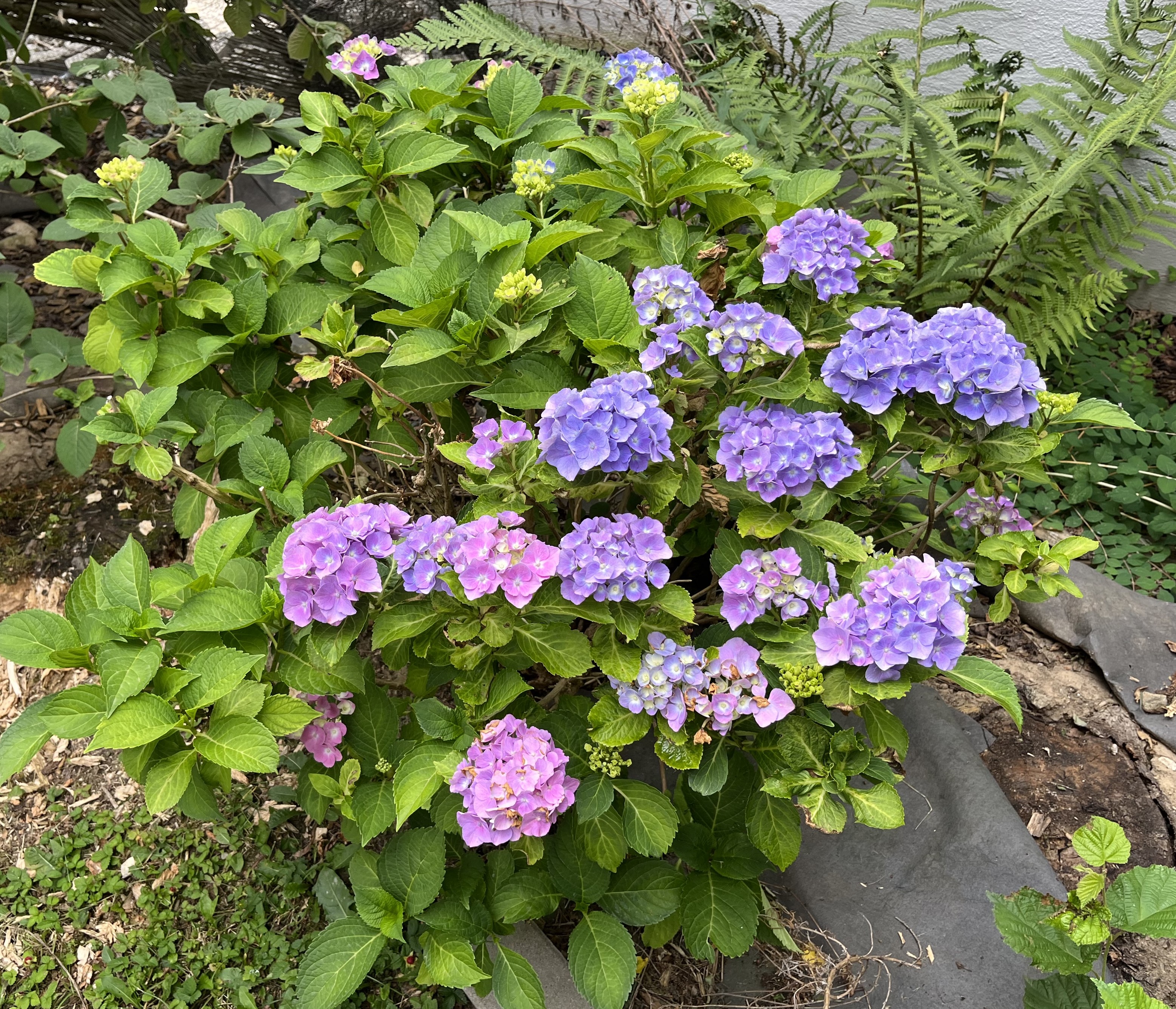
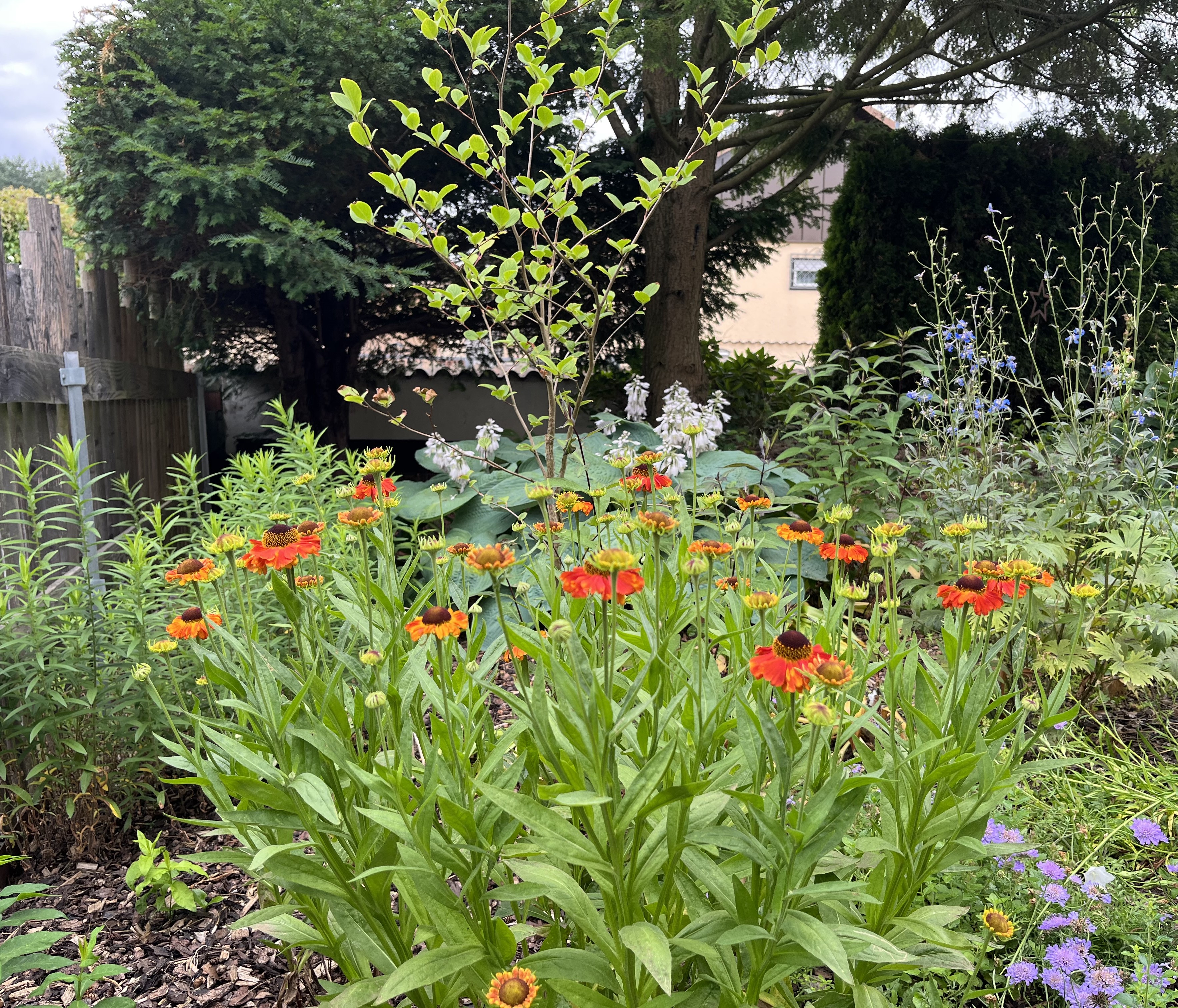
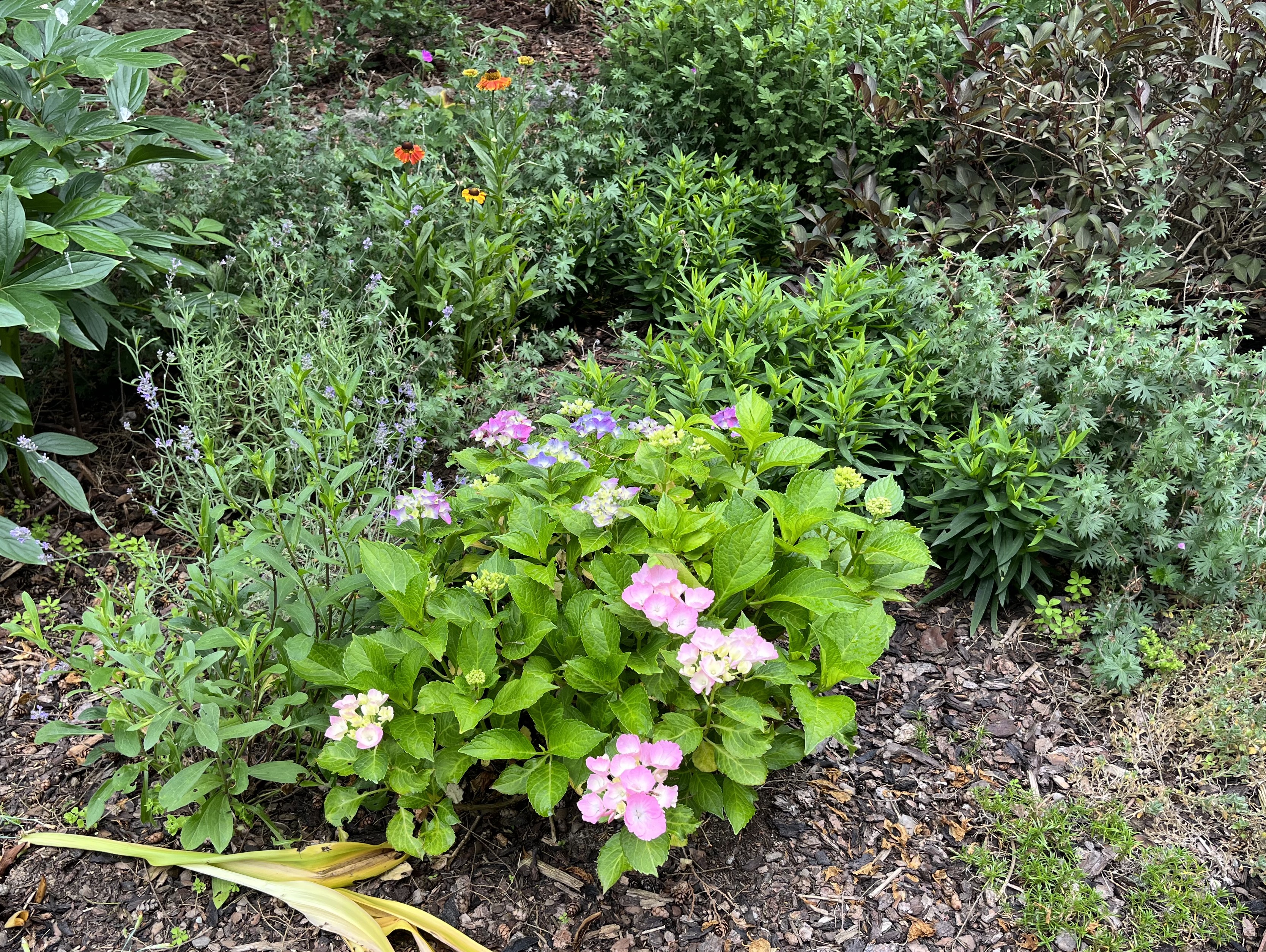
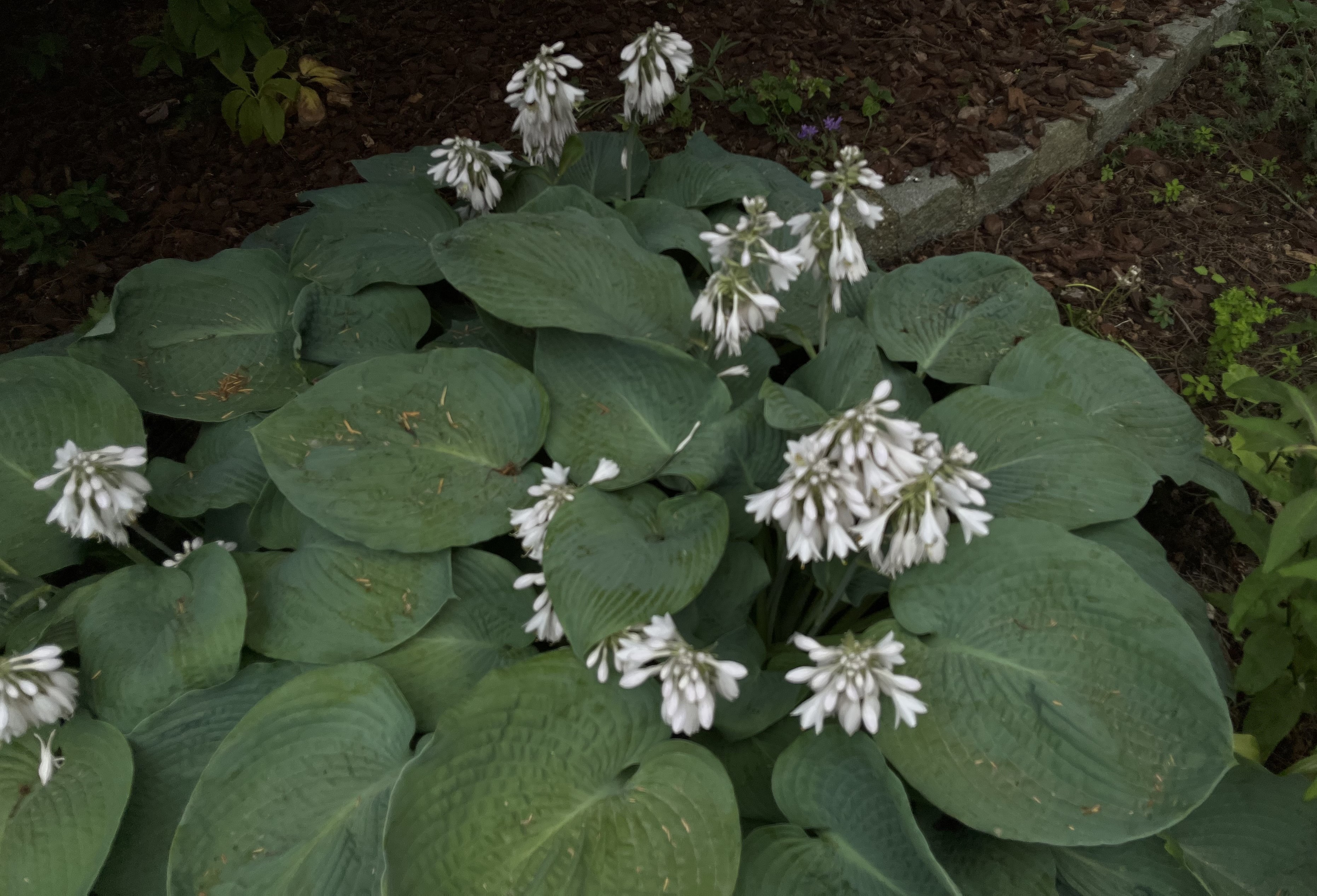
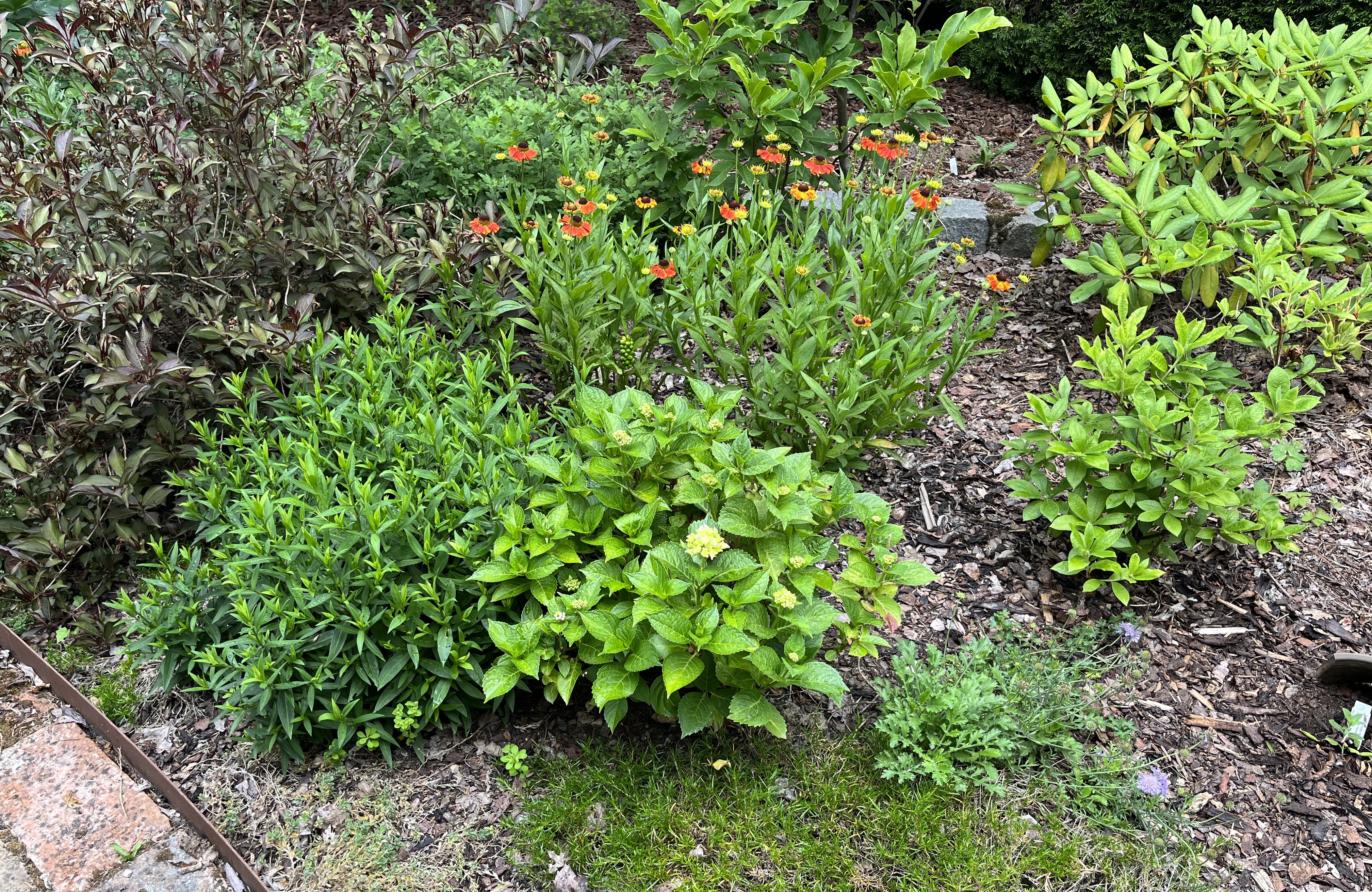
I love hydrangeas but I fear I may have to part with them at some point in the future. They are not drought/heat-loving plants. On top of that, to get that wonderful blue color, I have to add a specific fertilizer product that artificially makes the soil around the plant more sour (or is it sourer???). Our soil here is not sour at all. The hydrangea in the back (west side of the house) is fully “pimped” with the blue-making fertilizer. The two hydrangea in front (east side of the house) are not treated and therefore have mostly reddish/pinkish blossoms.
The photo I took of the hosta plants didn’t quite work out as I had hoped. There were several bumble bees buzzing around the white blossoms which didn’t show up, unfortunately.
The orange flowers in the second photograph are Helenium “mardi gras”. I was told that these plants, too, probably won’t last in our climate of the future. As with the hydrangeas, I’ll keep them as long as they are healthy and happy. That pop of orange (I have them planted in three spots) is such a joy in this Month of Green.
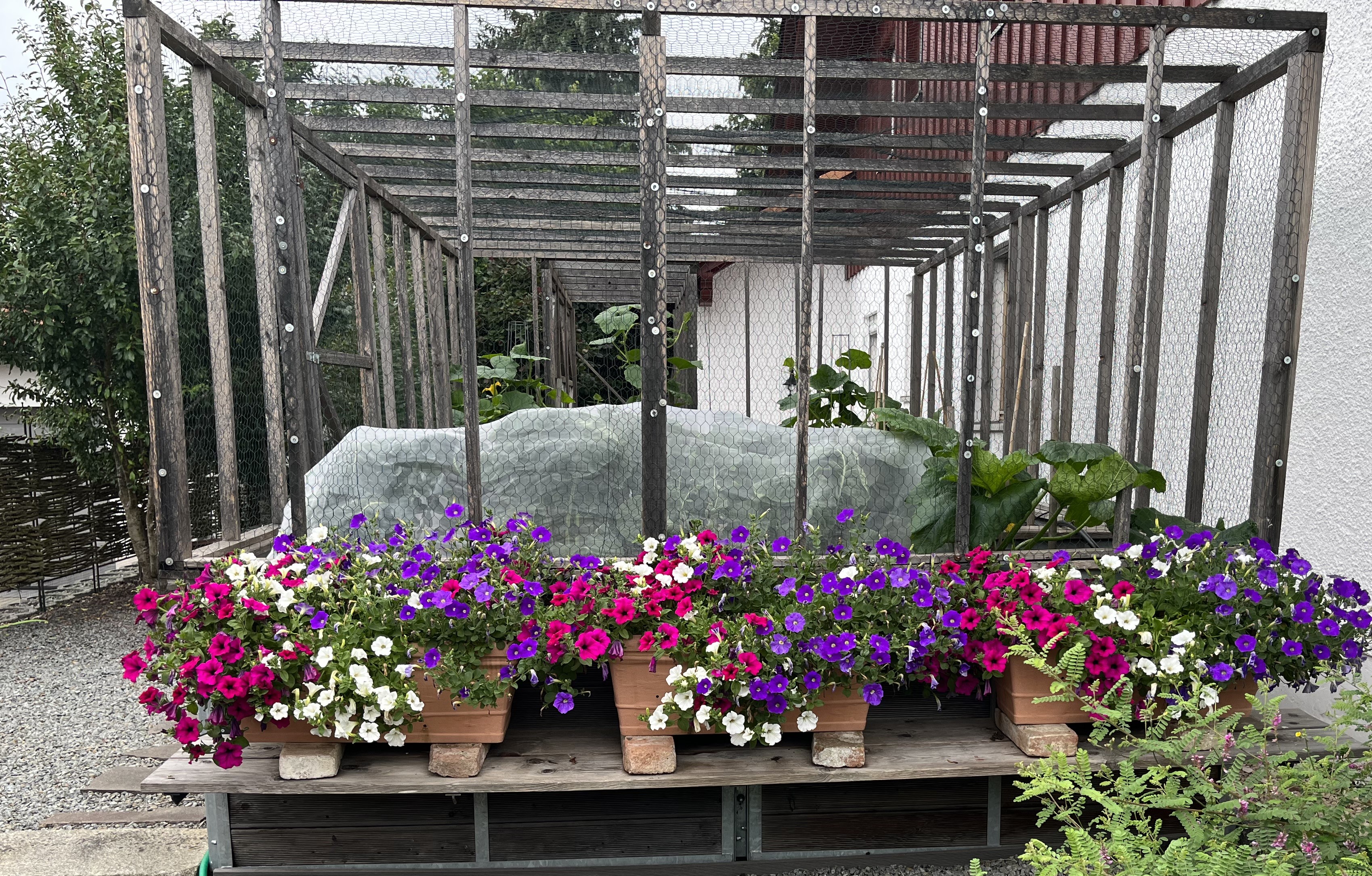
And, the petunias are going gangbusters by the veggie garden. It is such a joy to turn the corner and see that splash of color!
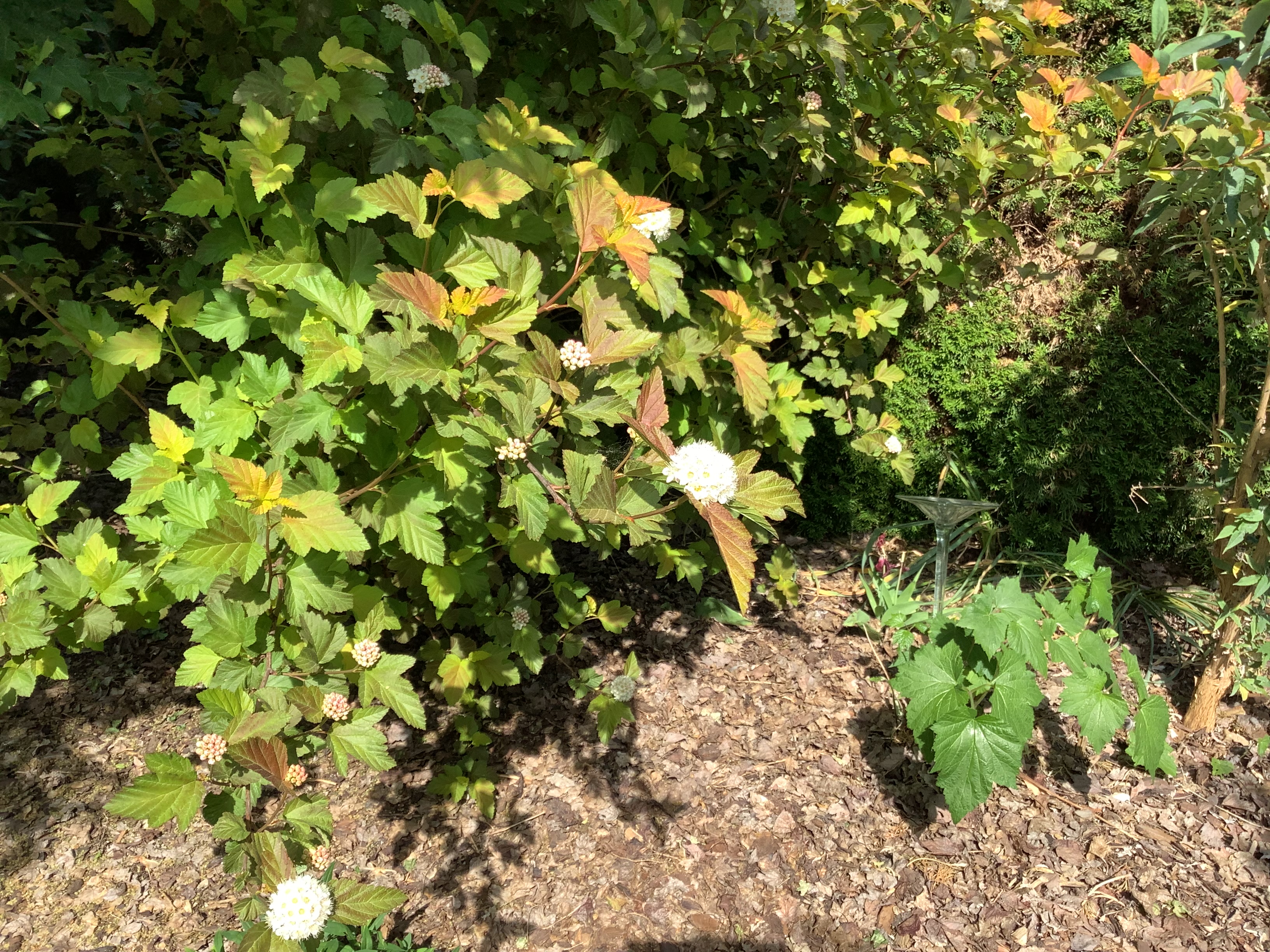
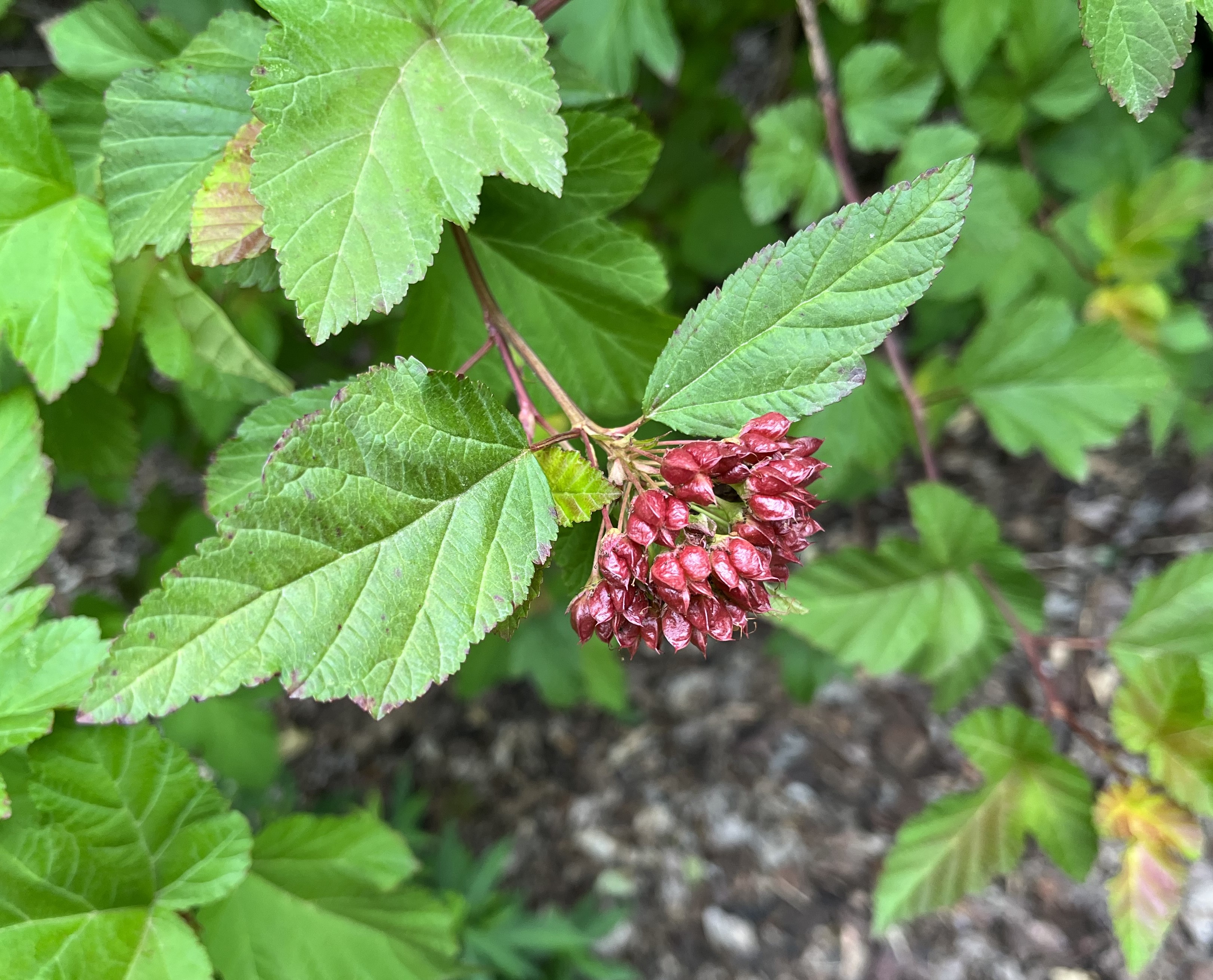
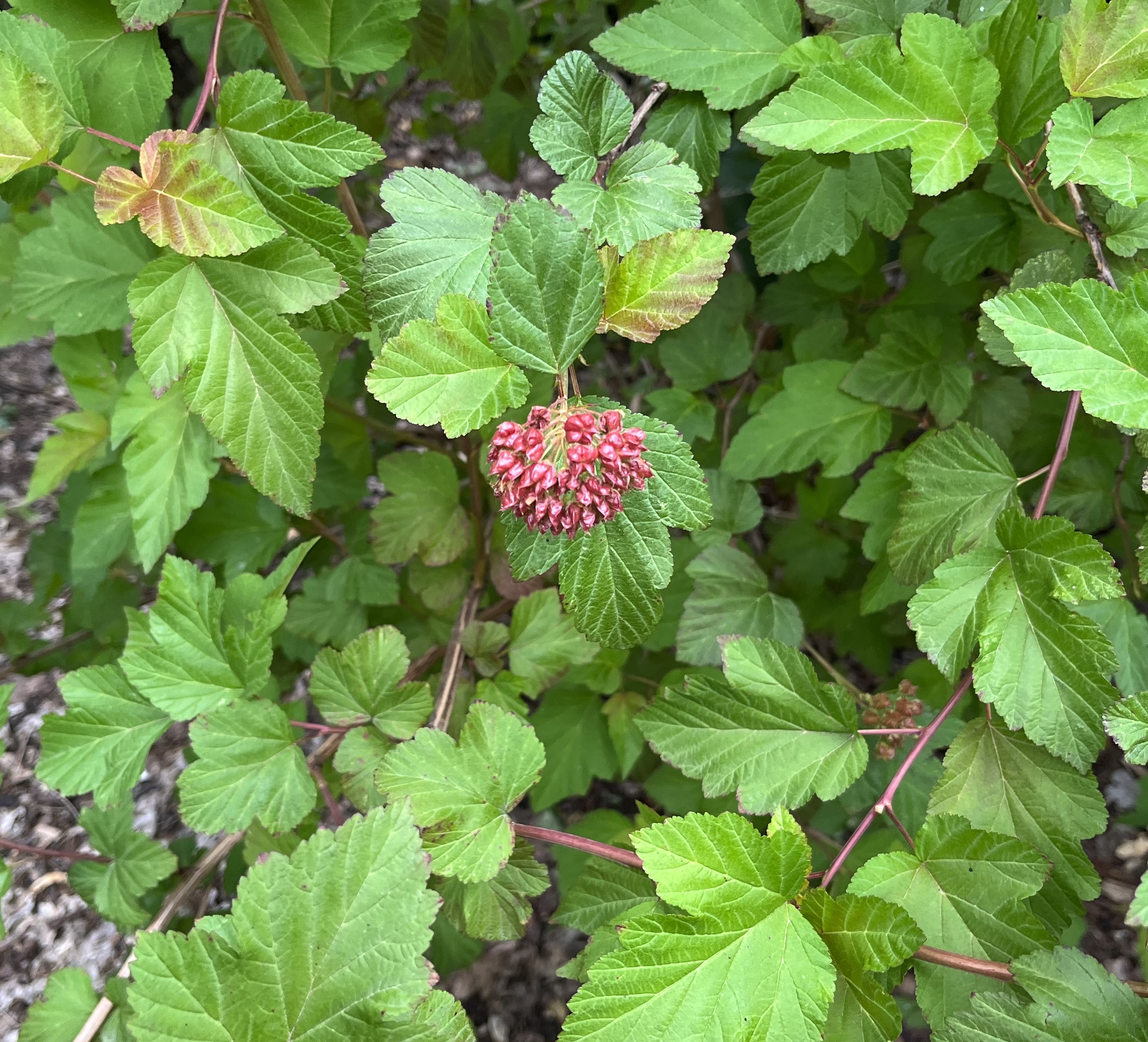
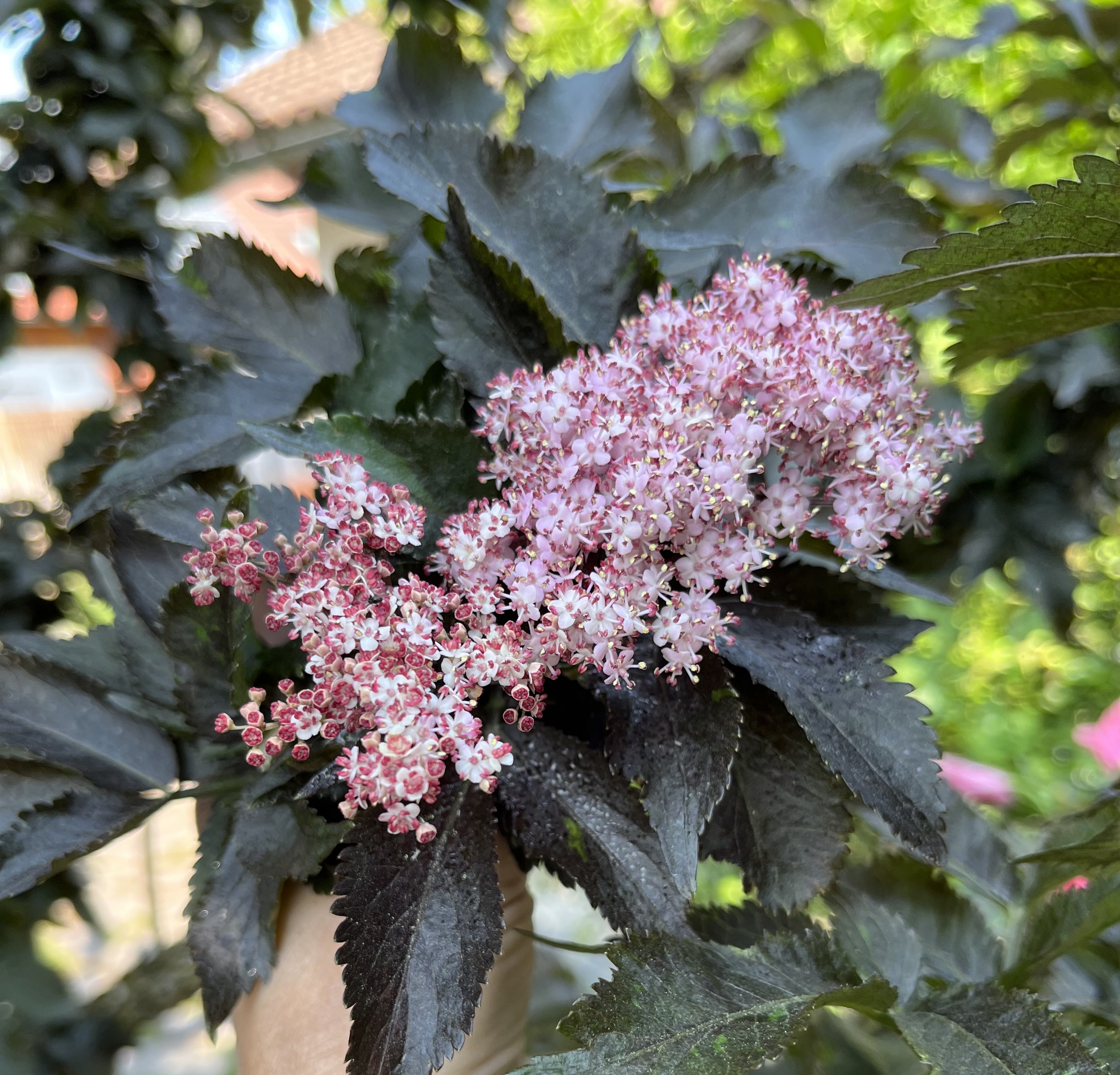
The pictures above are of the Physokarpus opulifolius “amber jubilee”. This is a fascinating bush. It’s deciduous and its leaves change color throughout the season. But, its flowers also change – the half-ball white puffs bloom in early summer and then turn into red berry-like bunches in July. The leaves will also start to change color, from green to orange to red/brown shortly before the leaves fall. A great plant to have if you don’t have a lot of room because it provides such visual interest during the entire growing season.
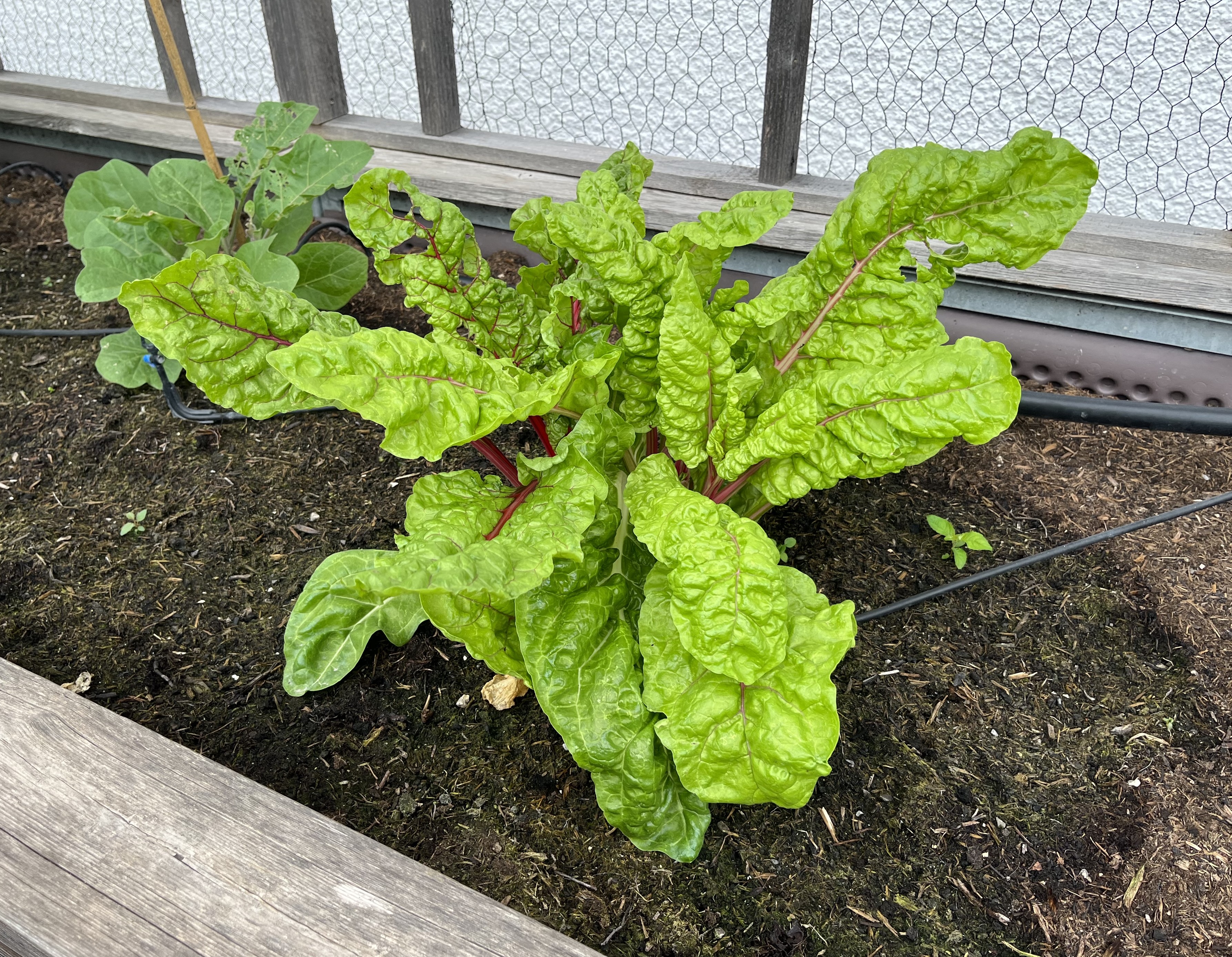
And, of course no update would be complete (at this point in the season) without an update on the veggie garden. We had our very first eggplant the other day and another is on its way. The hokkaido pumpkin plants are growing, growing, growing; soon I will have to add some additional climbing aids, so they have room to continue growing. The climbing zucchini has started blooming and little zucchinis are starting to pop. We’ve also been eating the mangold; I cut, from the outside of the plant, what I need for the meal and let the rest continue to develop.
The picture that looks like a mess of plants under netting is exactly that – the broccoli and cauliflower plants are getting pretty bushy under the net. Harvest-time can’t be very far away!
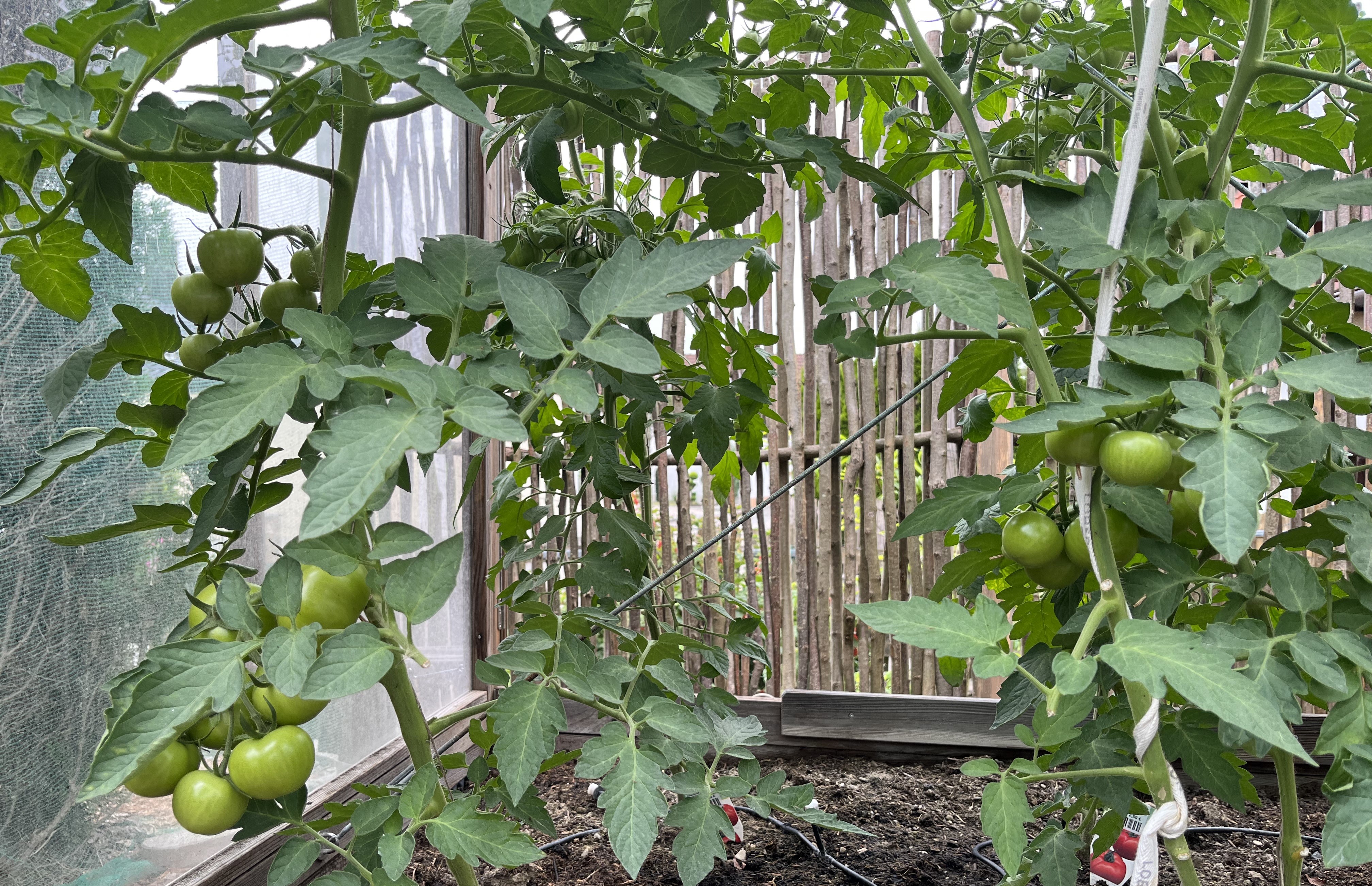
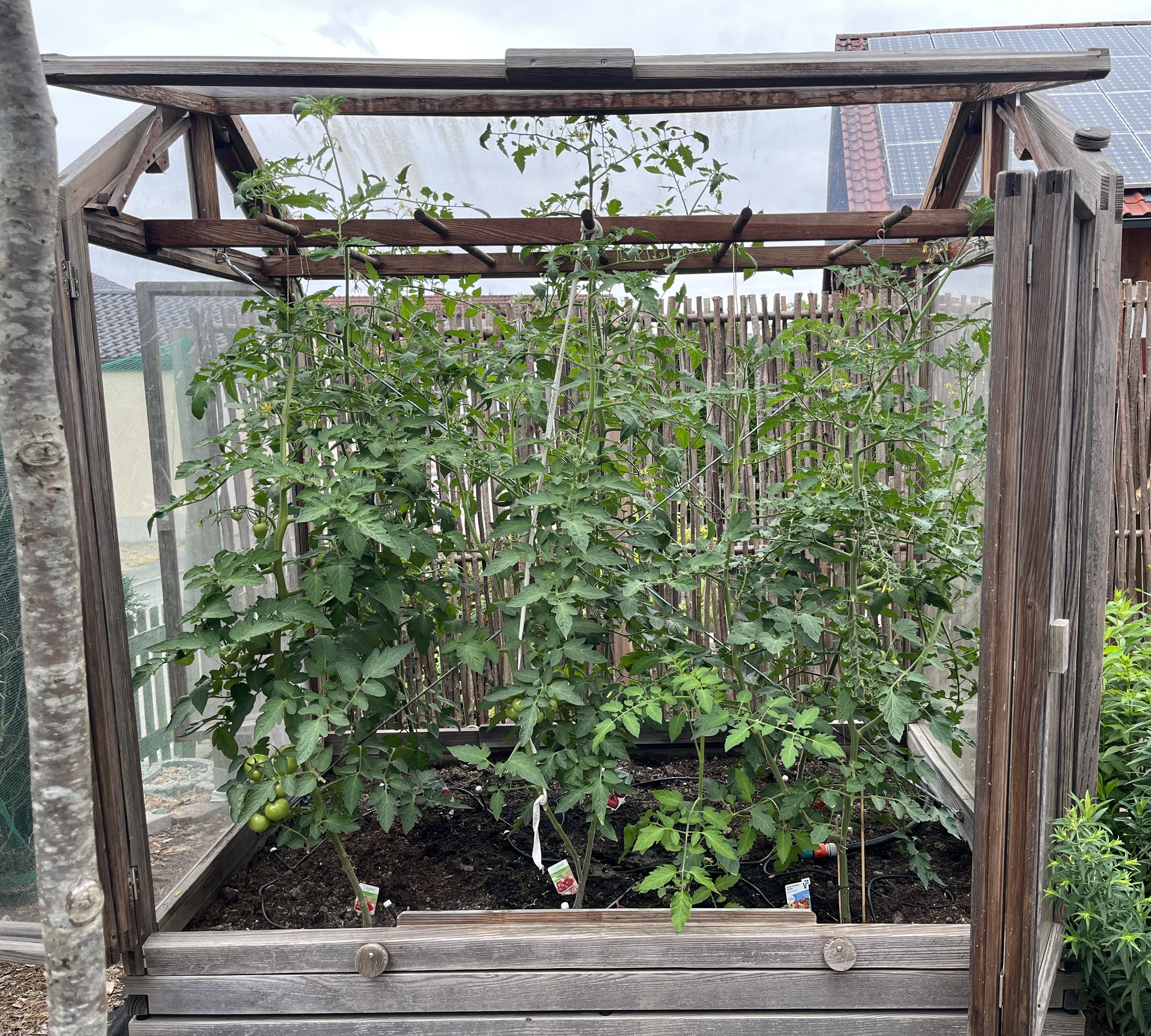
And then there are the tomatoes. Things are looking good. All six plants are blooming and producing tomatoes. We’ve got a while to wait until they’ll be ripe enough. But, it sure is fun to watch the plants develop.


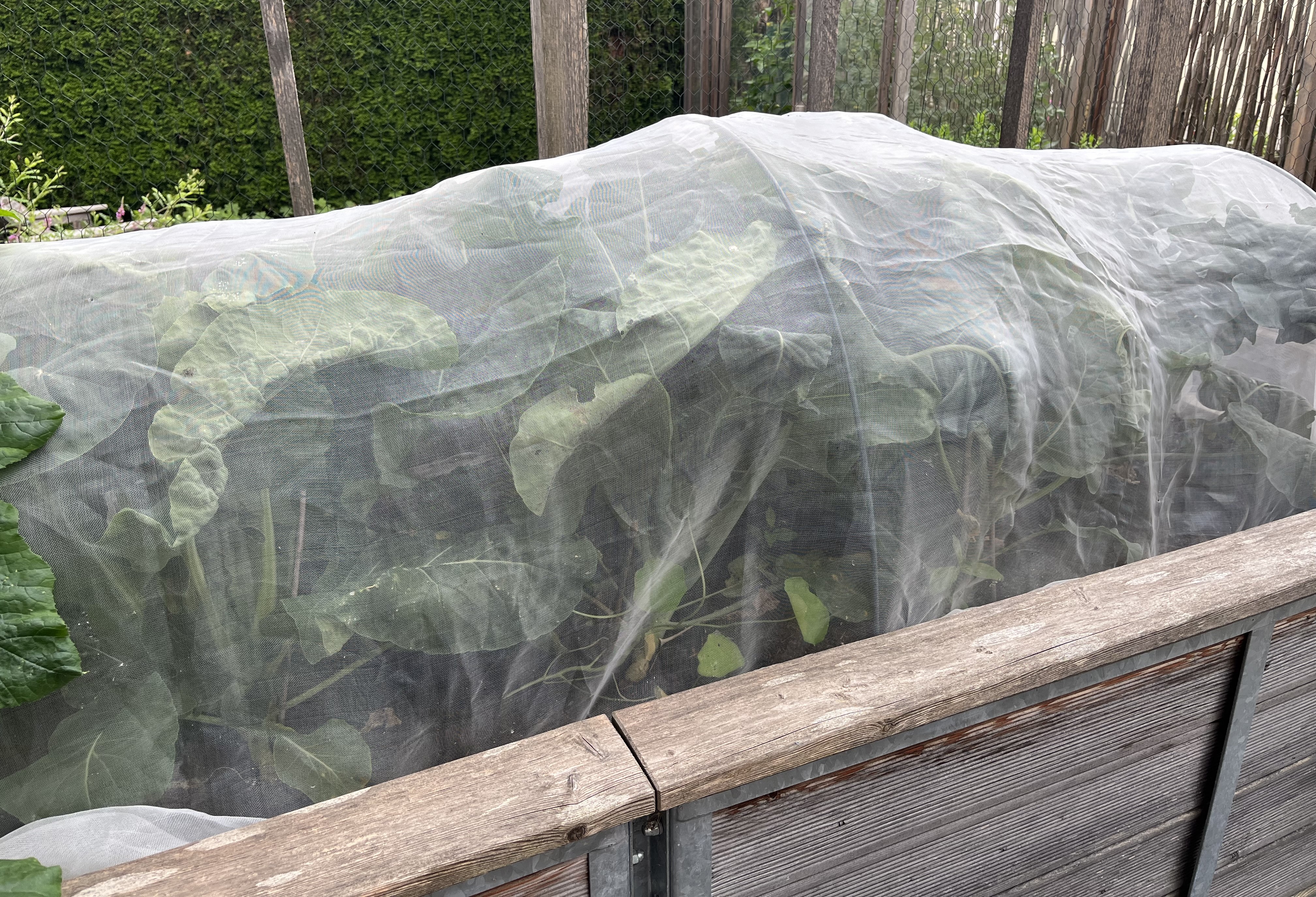
Because the lettuce is coming to an end (just gets too hot), I’ll be replacing those plants with peppers, if I can still get some. That will compliment the leaks I have planted in that raised bed. More on that on the next post.
Update 23.06.23: OK, I couldn’t resist posting this photo. As much as I say I don’t like roses because they require too much effort, this year seems to be a particularly good rose-year. When I come into the kitchen in the morning, I am greeting by this wonderfully cheerful sight!
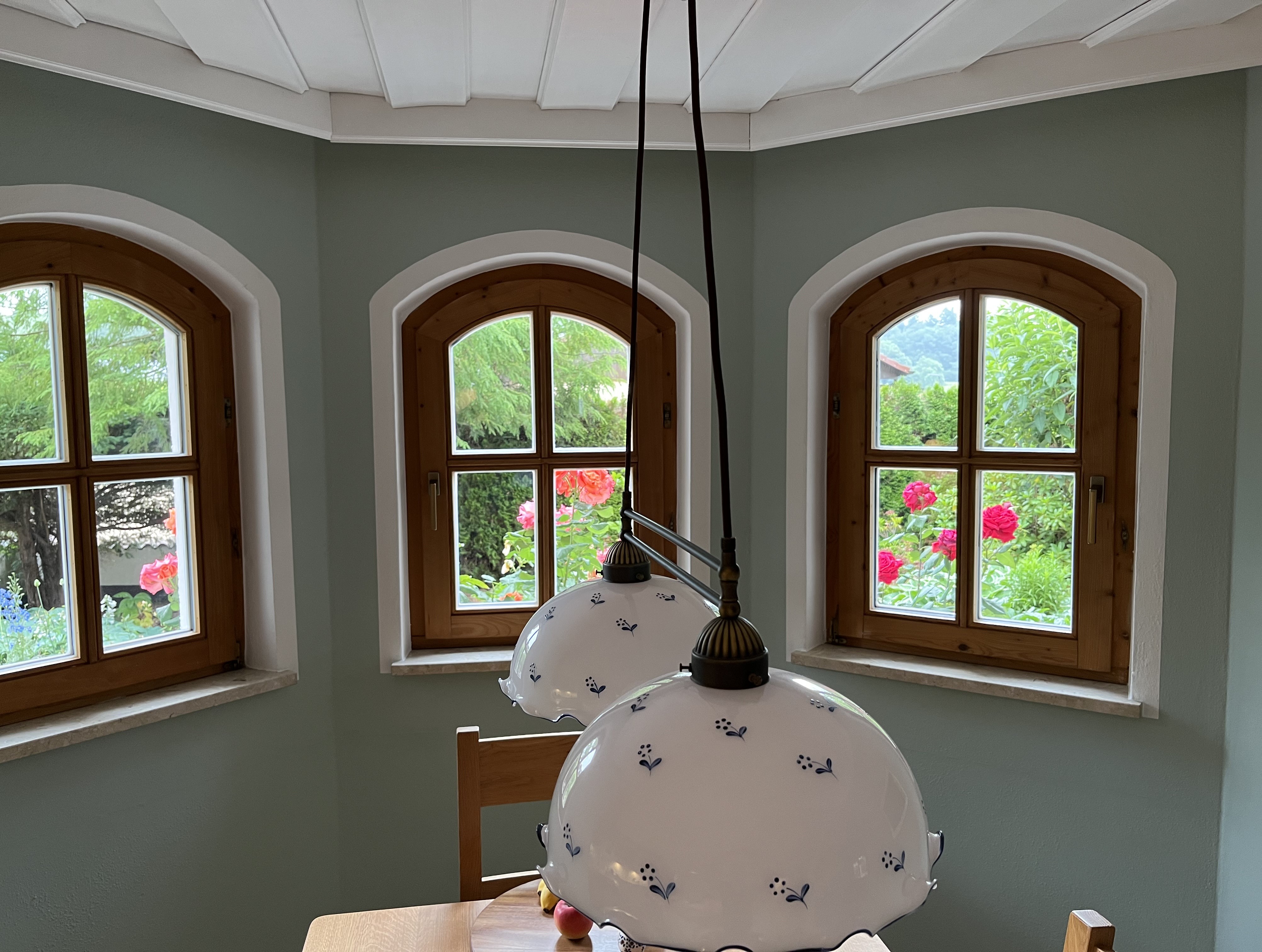
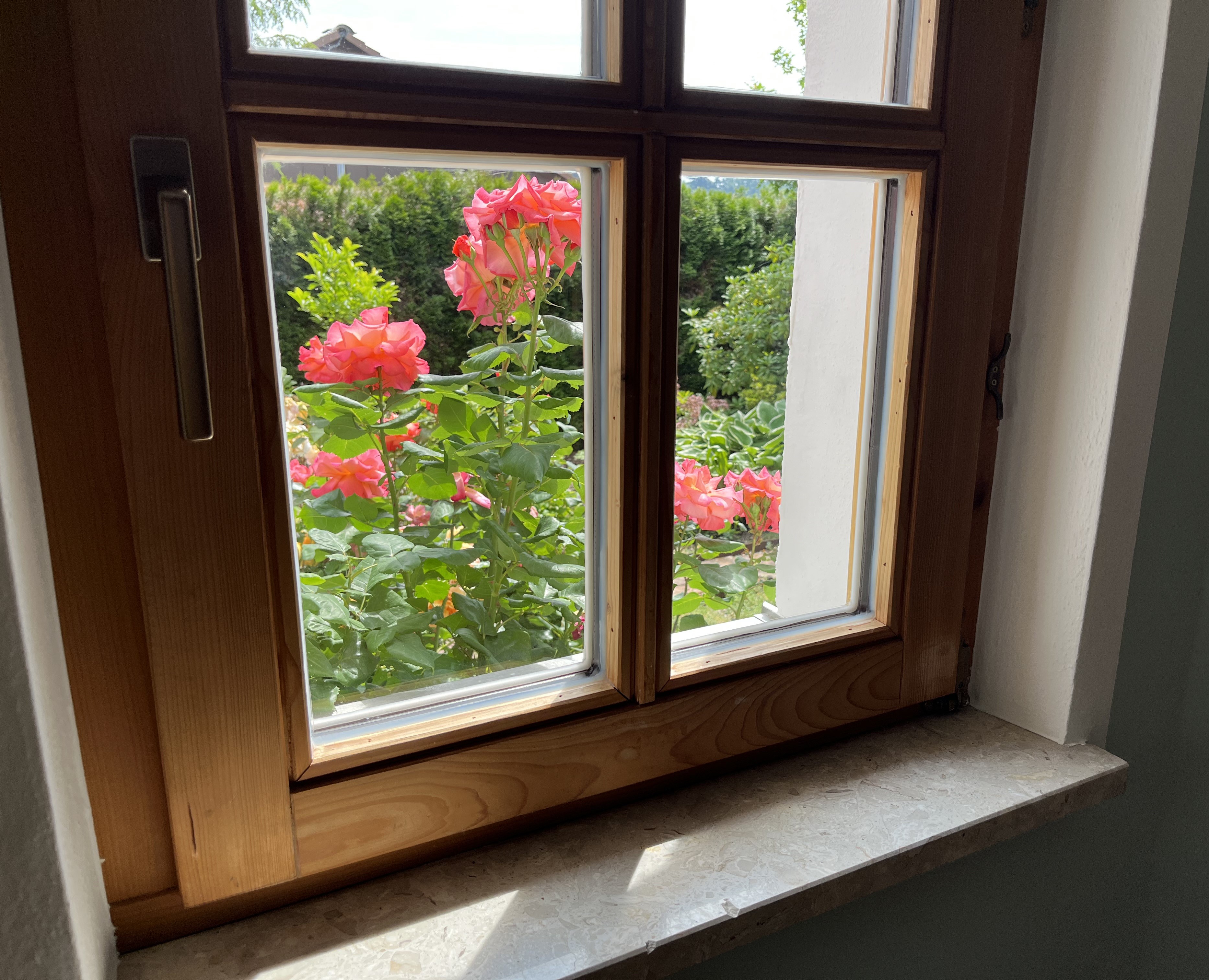
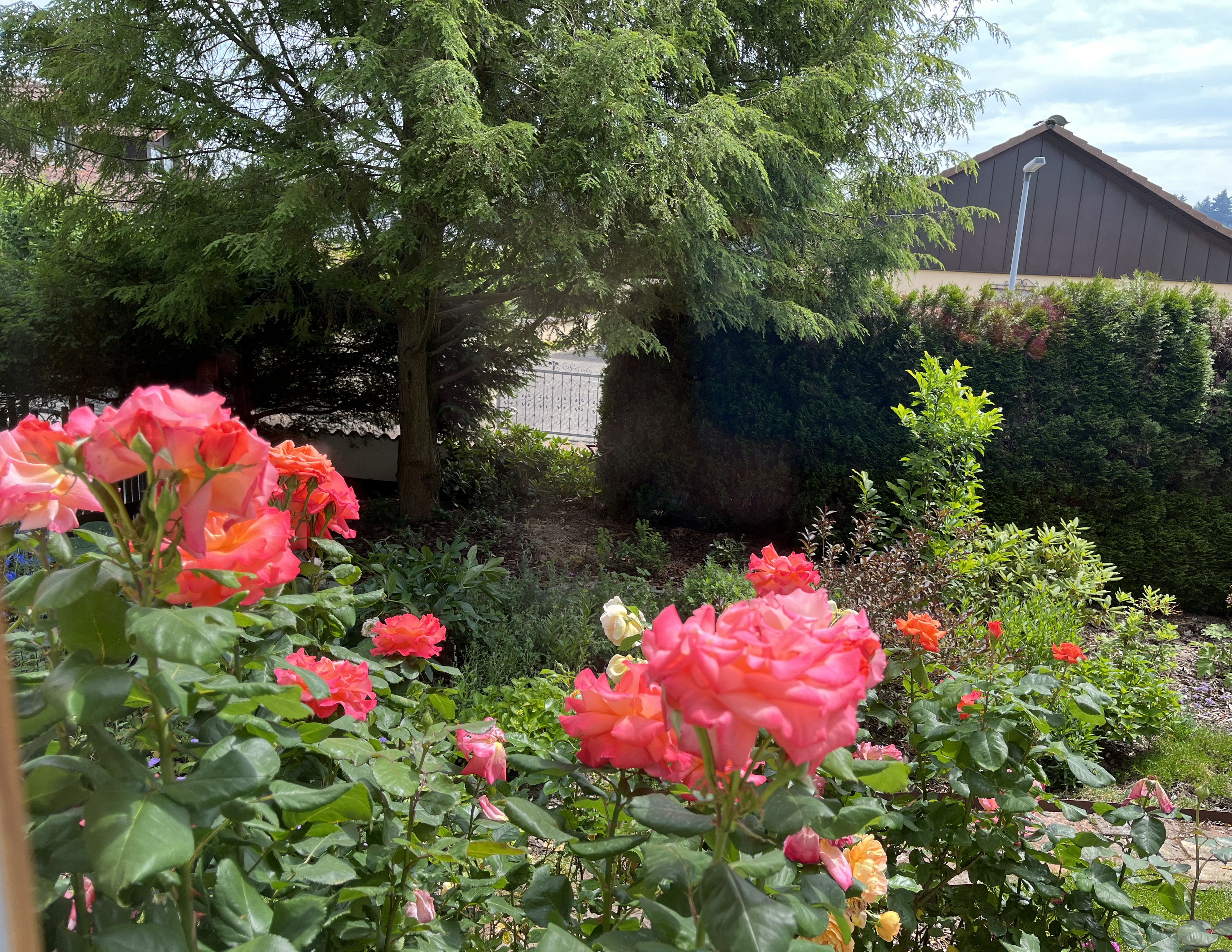


We had a couple of “stormlets” yesterday and overnight but the garden seems to have survived well. But, we had a 15°C drop in temperature! Yesterday it was 35°C and today it will reach only 20°C. But, not worries; summer will be back by tomorrow!
Update 22.06.23: It is hot hot hot! We are expecting 35°C today – way too hot for my taste. The perfect time to put down the tools and appreciate the work that has already been done. Thankfully, things will cool back down again in a day or two. So, here are a few photos I have taken over the past days/weeks.
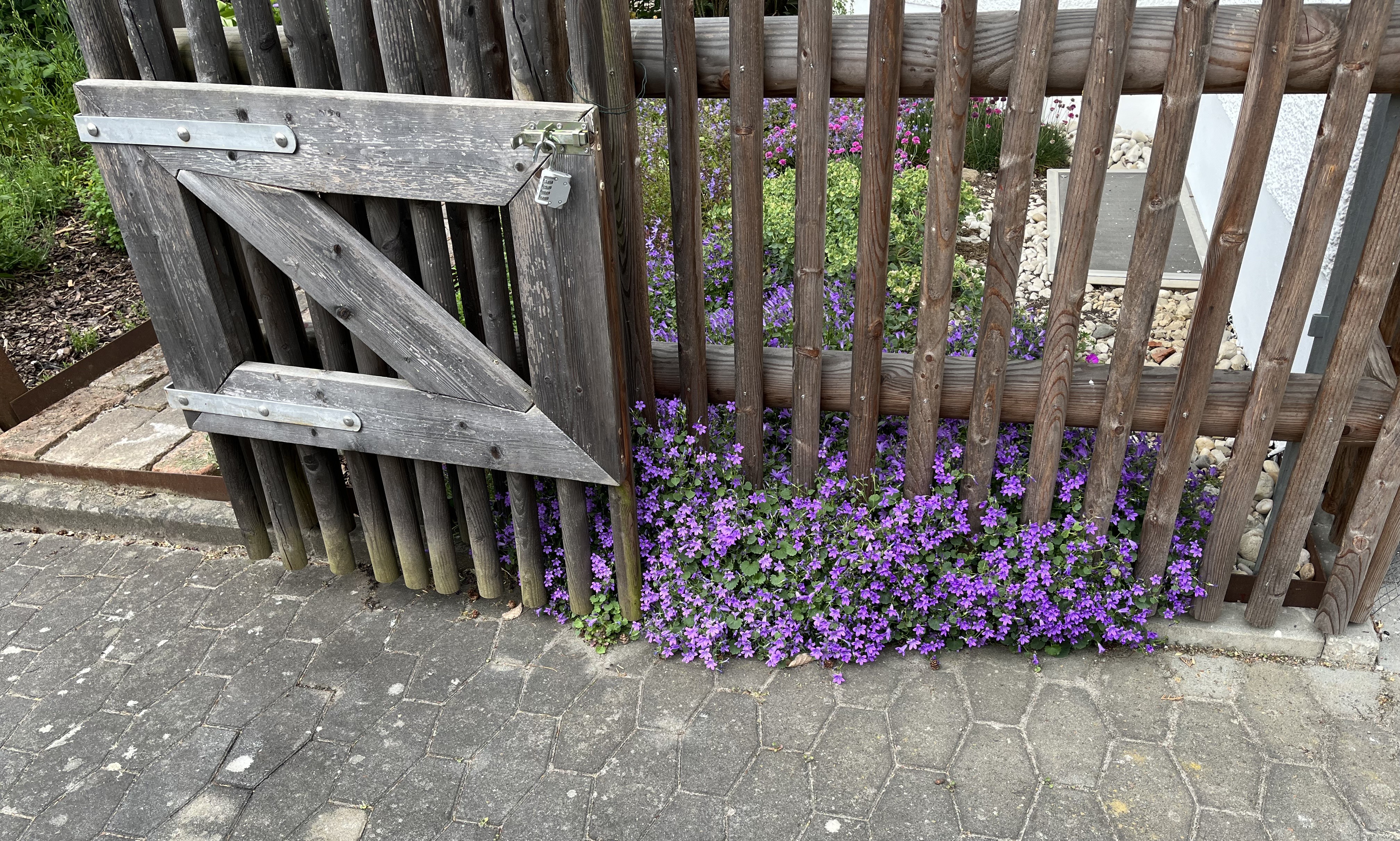
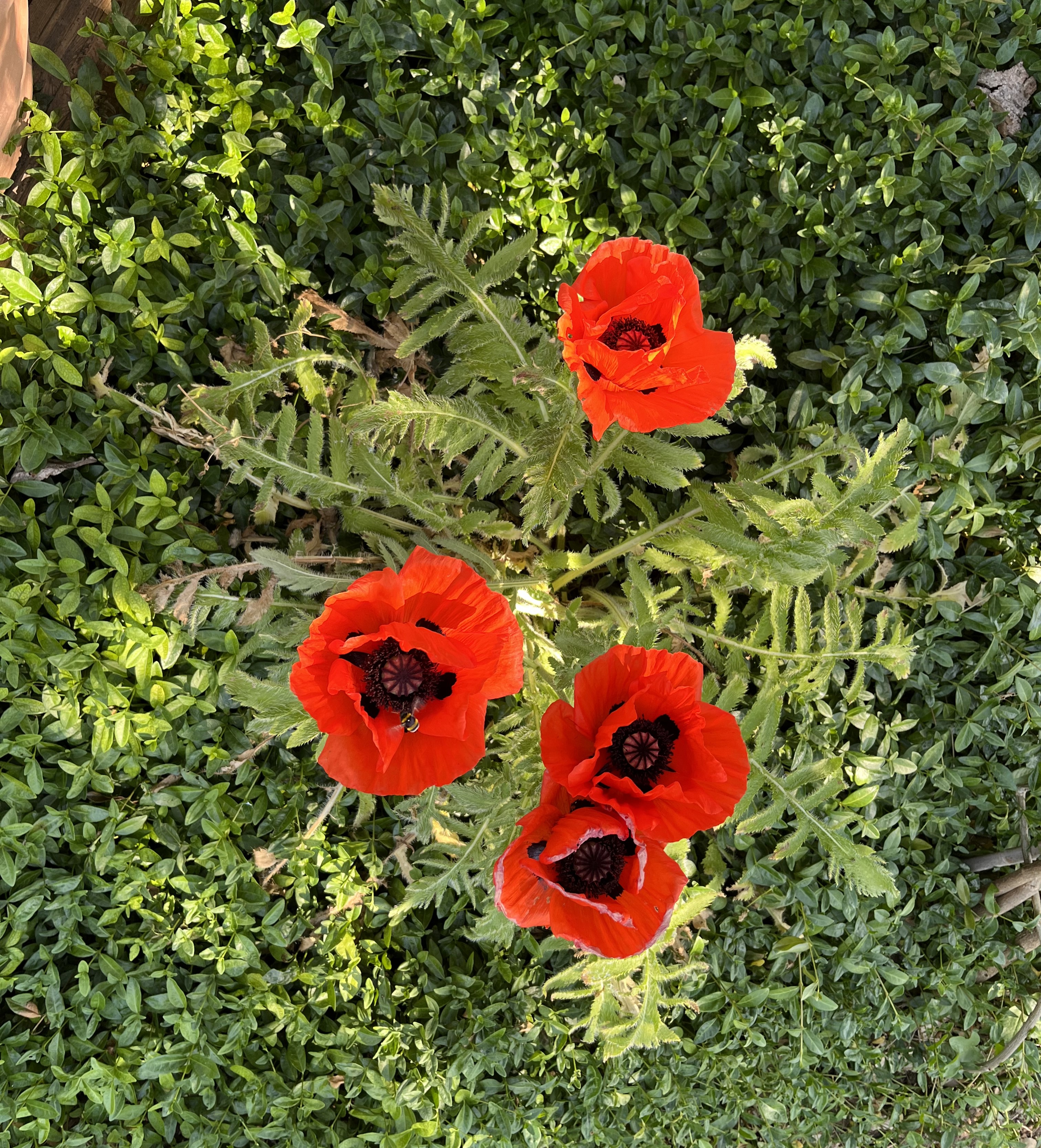
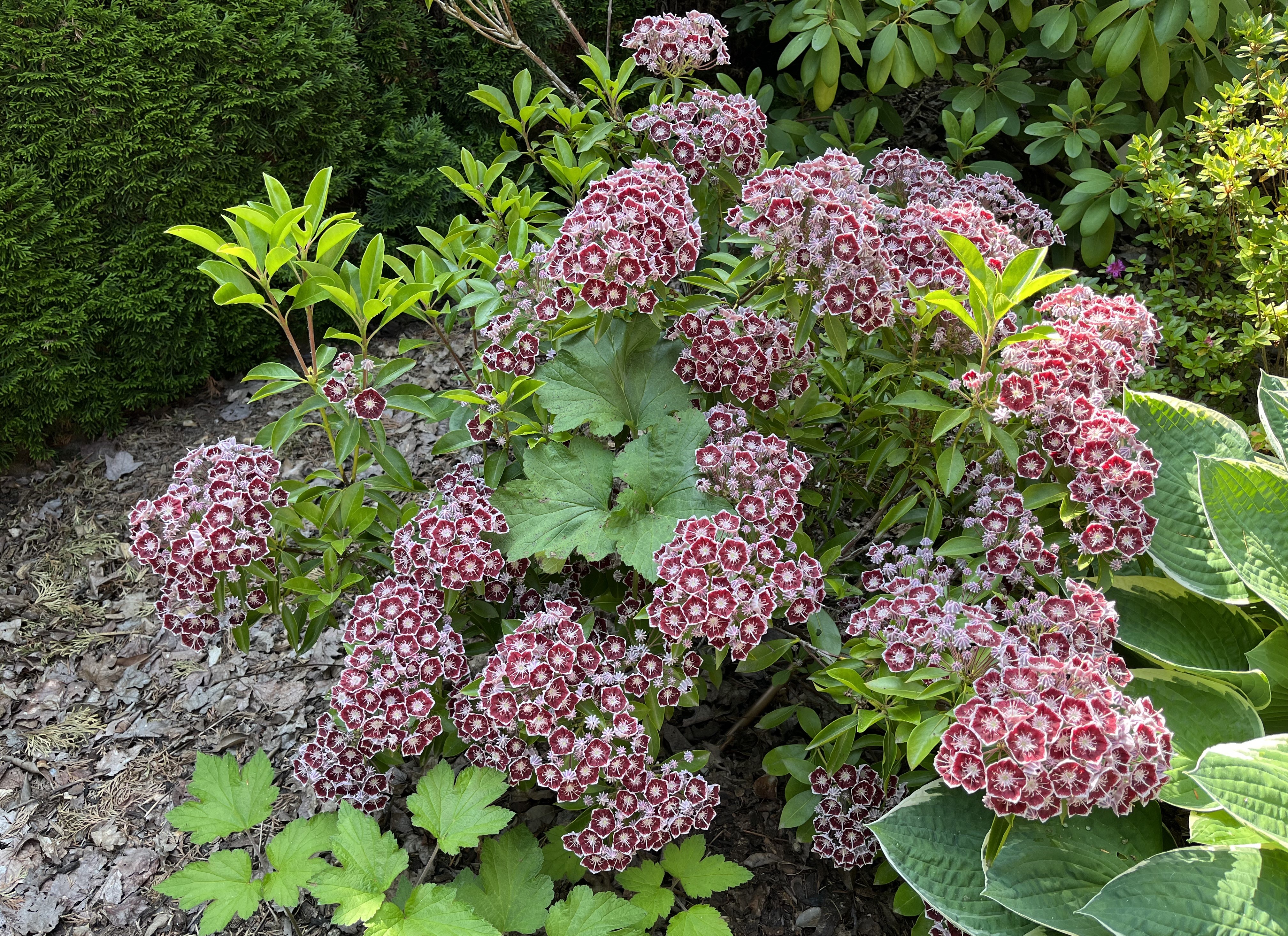
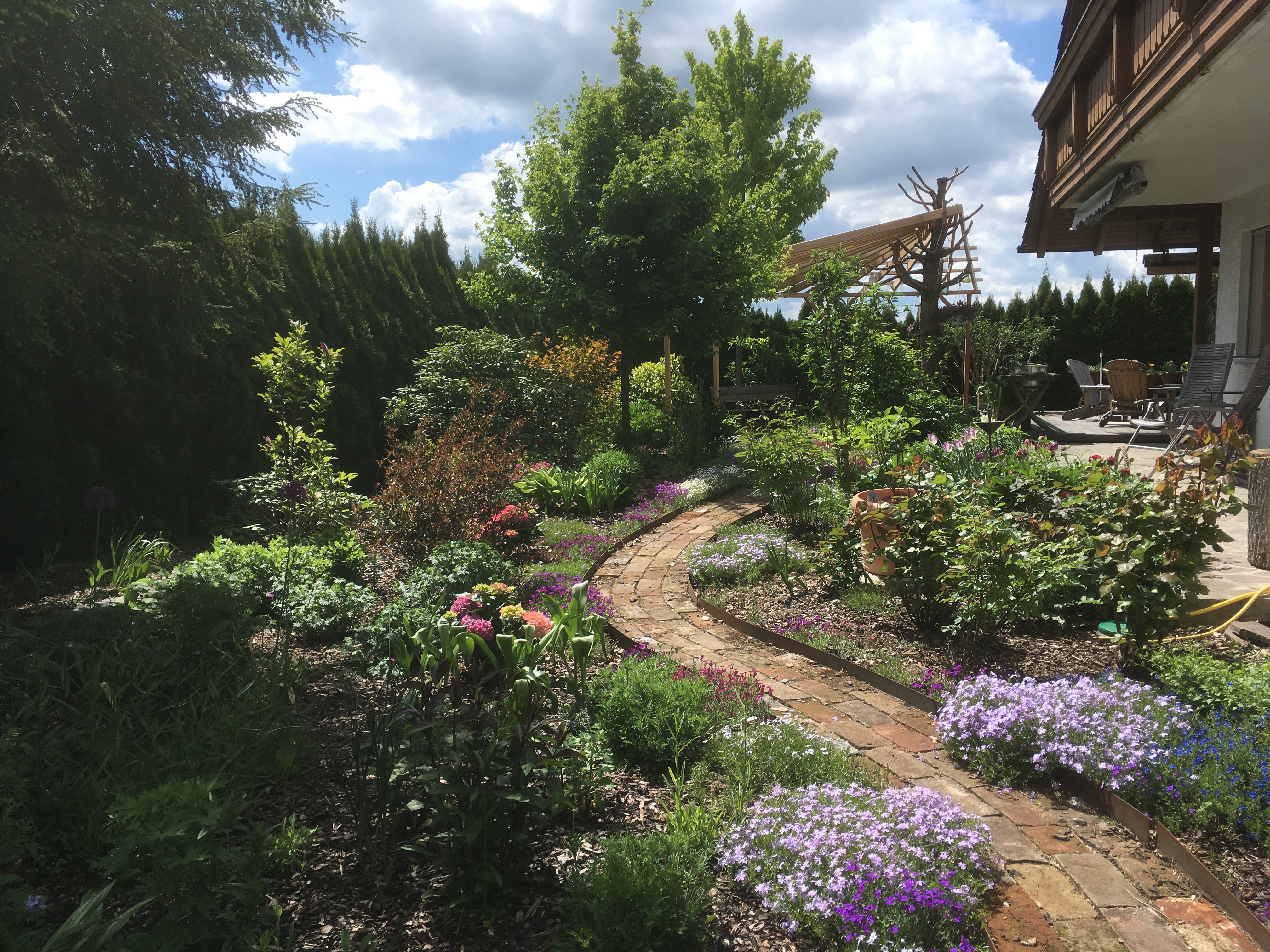

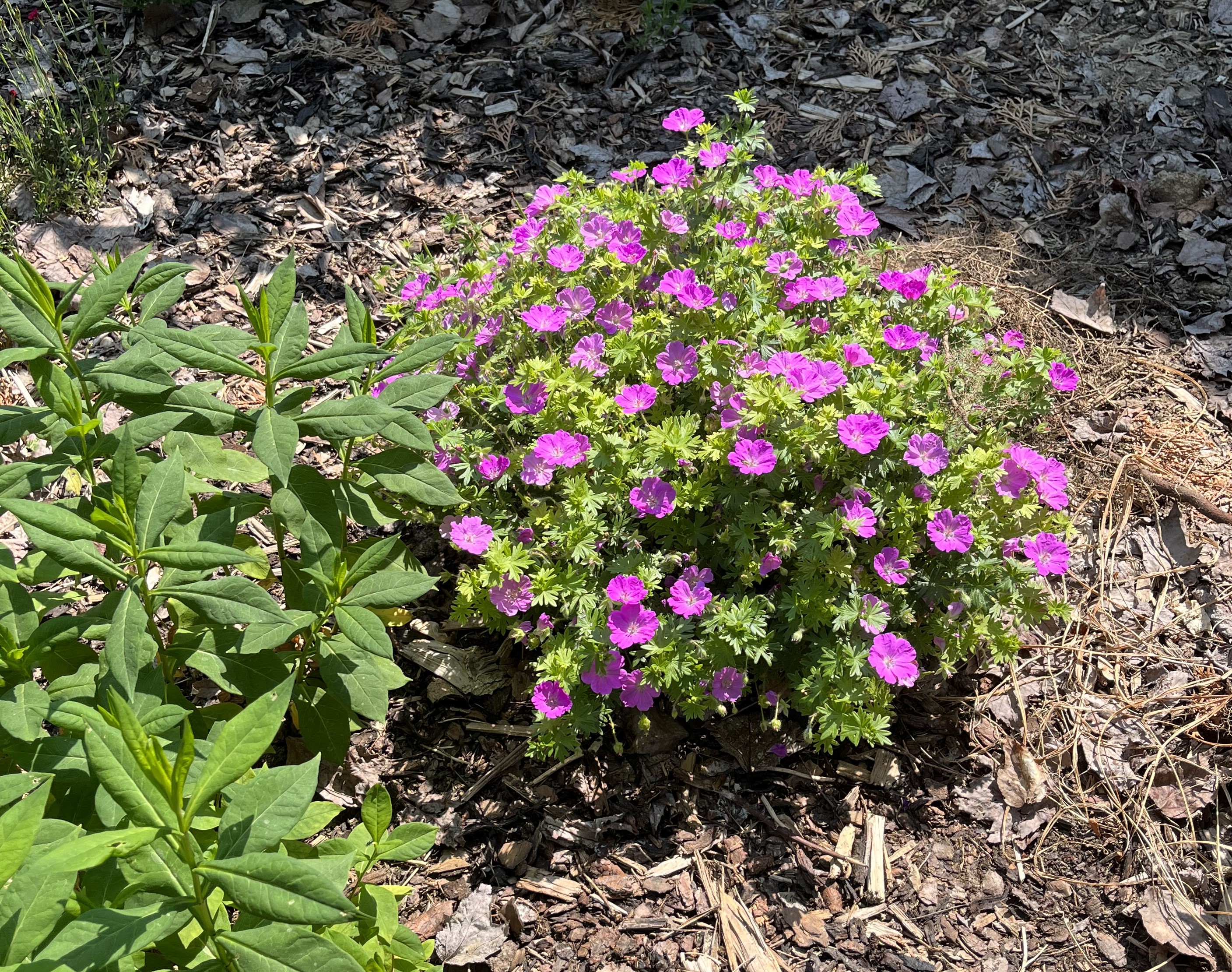

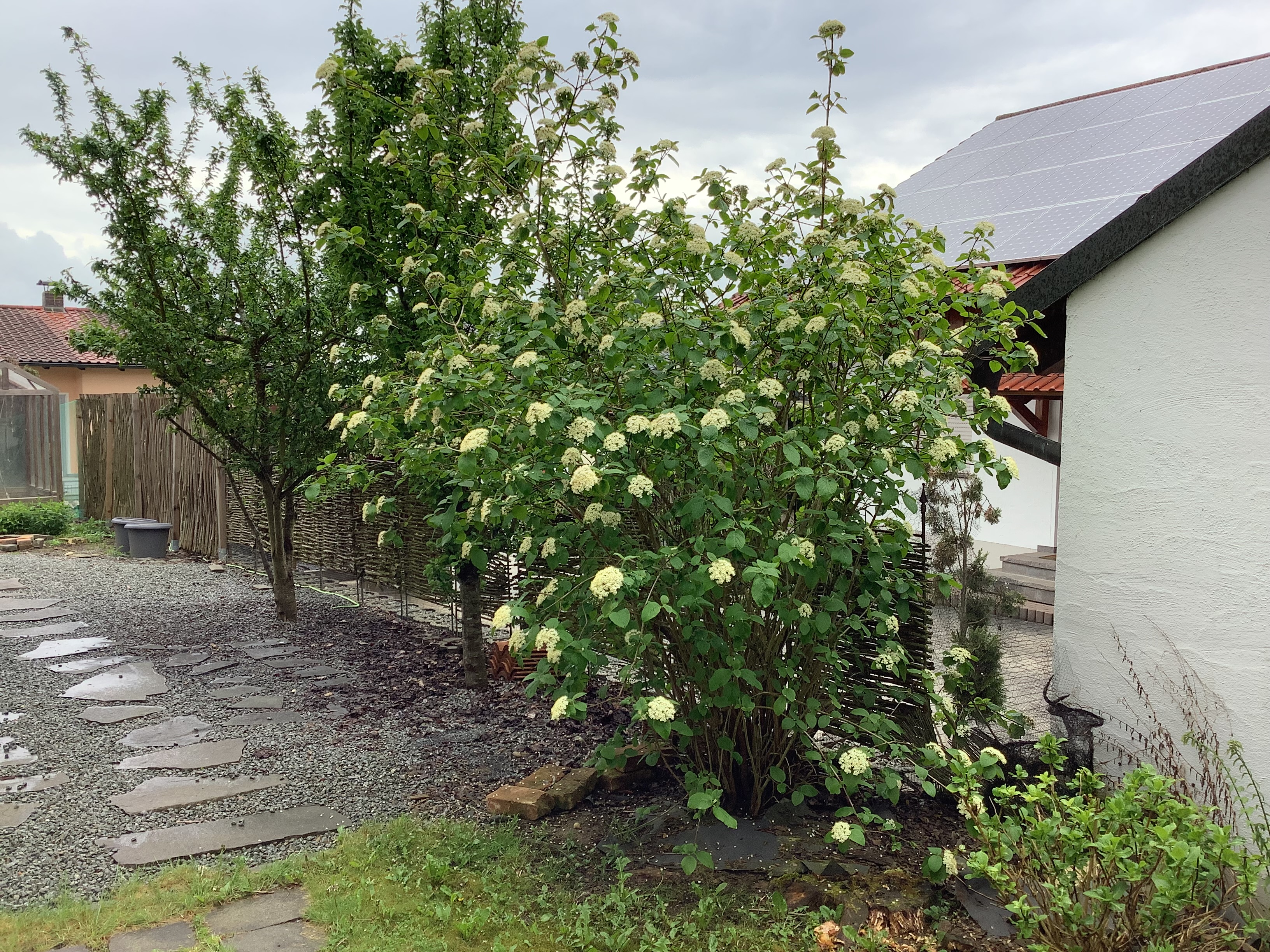
The garden is really beginning to fill out and soon it will be time to trim things back a bit. Until then, I keep busy puttering around, watering, weeding here and there (although thanks to the mulch, I don’t have to weed much on the east side), and I have added a plant or two to the yard … more about that later. Other than that, we are mostly just enjoying the garden and the various shady spots where we can sit back and have a cocktail!
Update 12.06.23: We hobby-gardeners are busy busy busy these days! While I love the sun, we have been having a little too much of it lately. In our part of Germany, we are still doing OK versus other regions. But, our groundwater levels still are not where they should be. Thankfully, we had a day of off and on rain/showers/thunderstorms on Saturday. Nature (and our rainwater barrels) got a nice boost.
This week, I want to take you through the decorative part of our garden. No worries! The veggies will get their due. I kind of divide our garden into four areas. North side: that’s where the driveway is and, behind the garage, where my “messy corner” is. East side: that’s where I am attempting a kind of cottage garden look. South side: the terrace and the Thyme Walk. West side: raised beds, tomato greenhouse.
Since the North side is kind of ho-hum, let’s start with the east side! This is where we used to have nothing but lawn. Over the years, I started reducing the lawn surface bit by bit until one day I just decided to eliminate it completely and replace it with a pathway bordered on either side by what the British refer to as an herbacious border. We’ll take a closer look.
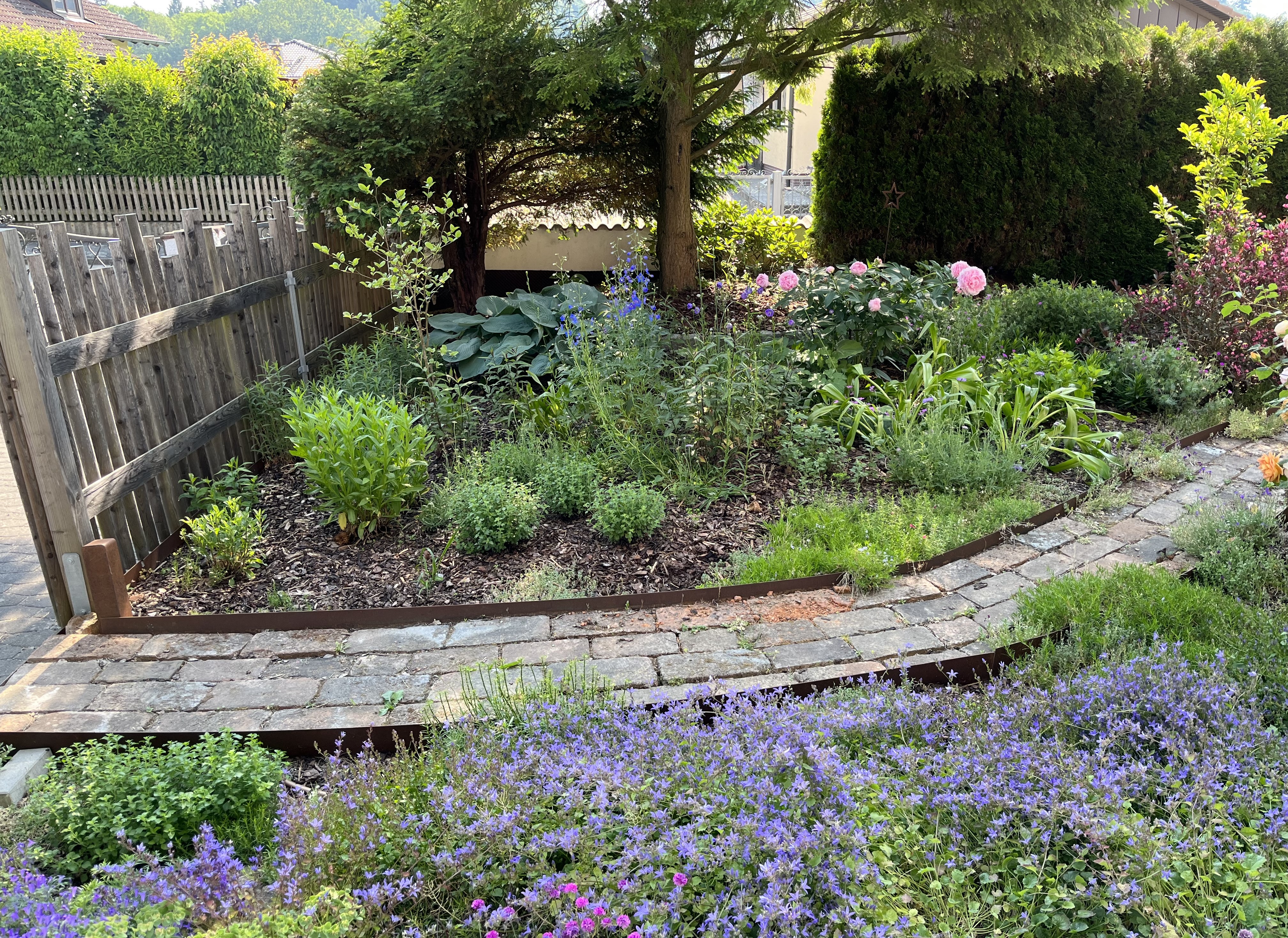
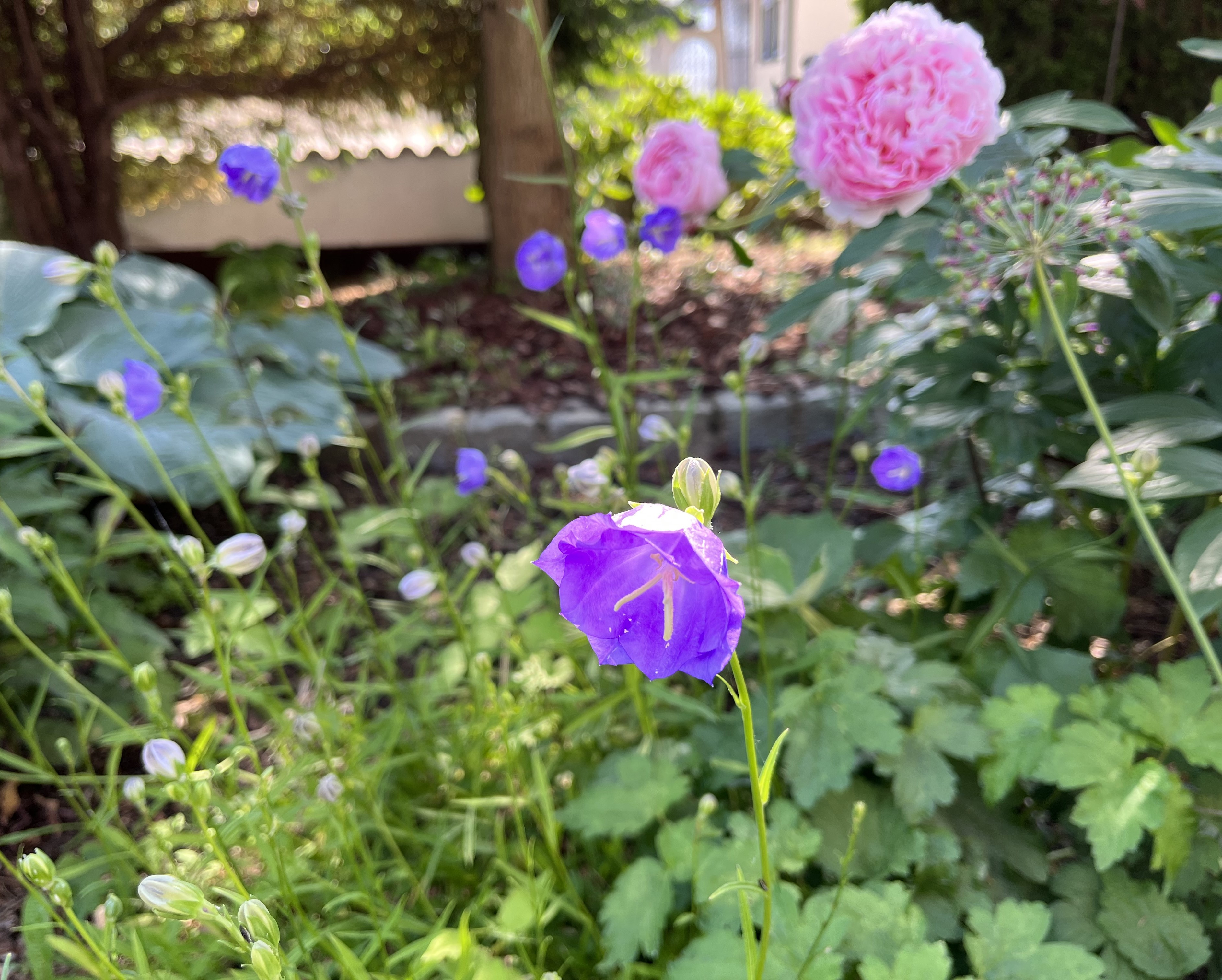
Above is the view from the kitchen window – right is a close up of the purple campanulla and pink peonie. The tree you see towards the left of the picture above, near the fence, is a nod to my father. This is Stewartia pseudocamellia. It is still very young but managed to blossom last year for the first time! It’s blossoms are white with yellow stamens and appear between June and August.
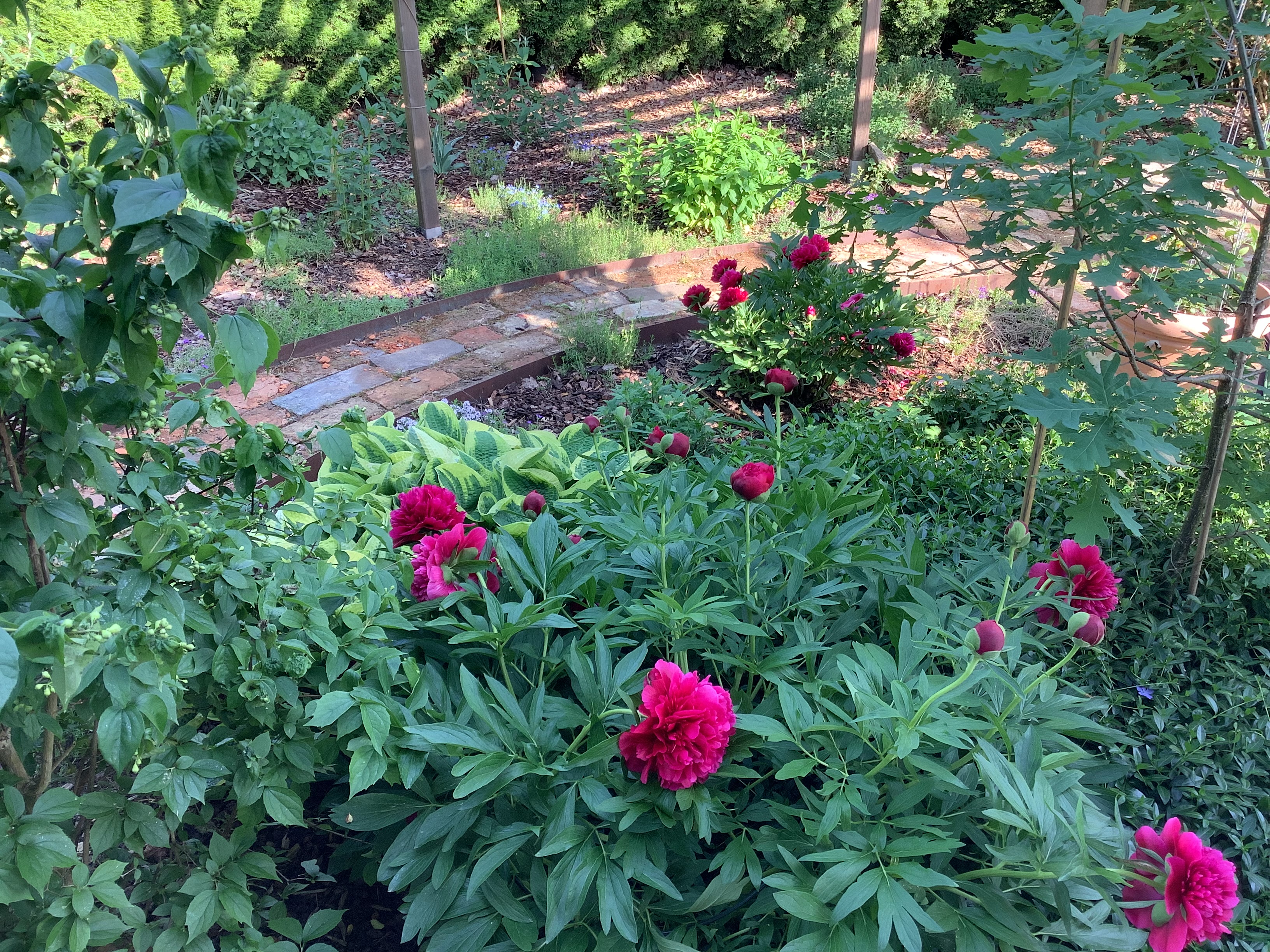
The pink peonie is one of several peonies in the garden. Although the blossoms are short-lived, they pack quite a whallop! I inherited a red peonie (i.e., it was in the garden when we moved in) and divided it over the years. It is a different variety than the others as it blooms much earlier than the others. I have two other peonies but they are too young and haven’t blossomed yet this year. Here are some photos of the various peonies.
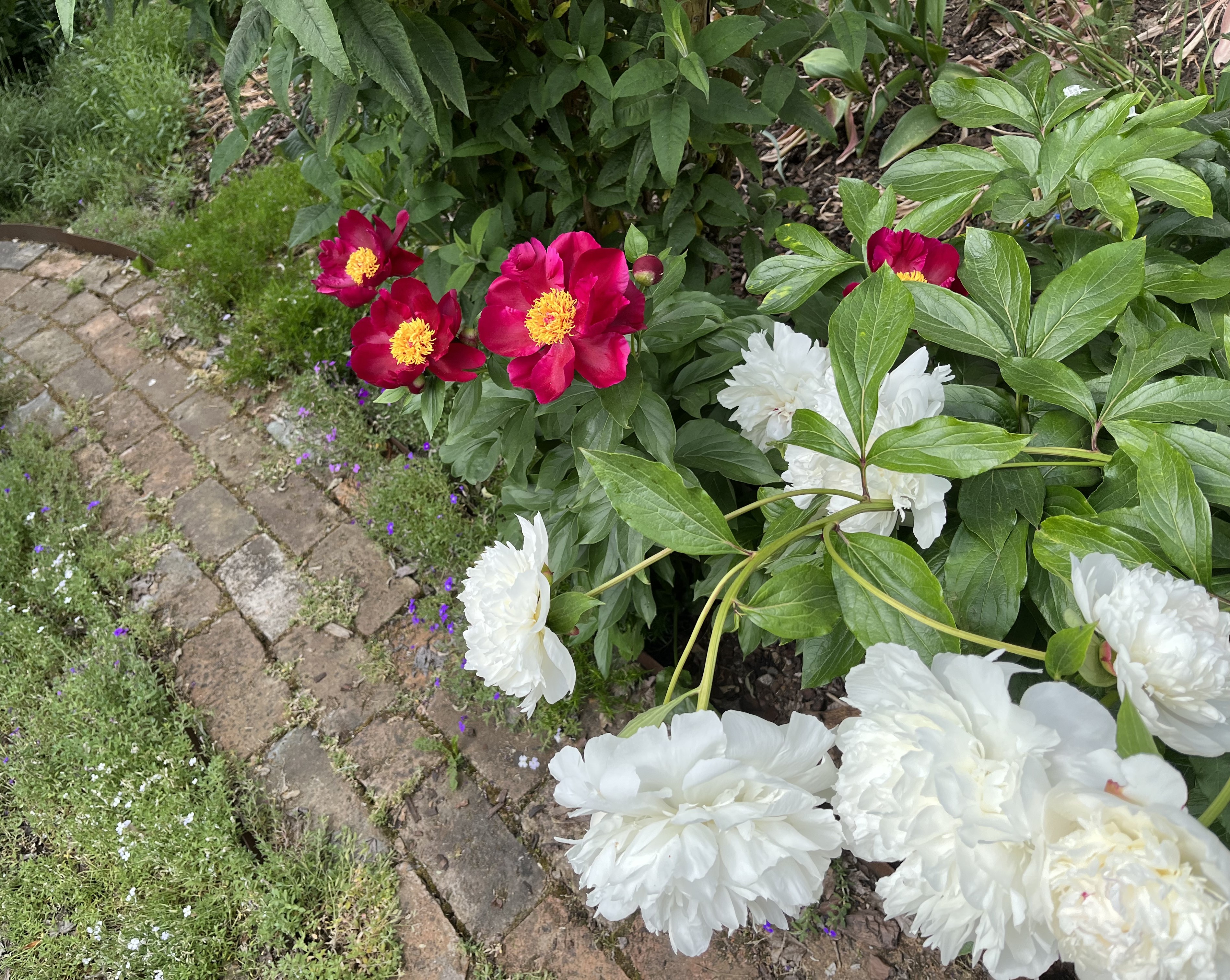
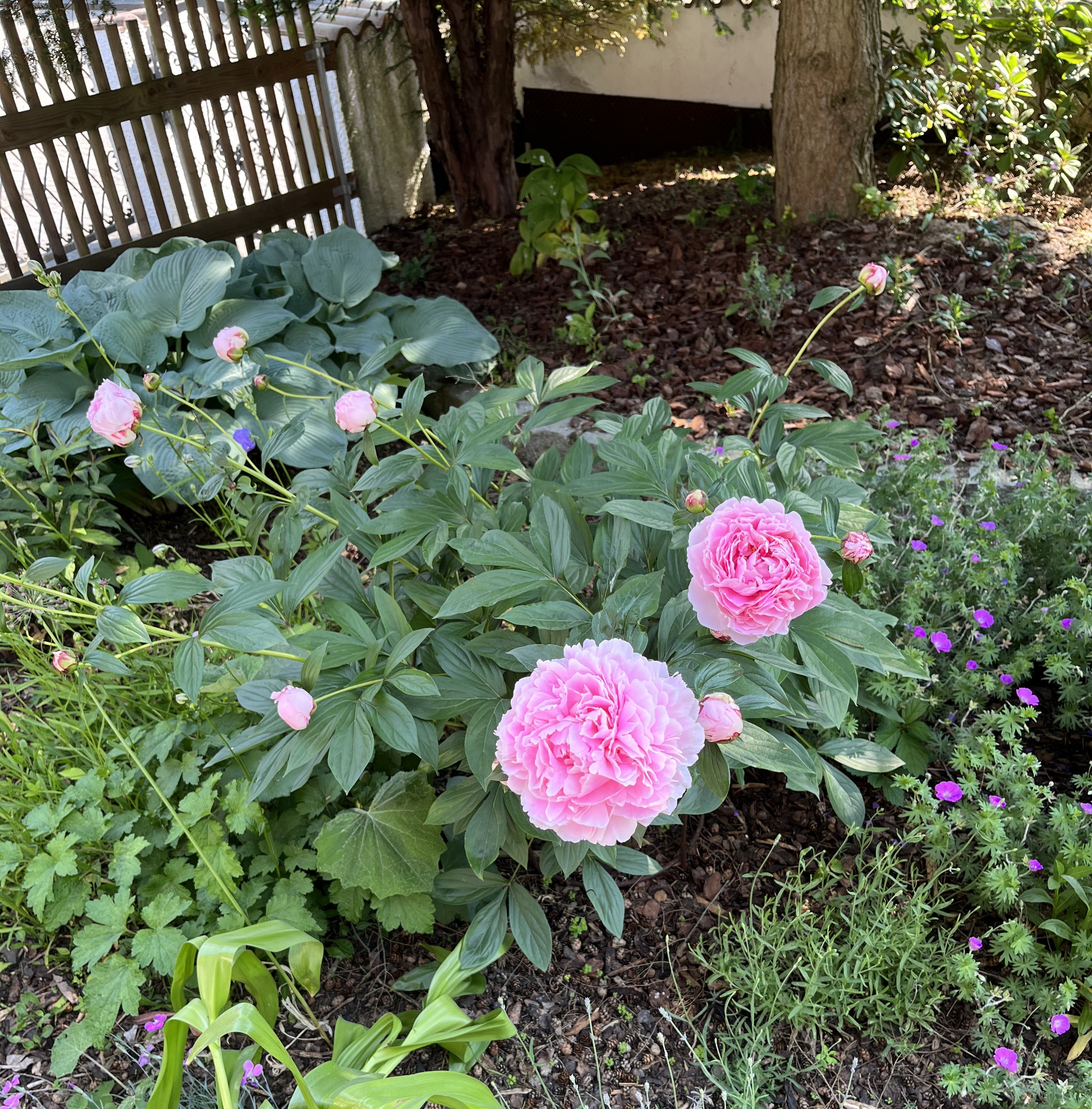


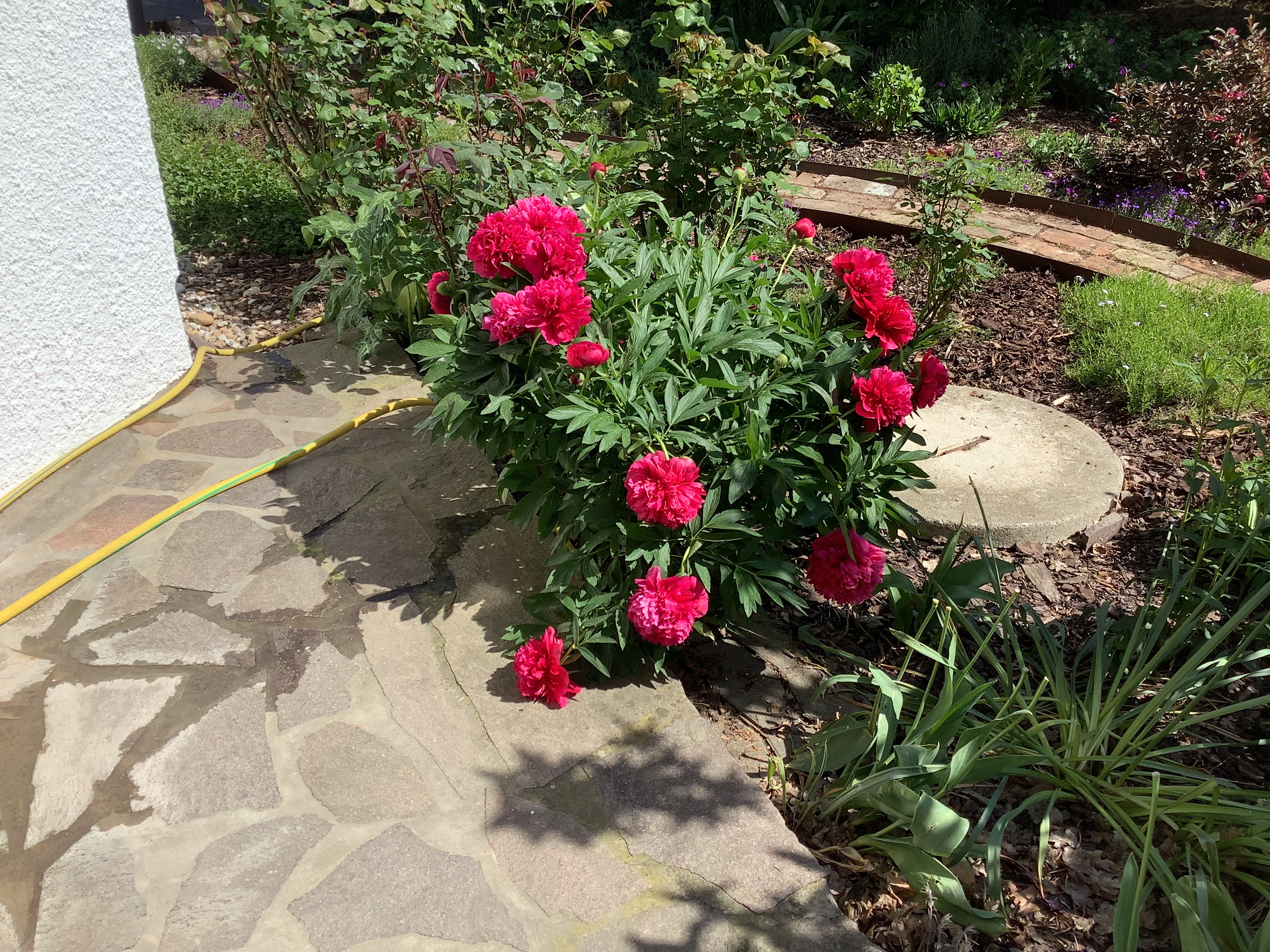
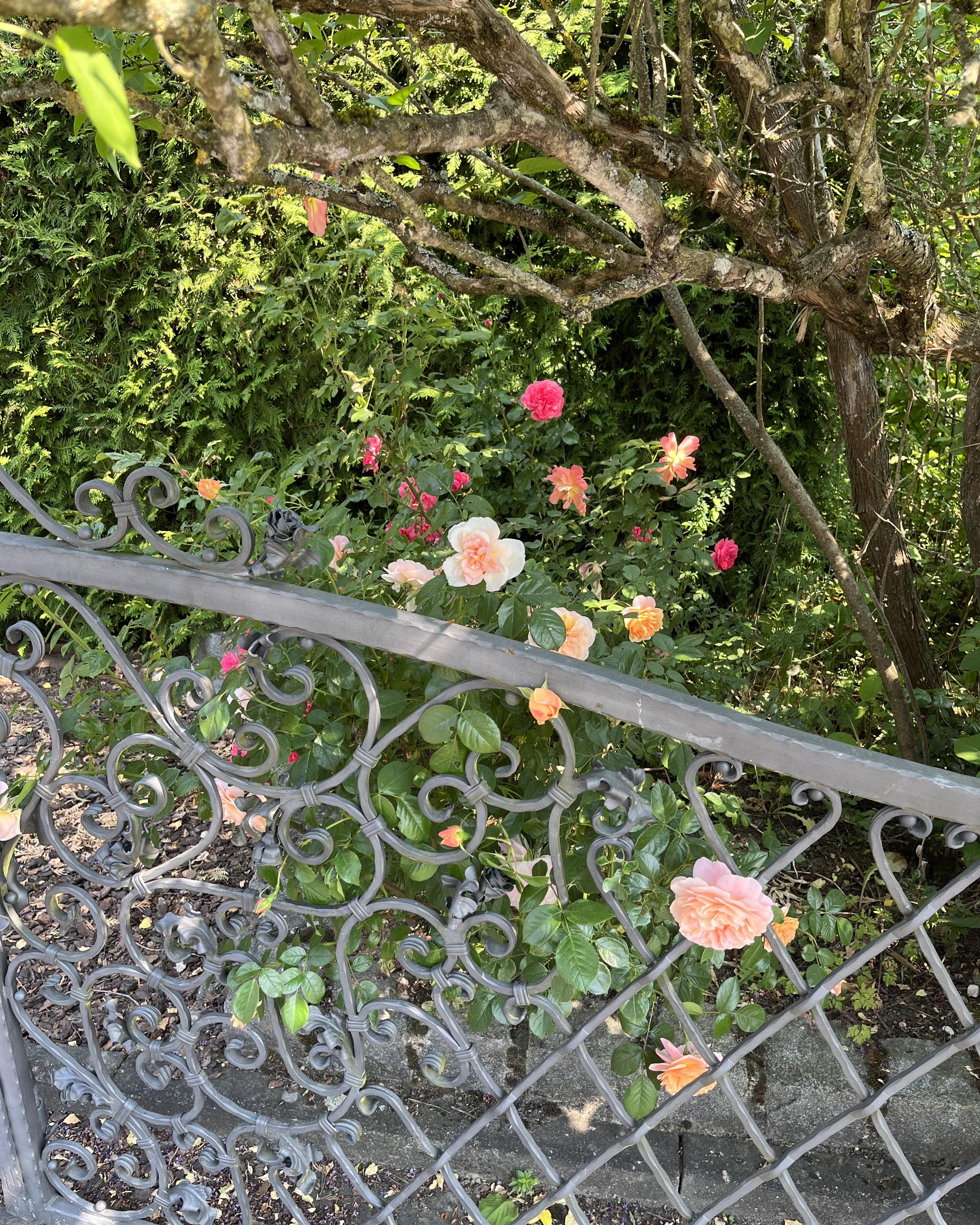
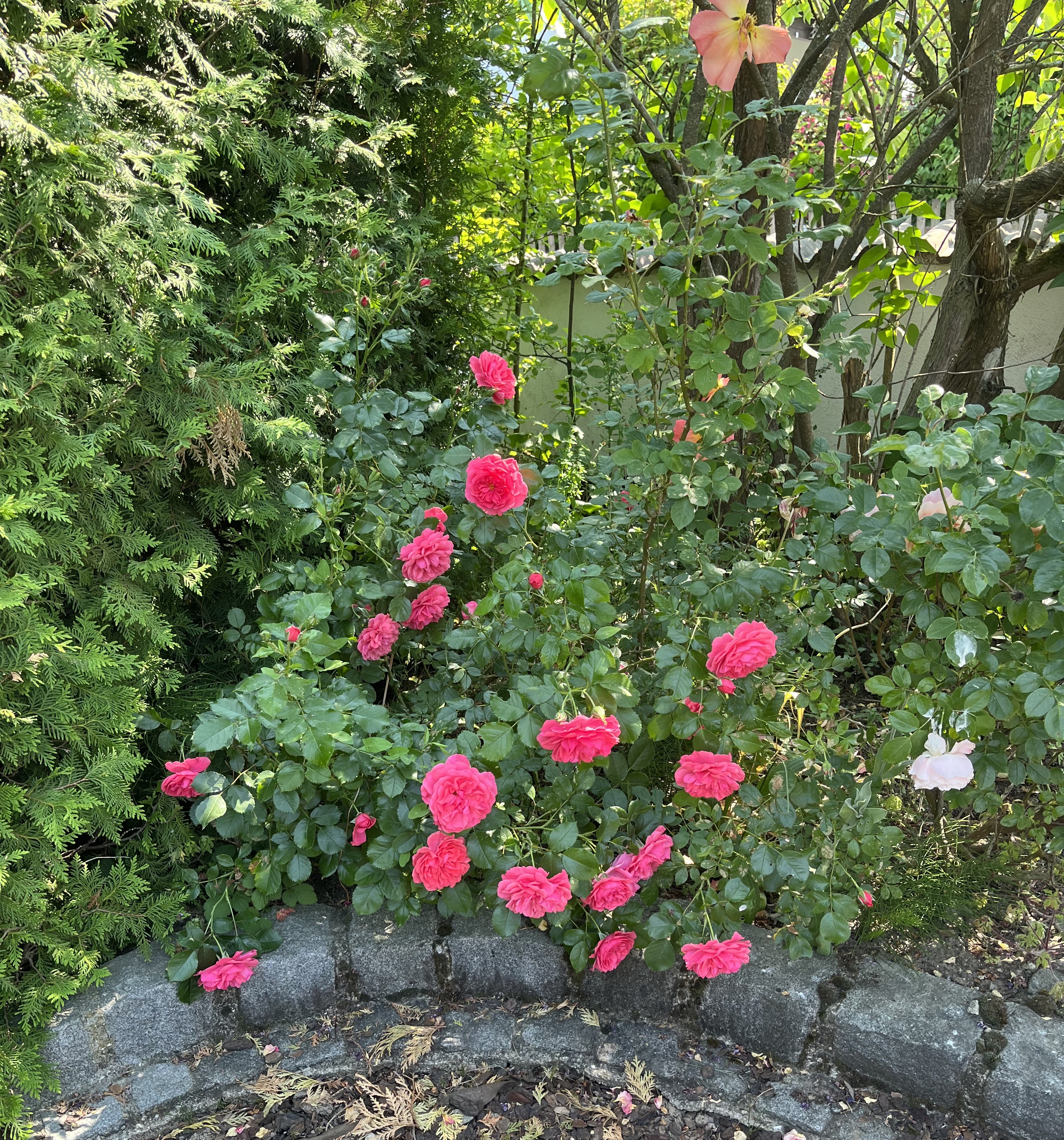
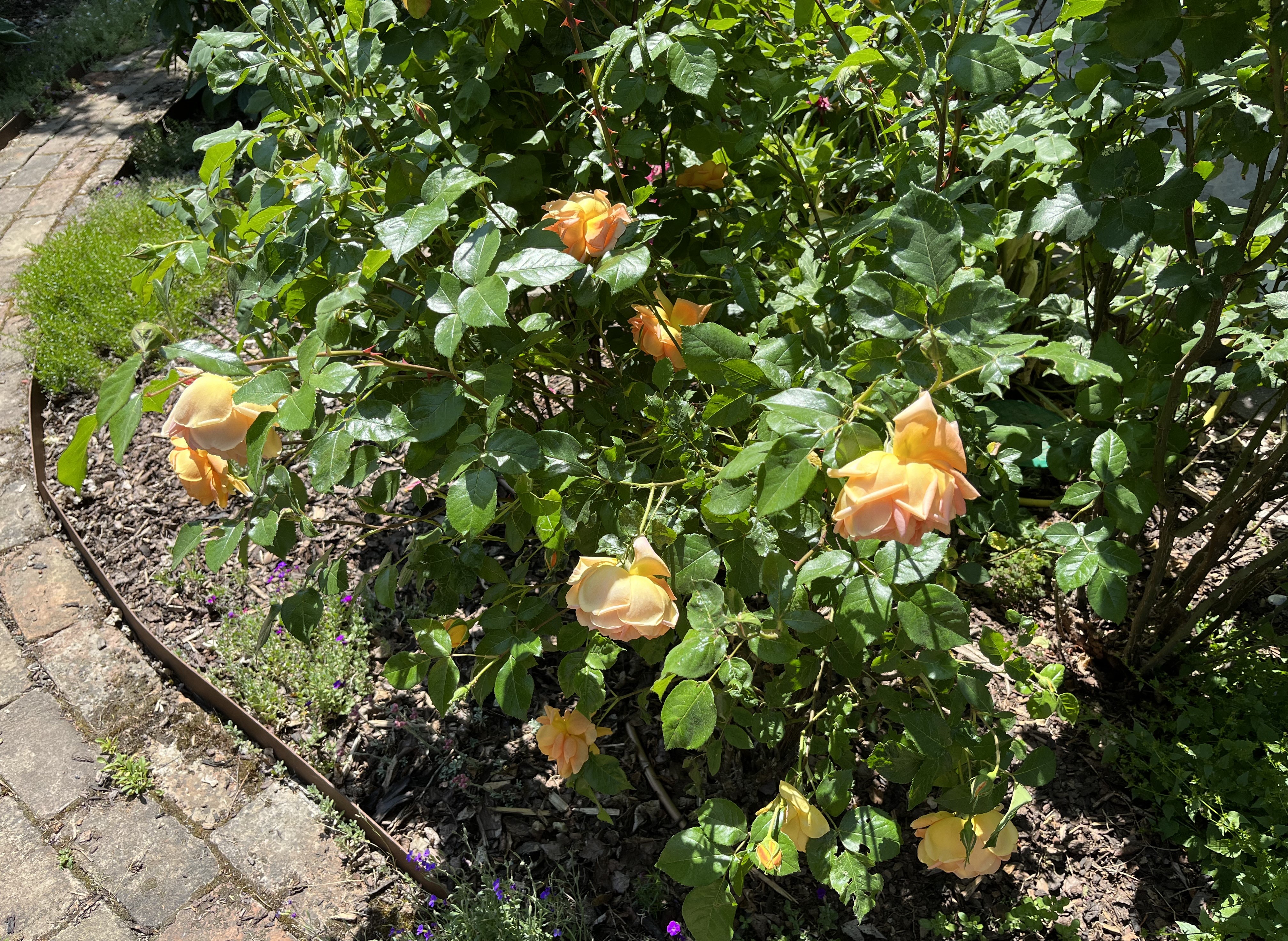
I also inherited a bunch of roses when we moved in. I have never been much of a rose fan. Sure, they are beautiful but finnicky. And, as I have always said, the right to exist in my garden depends on your ability to survive me (I can be a really lazy gardener sometimes!). If I have to hold your hand just so you bloom, go look for another garden!
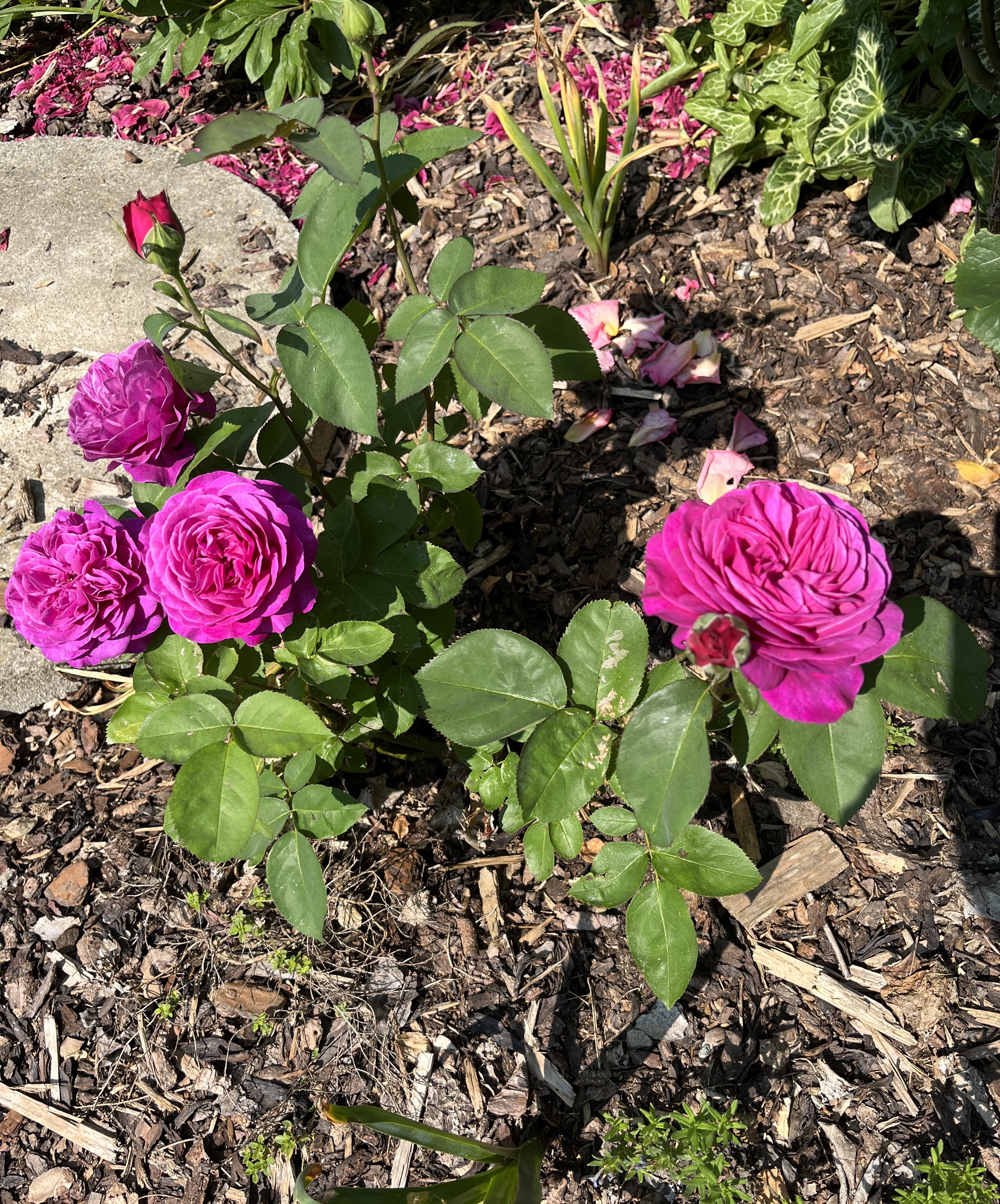
That being said, what do you do with a bunch of roses you don’t want? You can’t just throw them out. So, I selected the roses I particularly didn’t like (they were a neon shade of pink – yuck) and I gifted them to a neighbor. Once I decided to redo the east side, I pulled them all out and planted them in two spots for maximum impact: several cluster around the bay window and the rest decorate the right side of the driveway entrance, as you drive in. I don’t do anything special for these plants. Some years are great; some years are not so great. All I do is prune them down either at the end of the year or in early Spring and make sure they have enough water via the irrigation system underneath the mulch. That’s it. Looks like this is a good year.
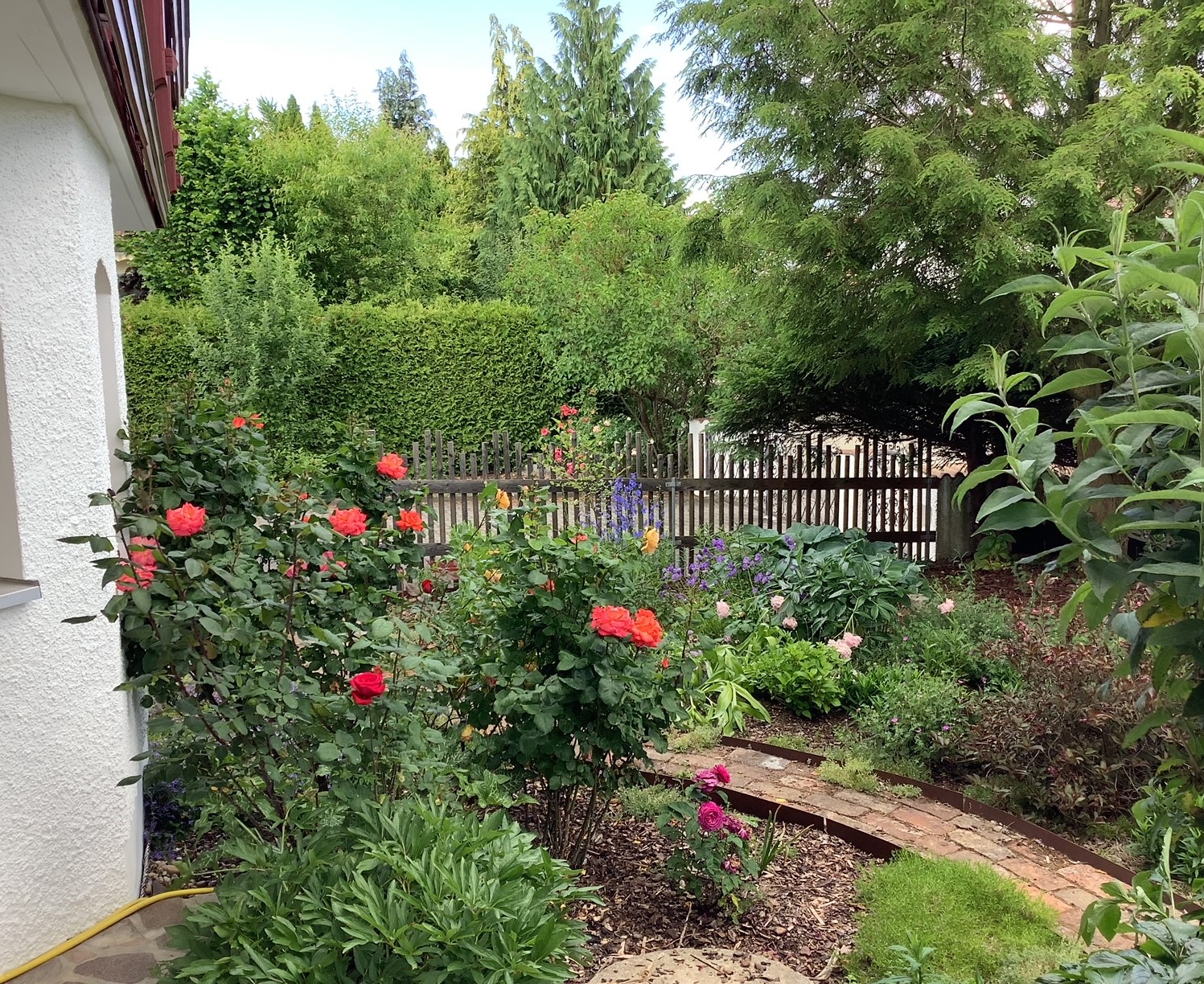
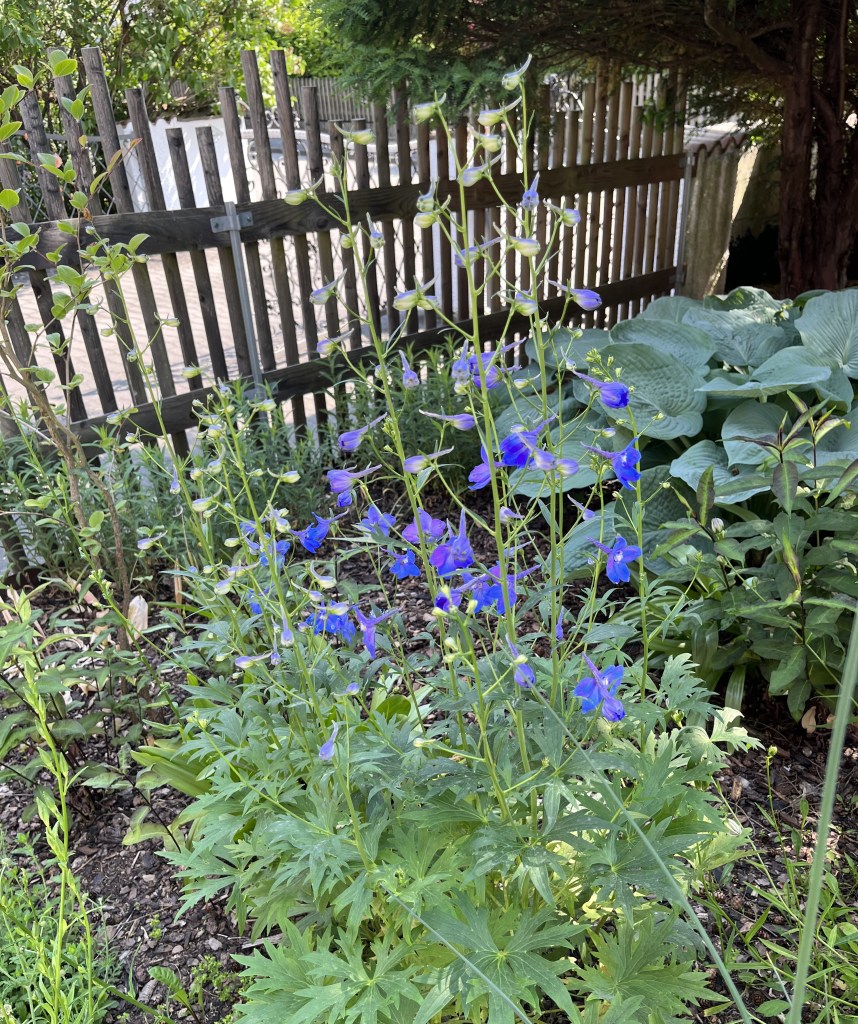
Lastly, I wanted to mention Delphinium. In the photo above, you can see that little splash of blue in the middle – that’s Delphinium. These are very finnicky plants, at least in my garden. But, I can’t resist that blue! Here is a close up.
Stay tuned for the next update, when I’ll showcase , among other things, Mountain Laurels/Rhododendrons/Azaleas … my homage to my New England home region!
Update 08.06.23: Things are looking really good in the garden. June is probably one of the best months for blooming plants here. And, while I will be adding posts showing the garden and the plants in bloom right now, I thought I’d start off by showing you the”Thyme Walk”.
When I first started changing the garden around, I wanted to eliminate as much grass as possible. Grass is basically dead surface area for insects and butterflies; it is a pain in the neck to keep in good shape requiring just the right kind of mowing, fertilizing, and aeration; and, it requires watering. Since our summers are getting dryer and dryer, and our ground water levels keep falling, there is just no justifiable reason to waste water on lawns.
Using natural stone slabs, and with the help of a couple of very strong young men, we made a walk way out of stone with about 3-5 cm of soil between the stones. In between the stones, I planted over 120 tiny little creeping thyme plants (Thymus serpyllum ‘Coccineus’). Thyme can be a great plant for dry, hot climates … not what you generally think of when you think of Bavaria; but our summers are becoming more and more southern European. They have taken root nicely over the past 7 or 8 years and the wild and honey bees just love them.
But, while I considered how I would trim the plants when they grew too high, I failed to consider that creeping Thyme, well, creeps. That means, the plants require pruning horizontally more than vertically. Which leads me to admit: if I had to do it over again, I think I’d rethink this particular gardening idea.
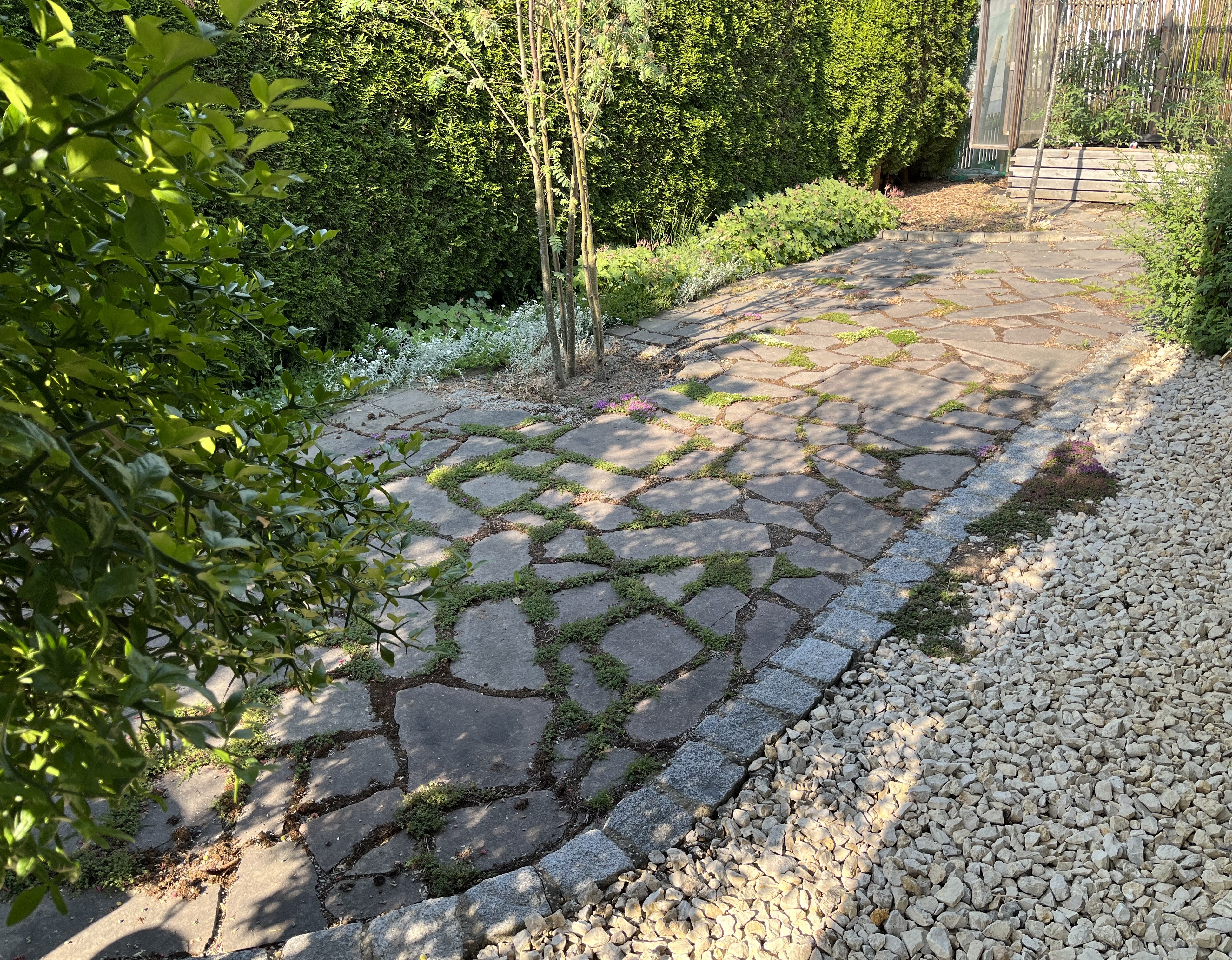
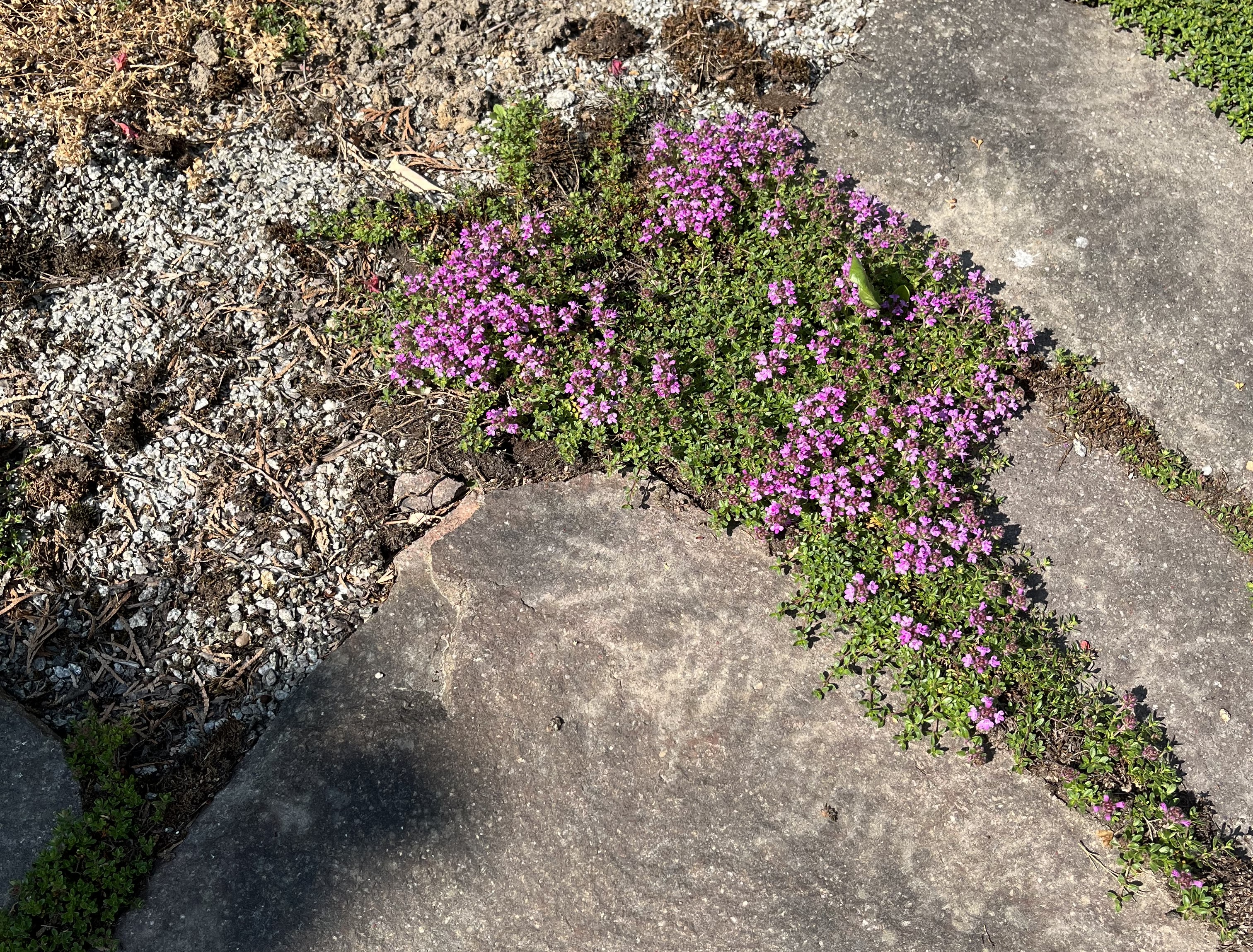

To get the above results requires pruning once, but really, twice a year – at the beginning and towards the end of the growing season. And, the only solution I have found to pruning horizontally is to use gardening scissors and cut/trim along the edges of the plants until I get close to the edge of each stone. It takes a lot of time (no pun intended ;-)).
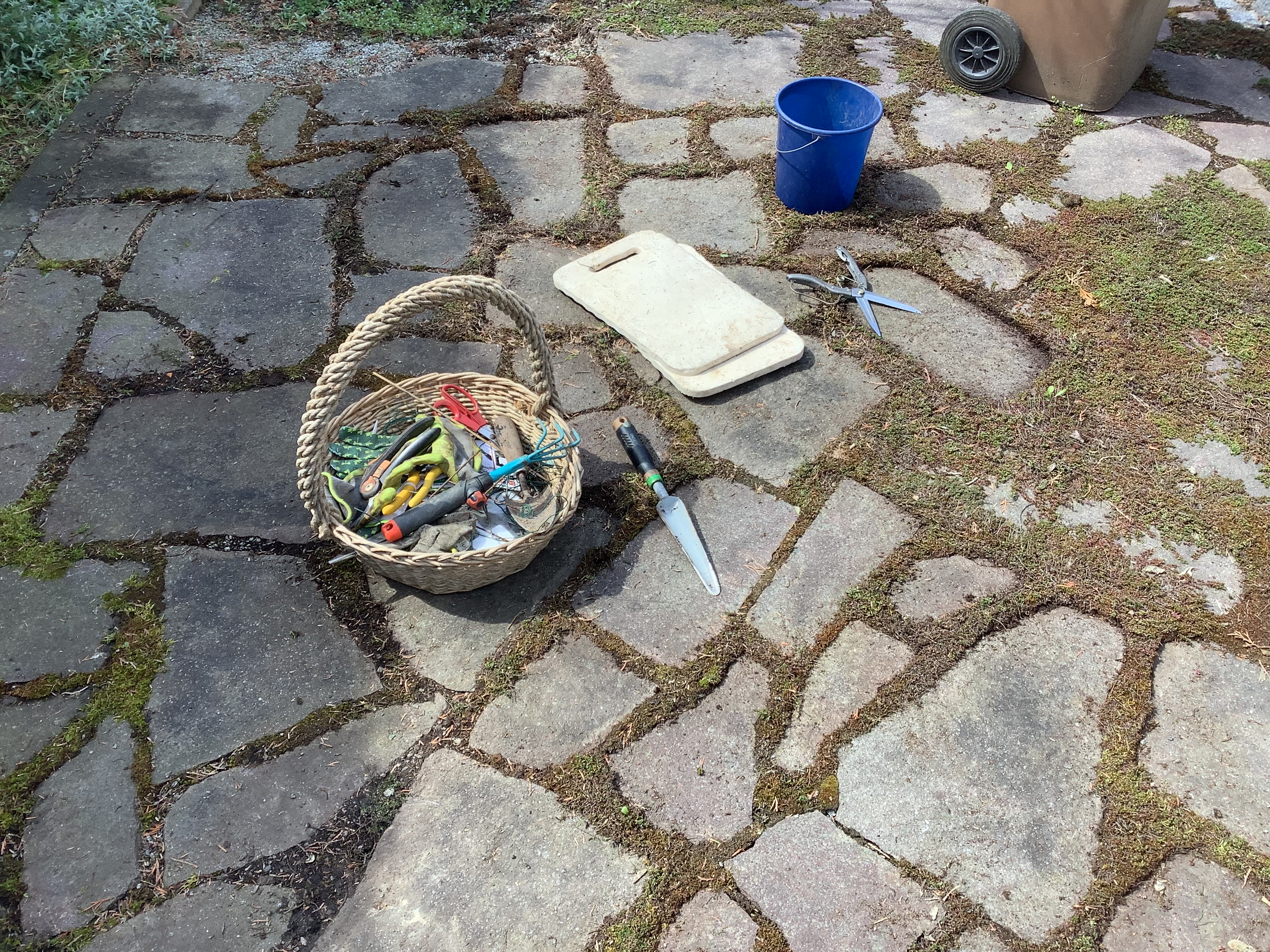
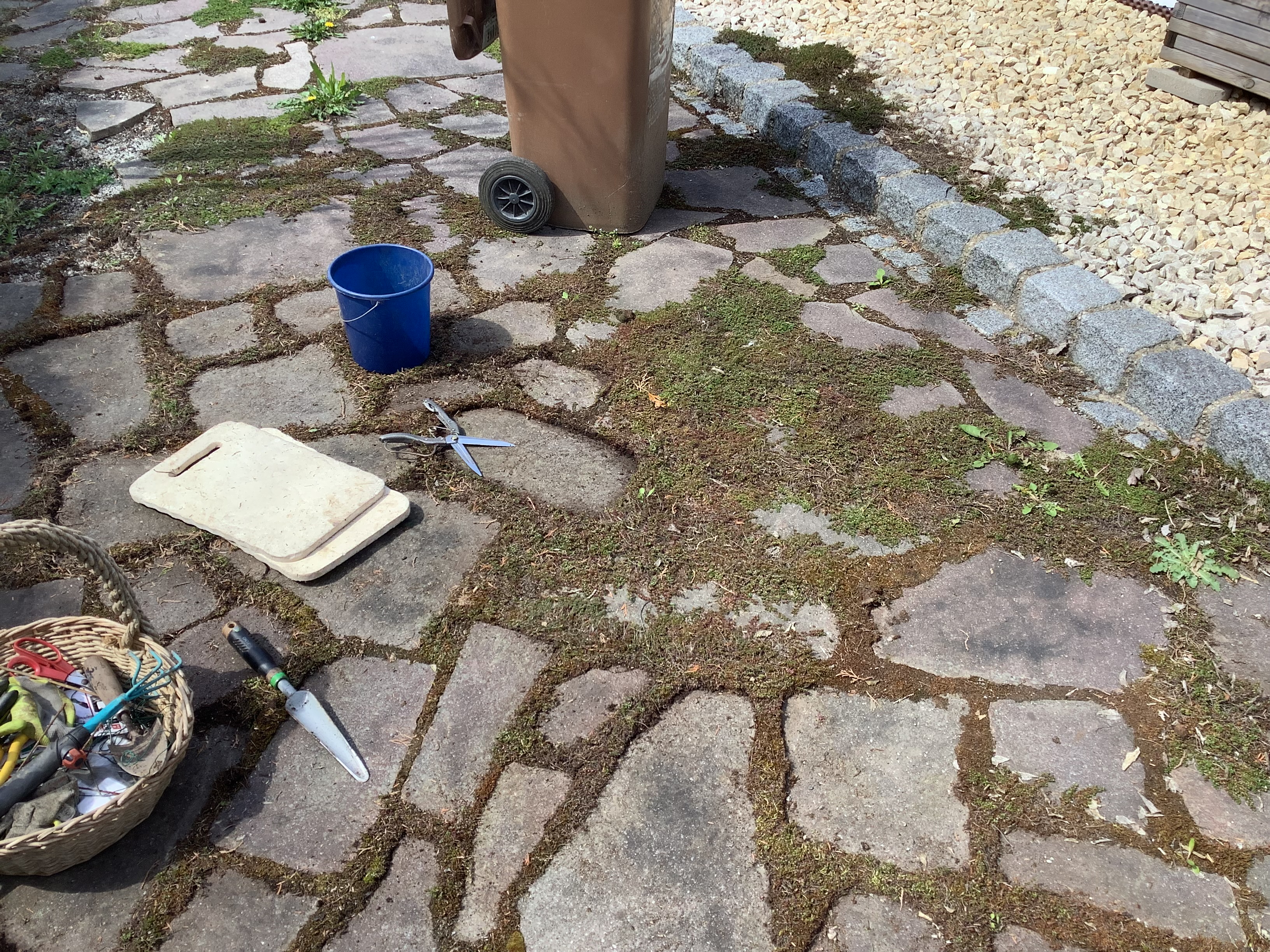
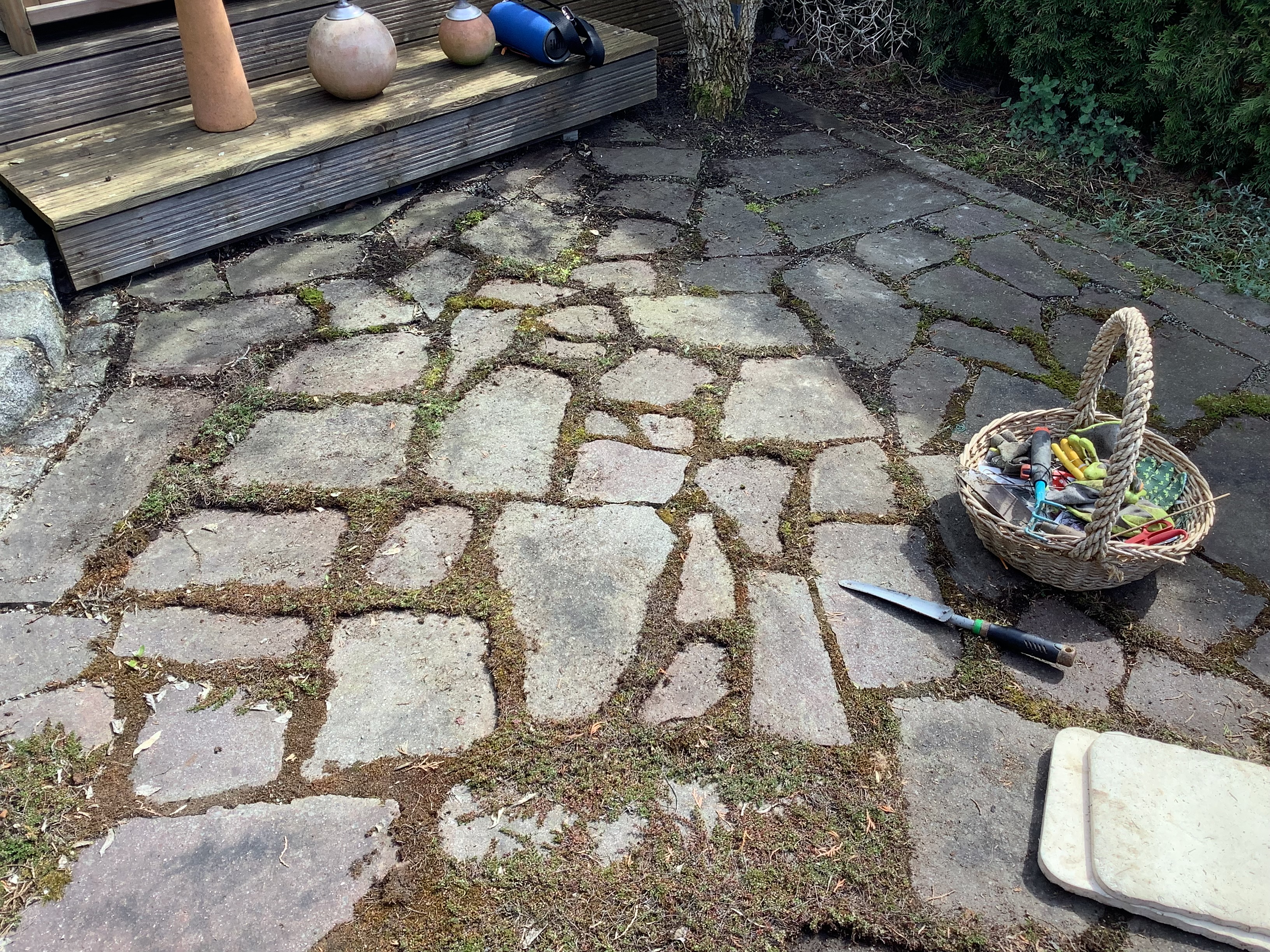
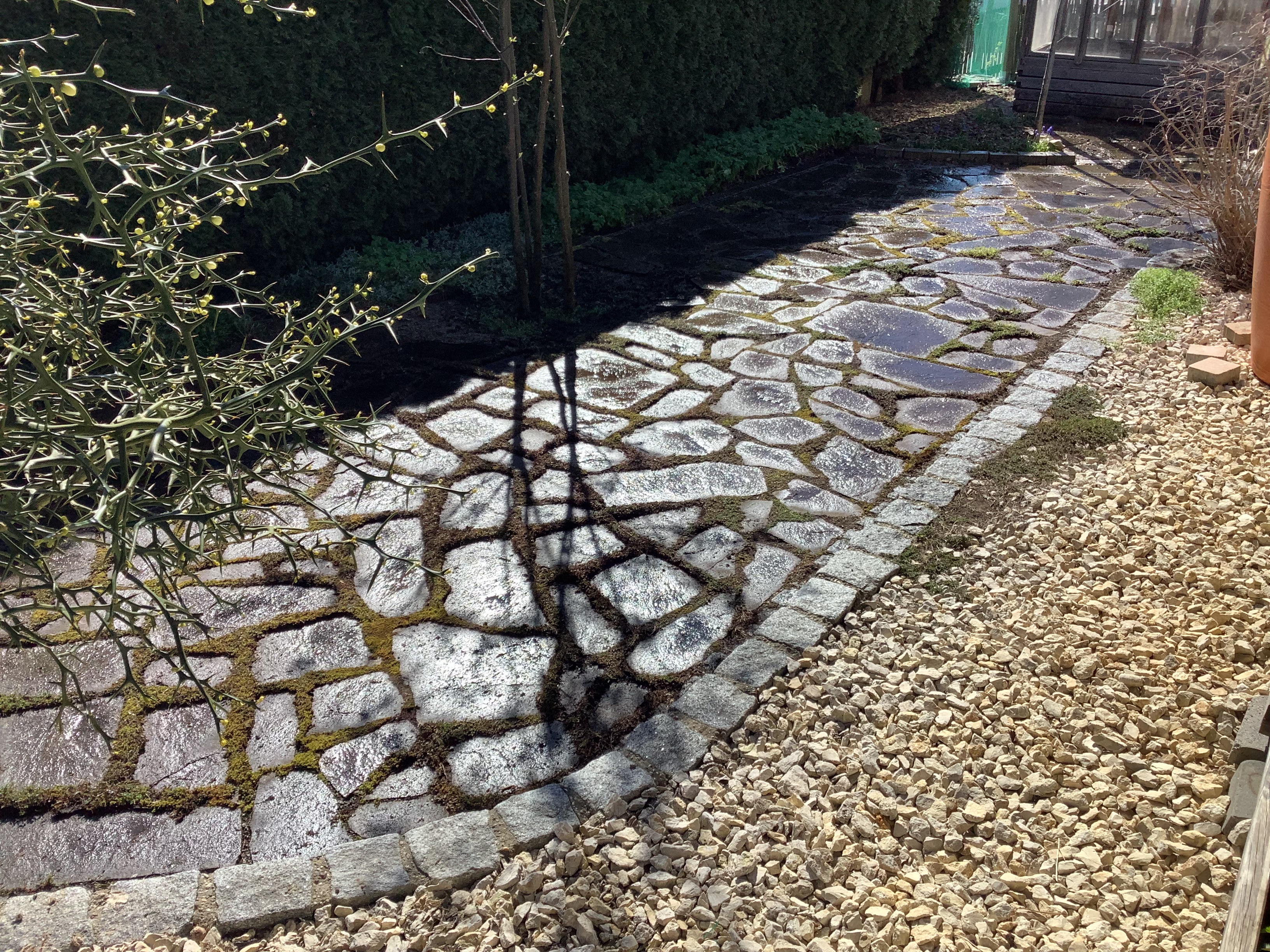
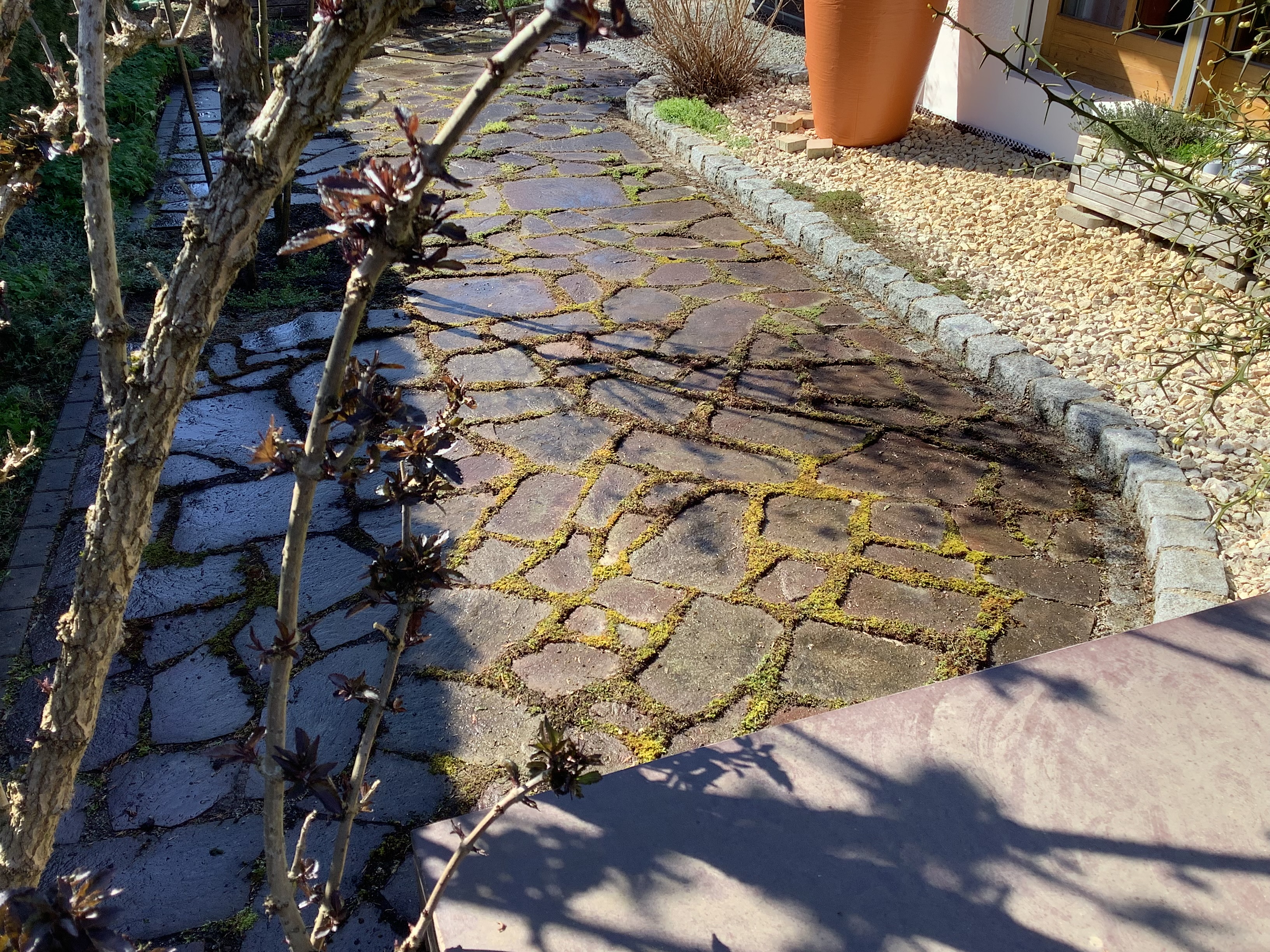
Back in April, I spent a good 6 hours on my knees, trimming back the thyme. It’s not the most rewarding gardening task but once it is all done, the walk way looks much better.
All the trimming does start to reduce the amount of blossoms over the years. And, I may just decide (one day) to do something else with this area. But, for now, the Thyme Walk will remain.
Update: 03.06.23: Finally! Finally, there are things to post about the garden. Too many things, in fact! Here’s what’s been going on in the past few weeks.
Vegetable Garden/Raised Beds
I took a break last year with the vegetable garden. Instead, I decided to help the soil in the raised beds by planting annuals that would give nutrients back to the soil. This year, though, it is time to get back to business!
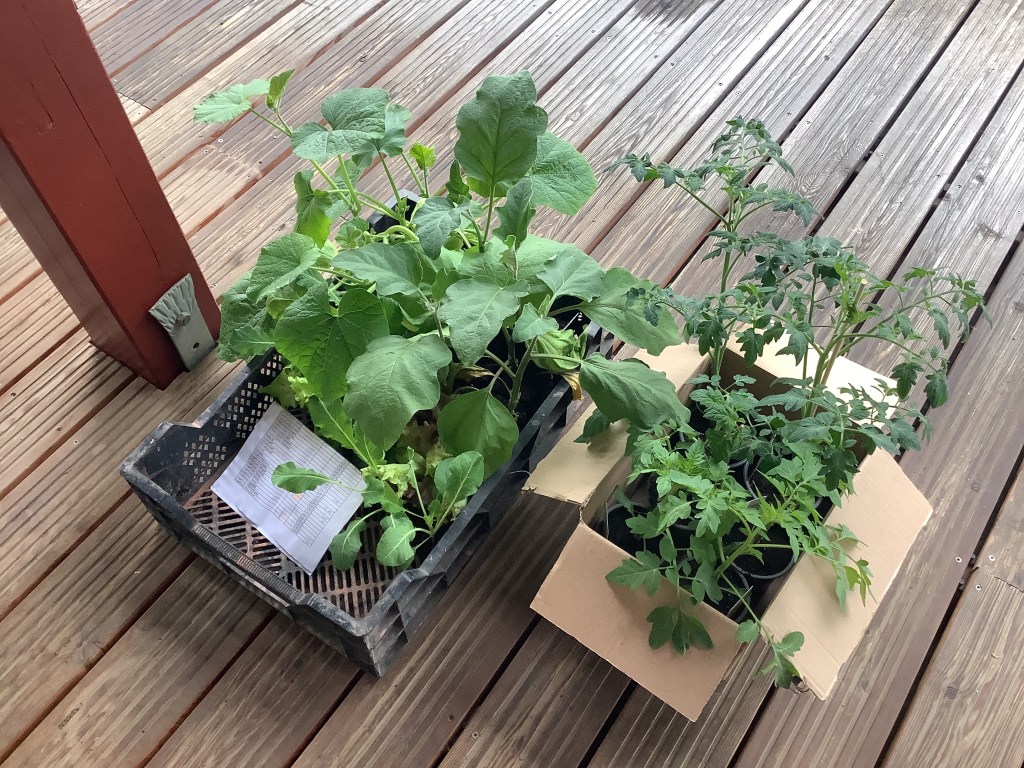
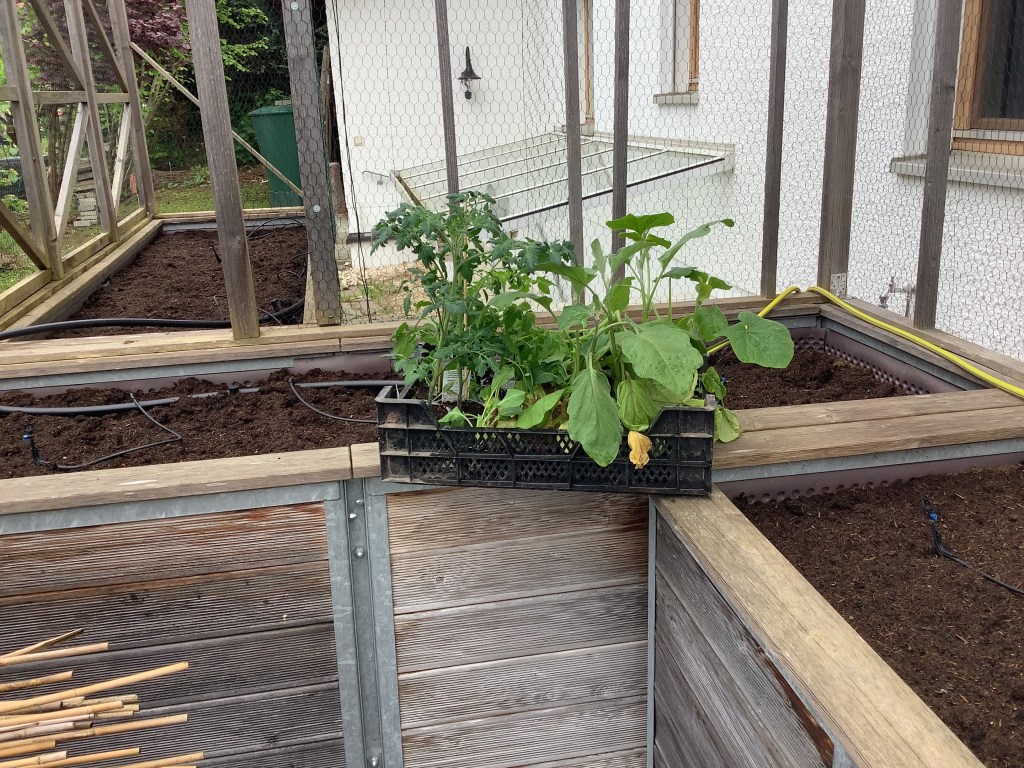
In the past, I’ve experimented with different vegetables. And, over the years, I’ve learned which veggies (for me) are the best. In this case, “the best” means easy to plant/care for and worth the effort/space. With basically only about 14 square meters of available planting space (i.e., the raised beds plus the small tomato green house), there is no space to waste!
So, after several years, I stopped planting peas, carrots, raddishes, and beans because either there was never enough harvestable at once (peas) or we just don’t really eat them (beans) or just not often enough (carrots, raddishes).
I prefer plants that keep on producing. You get more for the space you use, if a plant keeps producing all season long versus a plant you harvest and then have empty space or have to replant. But, there are veggies I love and am willing to dedicate the space to them even though there is only one harvest.
This year, the raised beds are home to lollo blanco and lollo rosso, cauliflower and broccoli (plants that are harvested only once), hokkaido pumpkins, zucchini (one plant does it for us!), eggplant, mangold, leeks, and one thai chili plant. In the tomato green house, I have three varieties: good for salads, good for sauce, and cherry tomatoes.
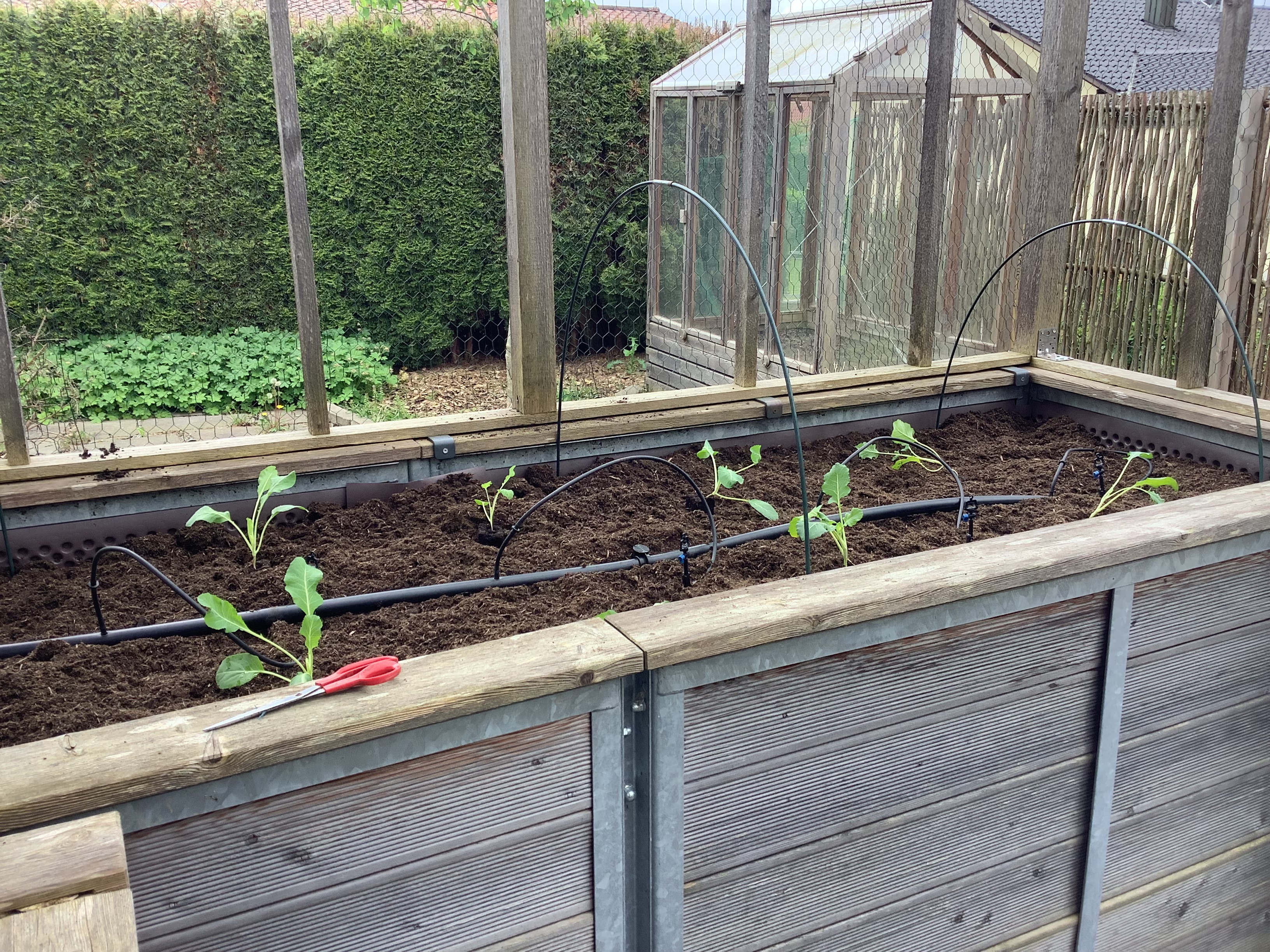
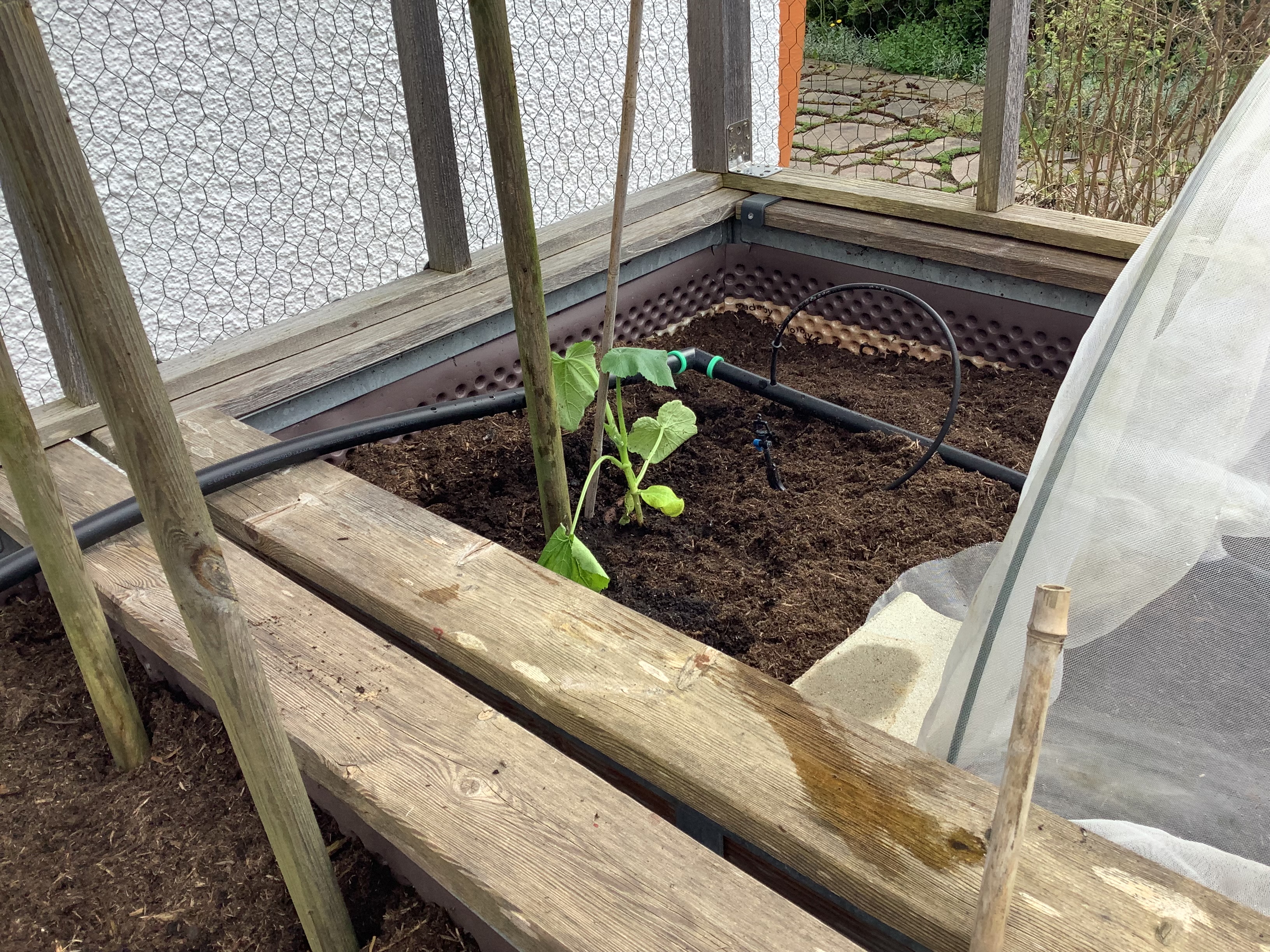
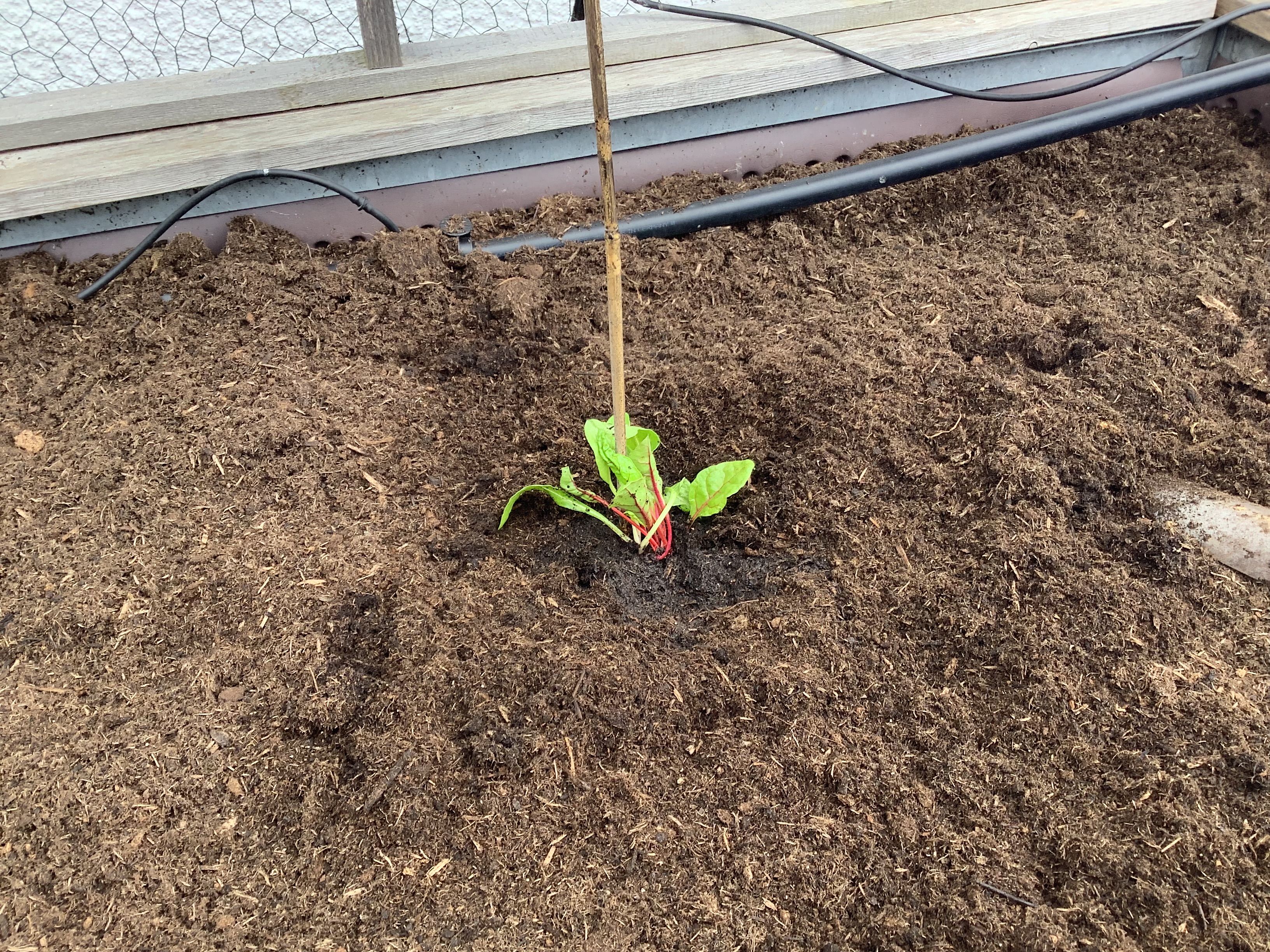

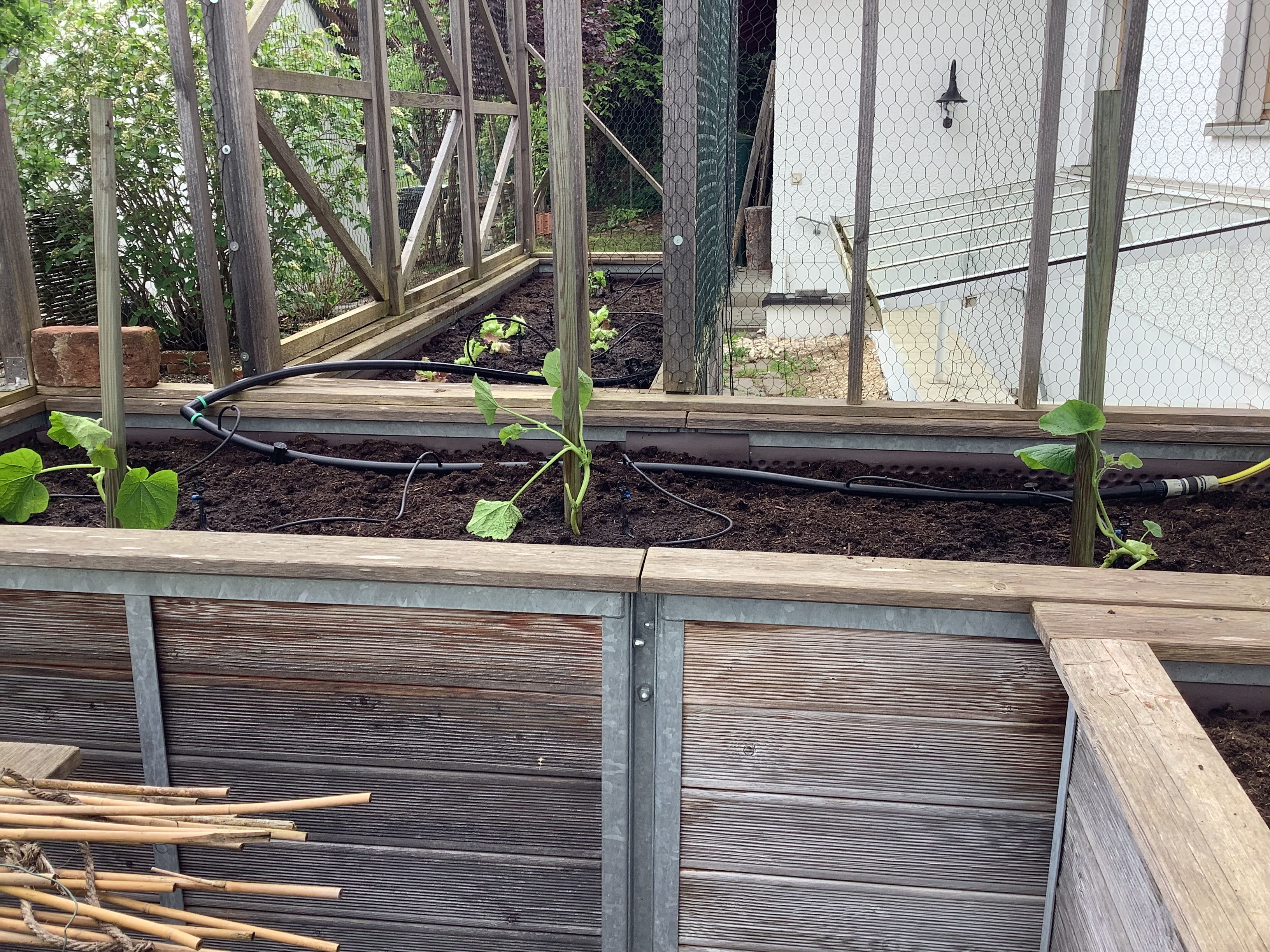
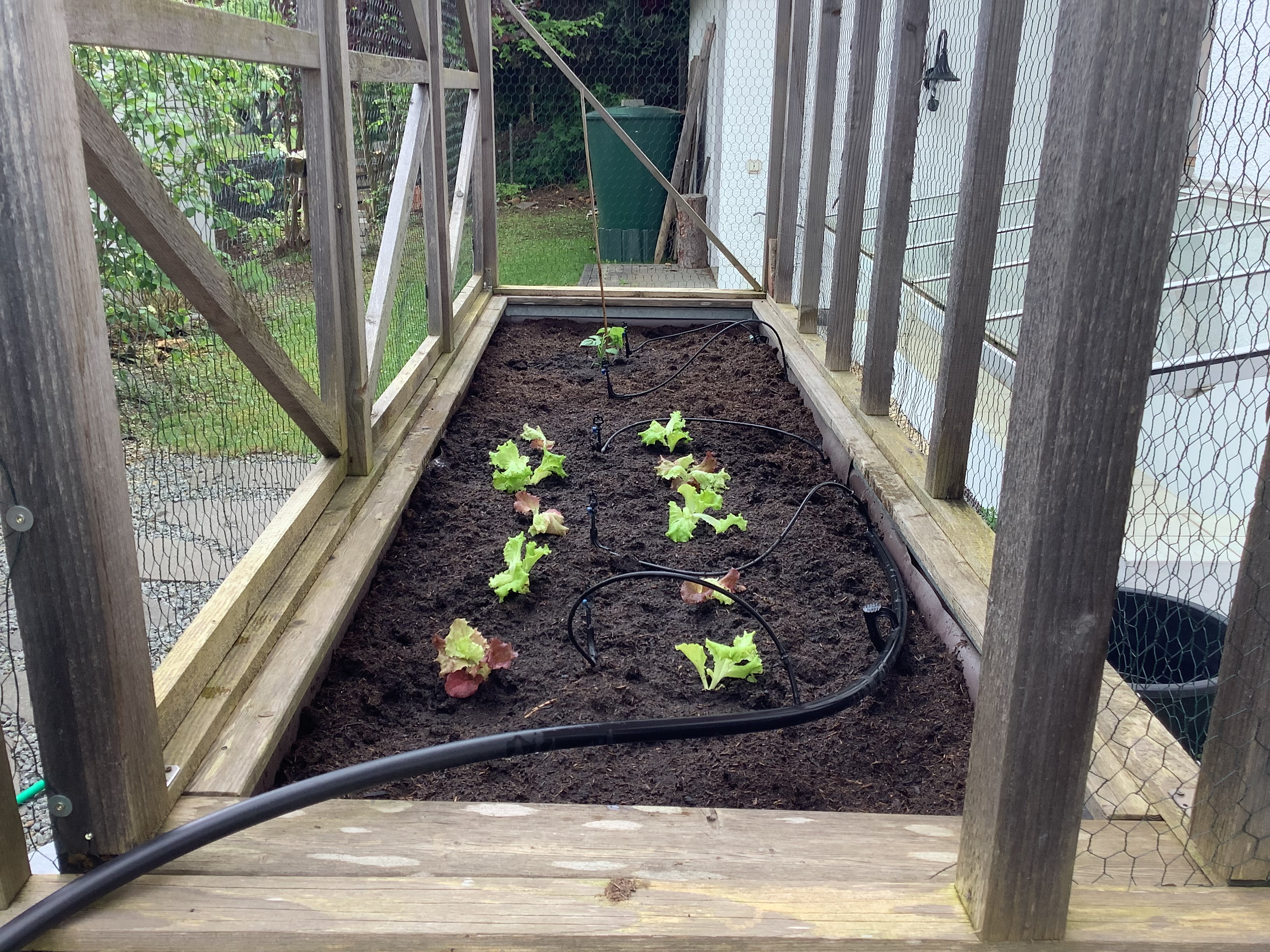
I’ll be updating the pictures as the season progresses. Since planting the veggies, I have already had some heartbreak. I had to replace two cauliflower plants, an eggplant and TWO zucchinis! The cauliflower, eggplant and the first zucchini were just weak plants and didn’t survive the planting process. The second zucchini is due to snails.
This is the second time I ordered plants from this one nursery and was disappointed with the quality. It will be the last time. The replacement plants came from my favorite nursery in a nearby town. I’ll stick to them next time. Live and learn!
I was not expecting that a snail would decimate a zuchini plant and should have taken the same precautions as I did with the salads, namely covering the area with an instect-net.
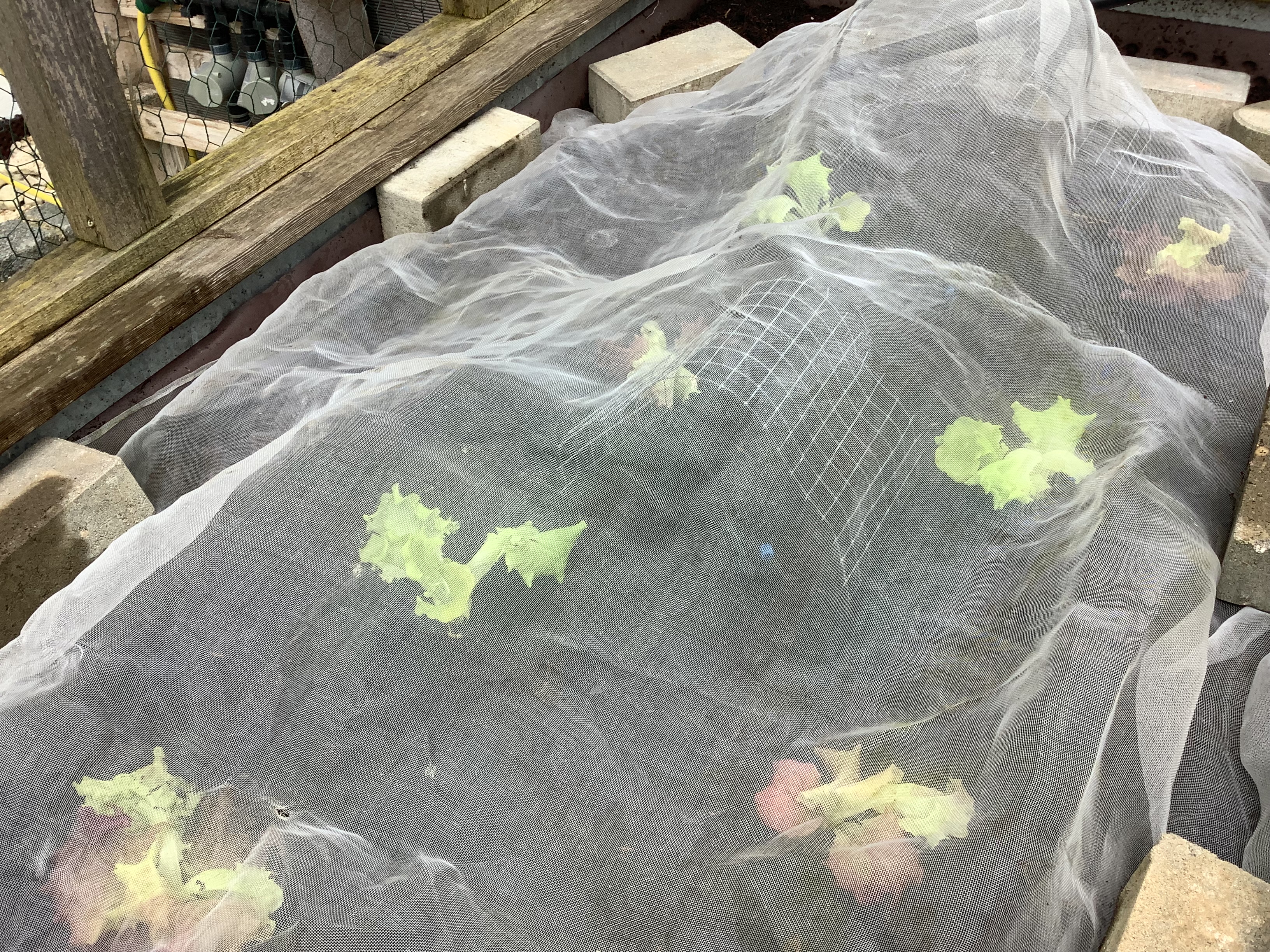
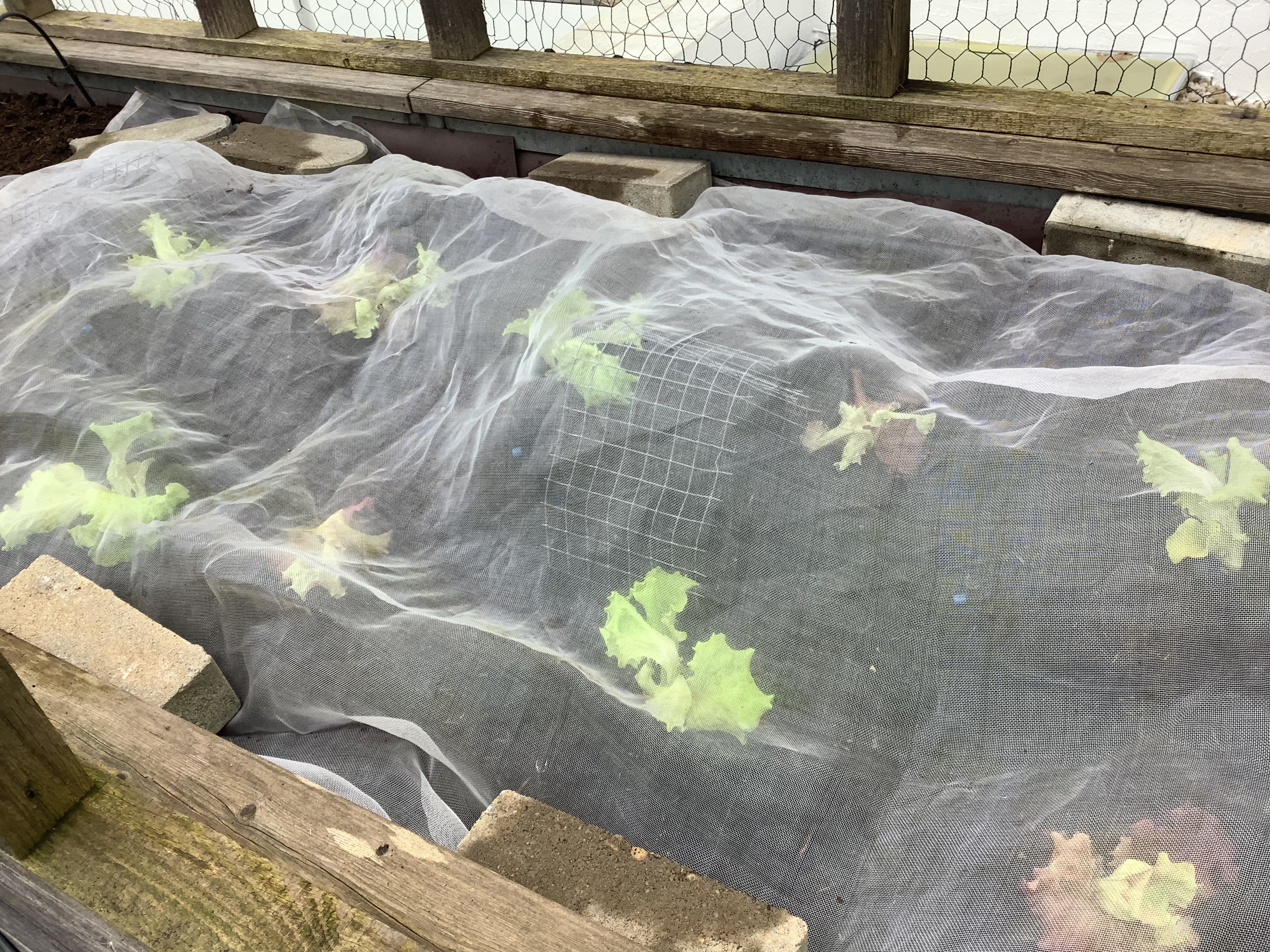
The second zucchini is now in a protected net. I’ll post a photo of that next time.
And, the tomatoes. Love me some tomatoes!

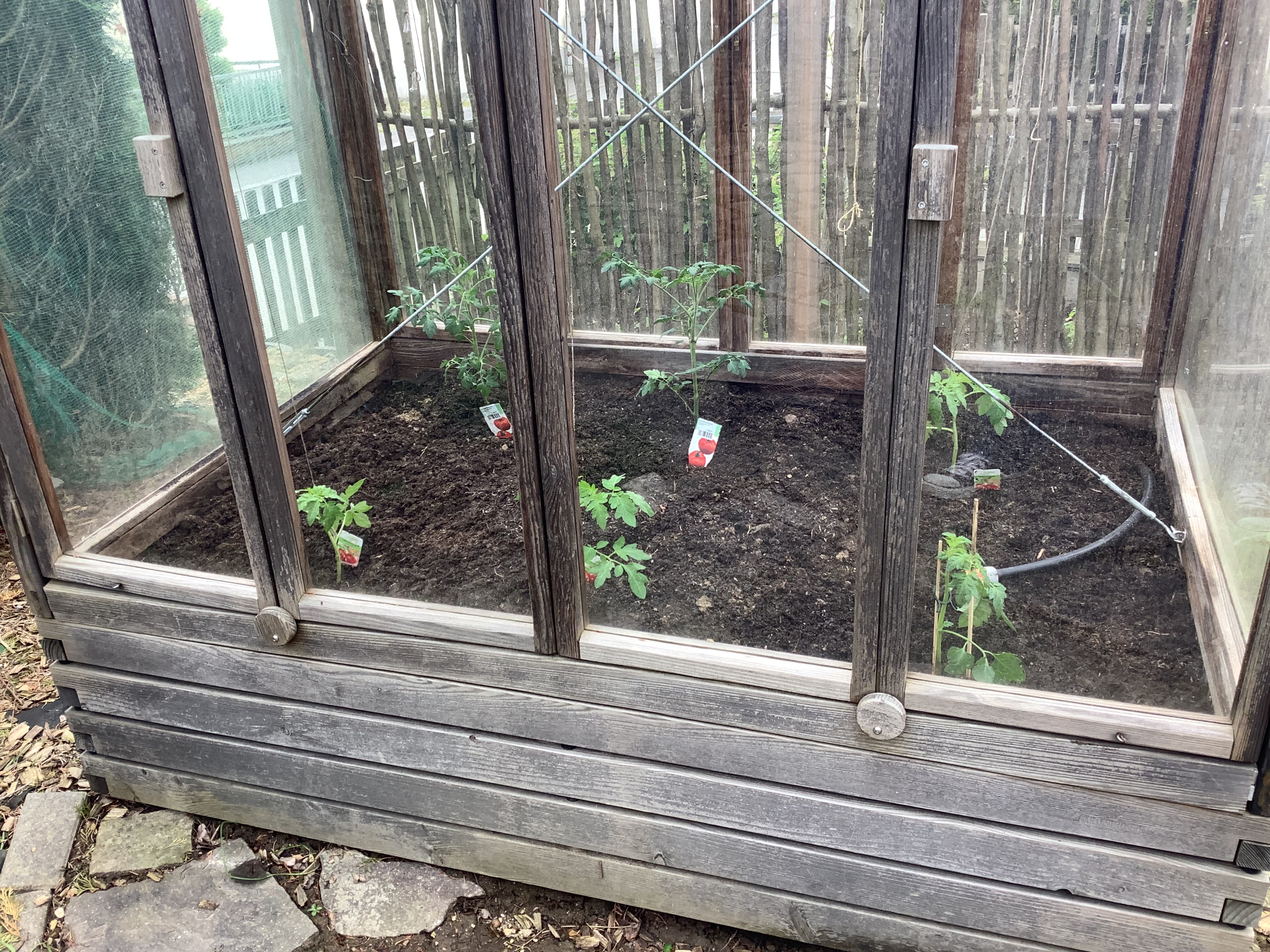
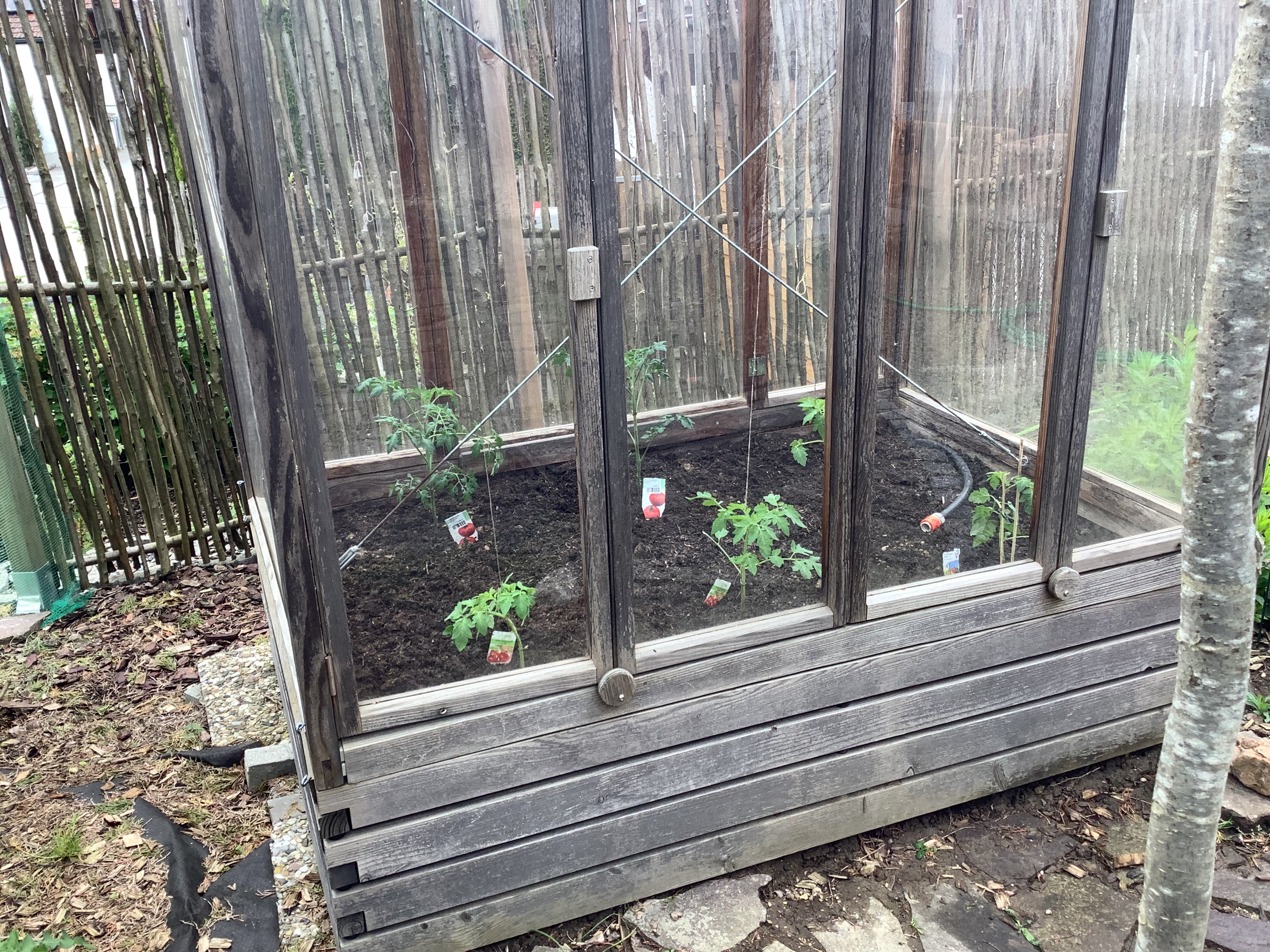
The tiny tomato green house is about 2 meters square and can handle up to 6 tomato plants. It has foldable doors on both sides, allowing for good air circulation. The roof can also be left open to allow for air circulation and, of course, it keeps the plants dry in the rain.
Lastly, the herbs. I decided to keep the herbs in two troughs and placed them in the hottest, sunniest part of the yard … conveniently right in front of my atelier’s window! The rosemary and thyme survived the winter nicely. I was surprised that the parsley also survived but looks a bit ragged. For this season, I added cilantro and chives. I’ve got the basil in a separate planter on the terrace (photo to follow) because basil is such a thirsty plant … it needs its own quarters.

I’ll be following up in the coming days with various photos from the garden. Stay tuned!!!
 Claudia's Atelier